
How Much Should You Pay a Contractor Up Front in Canada?
A homeowner’s guide to renovation deposits, material payments, credit cards, progress billing, written contracts and safer ways to pay for construction work.
Read Article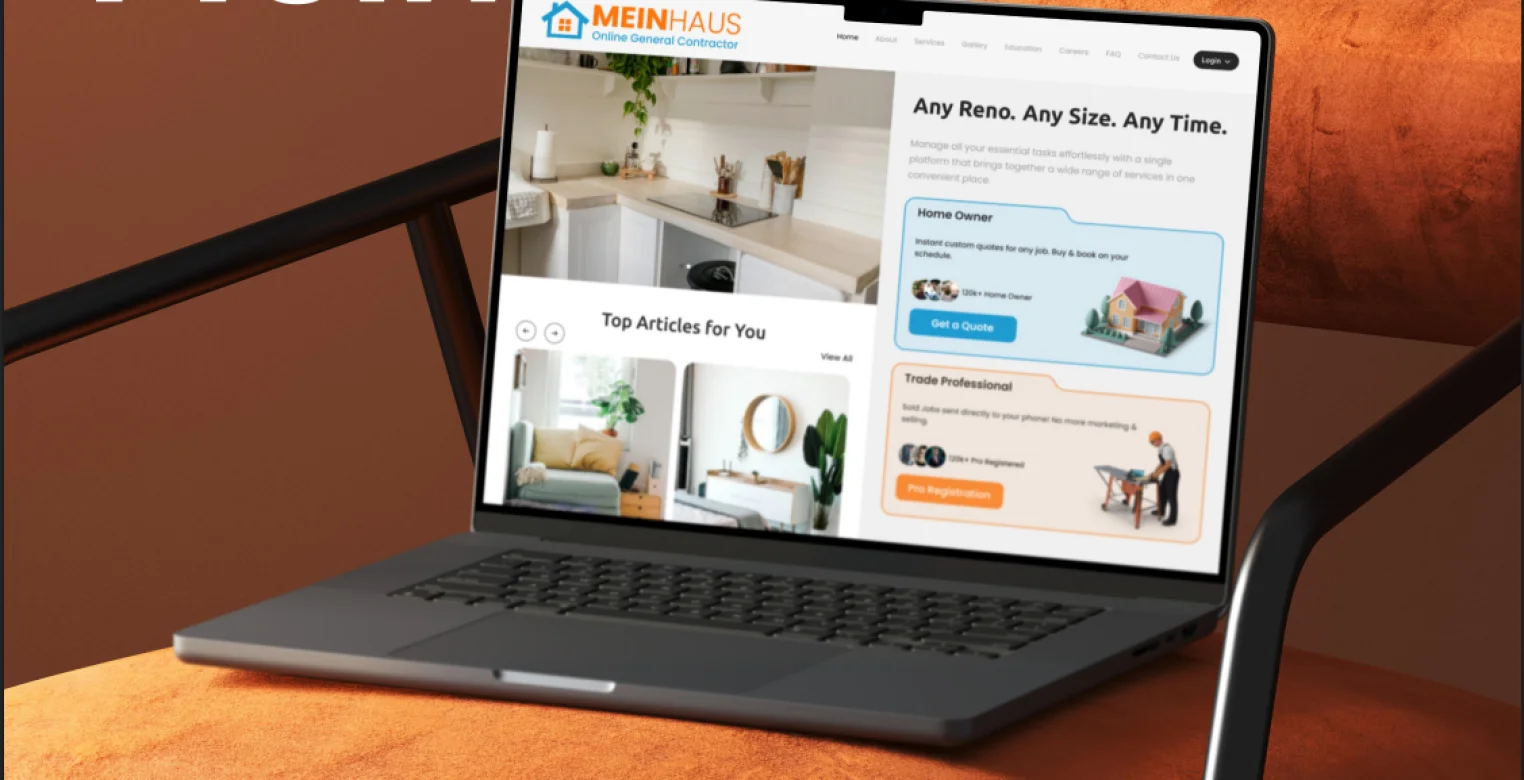
MEINHAUS The Online General Contractor
Where AI Meets Renovation — and the Home Becomes a Platform
Summary Introduction
Home renovation and home services represent one of the largest consumer markets in North America—yet the industry still operates without the infrastructure that modern consumers expect: standardised scope definition, consistent pricing, enforceable accountability, and an easy customer experience.
As a result, homeowners have difficulty accessing these services and are routinely forced to become the project manager, risk manager, and quality inspector of their own projects—often without the technical knowledge, regulatory familiarity, or leverage required to protect themselves.
Even when talented professionals are involved, the market remains vulnerable to fragmented coordination, unclear expectations, uneven compliance, and disputes that stem less from missing systems.
MEINHAUS is built to solve this as an Online General Contractor—not a directory, and not a lead marketplace.
MEINHAUS defines the scope, prices the job, governs compliance, assigns vetted professionals, and stands behind outcomes. AI is not used as a novelty, but as an enabling layer that standardizes what has historically been manual, inconsistent, and difficult to scale.
This paper outlines the structural market failure, the MEINHAUS operating model today, the systems that make it governable and scalable, and the long-term vision: an all-in-one online home platform where renovations and services connect seamlessly to a digital Home Profile which harvests immensely valuable data for the purposes of predictive advertising of renovations but also; insurance, financing, other complimentary services, and eventually real estate transactions.
Table of Contents
I. The Market Failure
II. The MEINHAUS Thesis
III. The MEINHAUS System Architecture; A practical breakdown of the systems required to guarantee outcomes at scale.
IV. Why AI Matters Here
V. The Platform Vision
VI. Closing: The Infrastructure Layer of Housing
I. The Market Failure
Home renovation and home services are enormous markets. Yet the industry still functions without the foundational infrastructure that consumers take for granted in other major purchases.
The result is not simply “bad contractors” or “uninformed homeowners.” The deeper issue is structural:
A typical renovation requires multiple independent operators—demolition, framing, electrical, plumbing, HVAC, drywall, tile, paint, flooring, finishing—often stitched together through informal coordination.
Even when each individual trade is competent, the overall outcome is vulnerable because there is no consistent governing layer responsible for the entire project end-to-end. Failures rarely happen in a single obvious moment; they happen in the gaps:
In practice, homeowners are forced to act as project managers, schedulers, quality inspectors, and dispute resolution—often for the first time, with limited technical knowledge and minimal leverage.
When “what is included” is unclear, price becomes a negotiation tactic rather than a reflection of work. This creates a perverse incentive: ambiguity can win business, while clarity can appear more expensive.
The most important failure: expectation mismatch
Both may be acting in good faith, but without shared definitions, conflict becomes inevitable.
This is why visual clarity is not a “nice-to-have” in this market—it’s missing infrastructure. When expectations are only communicated through text messages, rough sketches, or verbal descriptions, interpretation becomes the enemy of trust.
A written scope helps. But written scope alone often fails to convey:
Risk is transferred to the least-equipped party, homeowners who are not equipped to evaluate:
And yet the market structure pushes that risk onto them by default.
When something fails, many homeowners discover too late that:
This isn’t always malicious—it’s often a predictable outcome of fragmented incentives and a lack of governing systems.
Compliance in the industry is uneven. Some professionals operate with strong documentation, licensing, insurance, and safety practices. Others do not. In many regions, enforcement is inconsistent and consumers struggle to verify what’s real.
In a high-demand environment, this can create a “race to the bottom” dynamic where speed and low pricing out compete governance and accountability. That hurts homeowners—but it also harms the best professionals, because it compresses pricing, reduces trust, and makes true quality harder to identify and reward.
The core problem isn’t people. It’s missing systems.
The renovation market is not short on talent. It’s short on infrastructure.
And without these systems, the industry can’t compound improvement. It repeats the same mistakes project after project, because there is no structured feedback loop capturing what happened and converting it into better future decisions.
That is the market failure.
MEINHAUS begins here—not by listing contractors, but by building the missing operating layer that makes home renovation governable, repeatable, and scalable.
II. The MEINHAUS Thesis
MEINHAUS is built on a simple thesis: home renovation becomes reliable at scale only when someone is structurally responsible for the outcome.
Most platforms in home services try to solve the problem by improving discovery—profiles, reviews, lead forms, and “matching.” That approach helps homeowners find people, but it does not solve the core failure described in Section I. Discovery is not governance. And governance is what determines outcomes.
MEINHAUS is designed to be that governing layer.
MEINHAUS is an Online General Contractor, not a marketplace
The defining distinction is this:
MEINHAUS does not aim to be the place where homeowners shop for contractors the way they shop for products. MEINHAUS aims to be the system that turns renovation into an accountable, repeatable service—where the homeowner buys an outcome, not a series of handoffs.
This requires MEINHAUS to act as a principal, not a broker:
In other words, MEINHAUS does not outsource accountability—it operationalizes it.
Guarantees require control—and control requires systems
Guaranteeing outcomes in a fragmented market is impossible without controlling the variables that cause failure.
In renovations, the most common drivers of failure are known:
To guarantee outcomes, MEINHAUS must build systems that control each of these factors. This is the foundation of the platform: standardize what can be standardized, govern what must be governed, and create traceable accountability where ambiguity used to live.
From “trust-based hiring” to “system-based delivery”
Today, homeowners are forced to hire based on trust signals: referrals, impressions, and price comparisons. That’s not a moral failure—it’s simply what happens in a market without infrastructure.
The MEINHAUS thesis is that trust can be replaced with:
When those elements exist, the homeowner no longer needs to be an expert. The system carries the expertise—and the responsibility.
Why visualization matters to the thesis
A critical part of MEINHAUS governance is expectation control.
MEINHAUS uses both written scopes and visual confirmation to eliminate the most common source of disputes: “I thought I was buying this, but I received that.”
Visualization—today via AI-assisted photo renderings—turns an estimate into a tangible expectation. It improves conversion because homeowners can see the outcome, and it improves delivery because professionals have a clearer reference for what “done” means.
Over time, this evolves into a deeper asset: a persistent visual model of the home. The long-term value is not only in selling a single renovation, but in building continuity—where each project improves the system’s understanding of the home and makes the next decision smarter.
MEINHAUS aligns incentives by design
The traditional renovation market often rewards haste, price undercutting, and ambiguity. MEINHAUS is engineered to reward the opposite:
This is where the platform’s professional systems become as important as customer acquisition. A governed supply layer is not only a quality mechanism—it is a strategic advantage.
The category MEINHAUS is building
MEINHAUS is not trying to become “a better contractor directory.”
It is building the infrastructure for a new category:
This model becomes scalable because every project strengthens the system: improving pricing accuracy, refining scope templates, upgrading assignment logic, and reducing downstream disputes.
MEINHAUS is, fundamentally, a shift from renovations as a fragmented, trust-based gamble to renovations as a governed service—delivered through systems, backed by accountability, and built to compound.
This can only be done with a very ambitious focus on the most cutting edge systems and data driven decision making. A business model designed for AI.
III. The MEINHAUS System Architecture
The practical systems required to guarantee outcomes at scale
If MEINHAUS is going to operate as an Online General Contractor—pricing projects, assigning professionals, and standing behind outcomes—then it cannot rely on informal coordination or subjective judgement alone. It requires a set of repeatable systems that turn renovations into something governable.
The simplest way to understand MEINHAUS’s architecture is this:
1) Scope & Pricing System
Failure question: Do we know exactly what is being done—and what it should cost?
This is the foundation. If scope and pricing are not defined clearly and consistently, every downstream step inherits ambiguity—and ambiguity is where renovations fail.
What the system does
Key data inputs
Outputs
Why it matters: This is where trust-based guessing becomes system-based delivery. Clear scope and price remove the most common cause of disputes: “That’s not what I thought I was paying for.”
2) Visualization & Home Profile System
Failure question: Do all parties share the same expectation of the outcome—and can we verify it?
In renovations, written scope is necessary but often insufficient. The fastest way to eliminate interpretation risk is to make the expected outcome visible.
This system operates in two phases: what MEINHAUS does today, and what it evolves into.
2A) Visual Scope Confirmation (today)
What the system does
Key data inputs
Outputs
Why it matters: Most disputes are expectation mismatches. Visualization reduces that risk dramatically and makes scope enforceable in practice, not just on paper.
2B) 3D Home Profile (the vision)
Over time, rendering evolves from “single-project visuals” into a persistent asset: a 3D representation of the home that compounds value across the homeowner lifecycle and has predective rendering power for soliciting likely to purchase offers.
What the system becomes
Key data inputs
Outputs
Why it matters This is how MEINHAUS transitions from one-time renovations to a platform relationship—where each job improves the system’s understanding of the home and increases repeat engagement.
3) Professional Compliance & Risk System
Failure question: Should this professional be allowed to work under the MEINHAUS standard—and on which job types?
Guarantees require controlled supply. This system ensures that professionals are not only skilled, but eligible, documented, and aligned with the platform’s requirements.
What the system does
Key data inputs
Outputs
Why it matters The platform cannot promise outcomes while allowing uncontrolled risk into the delivery layer.
4) Job Assignment & Dispatch System
Failure question: Who is the best person to do this job right now—and why?
In most marketplaces, job distribution becomes a race: first to reply wins. That may be efficient for lead platforms, but it produces inconsistent results. MEINHAUS assigns work based on fit.
What the system does
Key data inputs
Outputs
This is arranged in the MEINHAUS "Project Dispatch Queue" a well developed, currently in use system for job assignments.
Why it matters: Assignment decisions are outcome decisions. Better assignment reduces rework, improves timelines, and protects the customer experience.
5) Execution Tracking & Quality Control System
Failure question: Is the job being completed to scope, to standard, and on schedule—with a record of truth?
Most renovation failures become messy because there is no reliable record of what happened during execution. This system creates that record and governs change.
What the system does
Key data inputs
Outputs
Closeout documentation at completion
Why it matters: This becomes the enforcement mechanism for clarity. If the project is governed during execution, it doesn’t need to be “argued about” afterward.
6) Warranty, Resolution & System Learning
Failure question: What happens after completion—and does the system get smarter because of it?
This is where renovations stop being one-off transactions and become a compounding system. If warranty events and disputes are handled informally, nothing improves. If they are handled structurally, the platform learns.
What the system does
Key data inputs
Outputs
Why it matters This is the feedback loop that most of the industry lacks. It’s also where MEINHAUS compounds defensibility: every job produces data that improves the next one.
The core point
MEINHAUS doesn’t rely on a single “secret sauce.” It relies on governing the failure points that cause renovations to break down.
When scope is defined, expectations are visualized, professionals are verified, assignment is controlled, execution is documented, and warranties are enforced—the market shifts from trust-based hiring to system-based delivery.
That is what makes MEINHAUS scalable as an Online General Contractor.
IV. Why AI Matters Here
AI only matters in home renovation if it solves the core industry failure: inconsistency at scale.
Most renovation businesses don’t collapse because demand isn’t there—they collapse because the work is hard to define, hard to price, hard to manage, and hard to improve consistently across dozens, nevermind hundreds or thousands of jobs. The market runs on unstructured information, informal coordination, and memory trapped in individual people.
MEINHAUS uses AI for a specific purpose:
to convert messy real-world inputs into defined, governable outputs—then compound learning across projects.
1) Turning unstructured homeowner inputs into a defined scope
Most projects begin with incomplete or ambiguous information:
a few photos, partial measurements, mixed priorities
Historically, the only way to make this reliable was a human estimator doing heavy manual work: extracting requirements, translating them into a scope, anticipating exclusions, then pricing and presenting it clearly.
AI increases throughput without losing detail by helping MEINHAUS:
Why this matters: If scope isn’t effectively defined, pricing isn’t real—and if pricing isn’t real, you can’t guarantee anything downstream.
2) Pricing consistency and margin protection—without “guessing”
Pricing in renovations fails when:
AI supports pricing governance by:
3) Visualization as expectation control (and as a verification tool)
Renovation disputes often reduce to one sentence:
“That’s not what I thought I was getting.”
Written scopes reduce confusion. Visuals reduce it further—faster.
MEINHAUS uses AI-assisted photo rendering today to:
When the outcome is visible, it becomes harder for anyone to hide behind ambiguity.
Over time, this evolves into the 3D Home Profile: a persistent model that makes recommendations visual by default (renovations, maintenance, upgrade paths), and creates continuity across the life of the home.
4) Compliance and performance become measurable—not “review-based”
Most platforms rely on reviews. Reviews are emotional, inconsistent, and easy to game. MEINHAUS needs signals that correlate with outcomes.
AI supports a more objective measurement layer by transforming operational events into structured performance data, such as:
This is the foundation for a true “Pro Success Score” style model: not a popularity score—an outcome and reliability index.
Why this matters: If MEINHAUS is guaranteeing outcomes, it must continuously improve who gets assigned to what and under what conditions.
5) The compounding loop: every job strengthens the platform
The real advantage is not “we use AI.” - The advantage is system learning.
When each project produces standardized records—scope, visuals, execution documentation, outcomes—AI helps MEINHAUS:
This is what the traditional market cannot do well: it does not retain and compound learning across a fragmented supply chain.
6) Data isn’t a byproduct—it’s part of the economic engine
A governed platform creates a unique asset: longitudinal, structured data about: home attributes and project history (the Home Profile)
That data has value in multiple directions:
Importantly: this only works if the platform first enforces standardization and compliance—because dirty inputs create worthless data. Governance is what makes the data monetizable.
7) Where AI stops: humans remain accountable
MEINHAUS is not a software-only marketplace. Renovations involve hidden conditions, real risk, and real consequences.
AI is best used for:
Humans remain essential for:
MEINHAUS uses AI to scale consistency—while keeping responsibility human.
In short: AI matters at MEINHAUS because it enables the company to do what the renovation market typically cannot—standardize delivery, govern outcomes, and compound improvement, while building a Home Profile-driven platform that becomes more valuable with every completed project.
V. The Platform Vision
Renovations and home services are the starting point—not the destination.
MEINHAUS is built to begin where the market is most broken: scope clarity, pricing consistency, professional accountability, and outcome governance. But the long-term vision extends beyond completing individual projects efficiently.
The deeper thesis is that a home is not a one-time transaction. It is a living asset with ongoing needs, recurring costs, evolving risks, and continual decision-making. Today, those decisions are scattered across contractors, spreadsheets, receipts, text messages, and disconnected vendors.
MEINHAUS is building toward a future where the home becomes managed through one integrated system.
From “project-by-project” to a lifelong home relationship
Most renovation businesses are episodic. A homeowner renovates once, maybe twice, and then disappears until something breaks again years later. No continuity, no shared history, no compounding value.
MEINHAUS aims to change that by creating a platform where:
This is the foundation of an “all-in-one online home platform.”
The 3D Home Profile becomes the interface
The centerpiece of this platform vision is the 3D Home Profile—a persistent digital representation of the property that improves over time.
It is not simply a visual model. It becomes the home’s operating interface:
This is where MEINHAUS’s visualization system evolves from a sales tool into a platform engine: recommendations become visual, planning becomes intuitive, and the homeowner can see the impact of decisions before committing.
Renovations and services: the entry point into the graph
Services and renovations are the most natural entry points because they produce the highest volume of real-world data:
This information compounds into a clearer Home Profile—and a clearer Home Profile improves:
Every job is not only revenue—it is a strengthening of the platform’s knowledge of the home.
Adding the adjacent pillars: insurance, financing, and complimentary services
Once MEINHAUS controls scope, pricing, compliance, and outcomes, it can responsibly expand into adjacent services that depend on reliability and structured data.
1) Insurance alignment and risk frameworks
Insurance is fundamentally about risk visibility. Today, much of the home insurance process relies on limited, outdated, or self-reported information.
A governed home profile can support better risk understanding by documenting:
This creates the possibility of insurance experiences that are less adversarial and more data-driven—because the home’s condition is clearer.
2) Financing and payment infrastructure
Many homeowners want upgrades but struggle with the mismatch between:
When scope and pricing are standardized and outcomes are governed, financing becomes more feasible and less risky because:
MEINHAUS can become the interface where homeowners view scenarios, approve scopes, and execute payment options without entering a chaos-driven contractor process.
3) Complimentary home services and partner ecosystem
A Home Profile enables relevant recommendations that are contextual—not generic advertising.
Instead of “random home ads,” homeowners can receive visually-driven recommendations like:
This becomes a powerful platform mechanism because the recommendations are tied to:
The long arc: Real Estate Transactions
Eventually, the Home Profile can become a new kind of asset in real estate.
Today, home sales rely on:
A persistent home record changes the narrative:
That creates the foundation for smoother transactions, better confidence for buyers, and potentially new pathways around how homes are represented and transacted.
What MEINHAUS is ultimately building
MEINHAUS is building the infrastructure that turns the home into a manageable system:
The platform vision is not to do everything at once. It is to start where the market is most broken, build the governing layer, and expand outward only where the platform can bring structure, reliability, and measurable value.
That is how MEINHAUS moves from “a renovation company that uses AI” to an all-in-one online home platform—where the home is not just serviced, but truly managed.
VI. Closing: The Infrastructure Layer of Housing
The home is one of the most important assets most people will ever own—financially, emotionally, and practically. Yet the systems that maintain and improve that asset have remained fragmented, informal, and largely unchanged for decades.
This is why renovation and home services continue to feel like a gamble.
Not because quality work is rare, but because the industry lacks the governing infrastructure that makes quality repeatable, verifiable, and scalable.
MEINHAUS is built to become that missing layer.
Renovation is not the product—the product is outcome certainty
In the traditional market, homeowners purchase “work” and hope it leads to an outcome. In MEINHAUS, the intent is to flip that relationship:
This is the shift from trust-based hiring to system-based delivery. It’s also the only way guarantees can exist consistently in a fragmented market.
Why this becomes defensible
This is not defensibility built on branding. It’s defensibility built on operational infrastructure and feedback loops.
The compounding asset: the Home Profile
The long-term significance of MEINHAUS is not only that it can deliver renovations more reliably.
It’s that each governed project contributes to a compounding asset: a structured record of the home, its upgrades, its condition, and its service history—eventually expressed visually through the 3D Home Profile.
That transforms the relationship from “one-off transaction” to “platform continuity,” where the home becomes a living system that can be:
This is how the home evolves from a static asset into a managed platform.
Why now? The timing matters.
For the first time, the tools exist to make this possible:
At the same time, consumer pressure has increased:
The market is ready for a governing layer.
The conclusion
MEINHAUS is not simply trying to be a better contractor, or a better directory, or a better lead generator. It is building the infrastructure layer that home services have been missing:
This is the path from a fragmented, grey-market experience to a reliable, repeatable system—one that protects homeowners, rewards the best professionals, and turns home ownership into something that can finally be managed with clarity.
That is what MEINHAUS is building.
Join us on this Journey
Visit MEINHAUS.com to start a new estimate, register as a contractor or seek more information as an investor.
Free quote in under 24 hours. MEINHAUS-vetted crews. Payment held until the work is done right.
A homeowner’s guide to renovation deposits, material payments, credit cards, progress billing, written contracts and safer ways to pay for construction work.
Read Article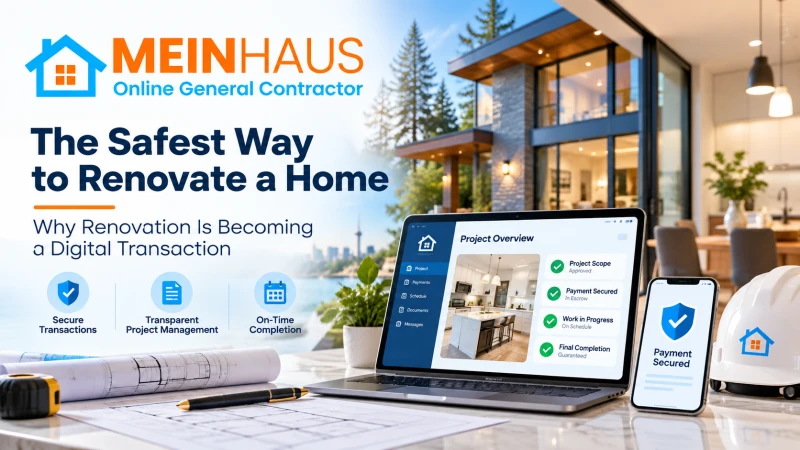
How MEINHAUS is using structured scopes, fixed pricing, online scheduling, documented payments, contractor verification and persistent project records to make home renovation more predictable, accountable and efficient.
Read Article
How to prepare your roof, eavestroughs, windows, exterior finishes, concrete, landscaping and home systems before freezing temperatures arrive
Read Article
Just bought a house? Discover which renovations to tackle first, what they cost in Canada, and how to prioritize repairs, upgrades and your budget before moving in.
Read Article
Why Every MEINHAUS Pro Should Carry Commercial Liability Insurance
Read Article
A Practical Guide for MEINHAUS Pros
Read Article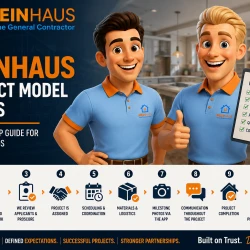
A general overview for meinhaus pros to understand the business cycle.
Read Article