01
Profile Completion
Measures participation and completeness of profile information: business details, identity and insurance-related documentation, work photographs, app activity and other account elements.
An inside look at MEINHAUS's evolving 900-point professional assessment framework, our human-led verification processes, and the AI-assisted capabilities we are building next.

A five-star rating can be useful. It does not tell the whole story about whether a professional is prepared for a particular construction project. ProScore is MEINHAUS's attempt to build a more complete, continuously improving picture—without pretending that any single number can replace professional judgment.
Hiring a contractor involves more than reading a star rating. A homeowner may need to know whether a professional has supplied relevant documentation, demonstrated appropriate experience, communicated consistently and successfully completed similar work. MEINHAUS has a direct operational interest in these questions because it acts as the Online General Contractor: we scope, price, sell and manage projects, while participating professionals execute the work.
ProScore is our developing framework for organizing these signals. It is intended to help our team make better-informed decisions, maintain continuity between interactions and eventually support more scalable operations. It is not a guarantee of workmanship, an independently certified credential or an automated project-award system.
ProScore is already in use, but it is still evolving. MEINHAUS administrators currently research available professional information, inspect submitted materials and work examples, assess compliance and manually adjust an administrative score. Team members can also record account-level observations for future reference.
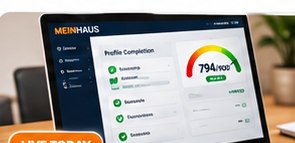 LIVE TODAY
Basic details, documents, insurance-related fields, photographs, app activity, project history and subscription participation.
 LIVE TODAY
Administrative review of information quality, compliance and relevant observations. Human judgment remains central.
 LIVE TODAY
Account-specific notes help authorized staff understand prior interactions and follow up on outstanding items.
 IN DEVELOPMENT
Potential automation of research, evidence organization and review prompts, with source checks and human oversight.
Measures participation and completeness of profile information: business details, identity and insurance-related documentation, work photographs, app activity and other account elements.
Uses MEINHAUS project-history signals. The current interface displays completed jobs and a project-success score, although its full calculation is not documented here.
A manually editable 1–100 assessment of adherence to MEINHAUS policies and standards, supported by administrator review.
The dashboard shows these pillars as values out of 100. The exact formula translating them and their underlying inputs into the 900-point overall score has not been independently established from the screenshots. We therefore do not publish an invented formula.
MEINHAUS currently describes its ProScore framework as having 900 available points. Of these, up to 110 points are allocated to subscription participation, leaving 790 points attributable to other factors. That is a meaningful distinction: commercial participation is visible, but it is not the whole evaluation.
| Current subscription situation | Available subscription points |
|---|---|
| No paid trade subscription | 0 / 110 |
| Subscribed to one trade | 70 / 110 |
| Subscribed to multiple trades | 110 / 110 |
A professional with a strong record, appropriate documents and good compliance can therefore have a higher overall score than a subscribed professional with significant deficiencies. A subscription is not proof of competency, licensure or quality.
Important current limitation: ProScore does not automatically assign projects today. MEINHAUS may consider subscription status in future prioritization logic, but no such automated assignment should be represented as operational.
The administrative interface exposes granular fields that can help the team identify missing information. Some visible point allocations are listed below. They are inputs shown in the interface, not a confirmed mathematical decomposition of the final 900-point score.
| Visible profile component | Displayed maximum | What it helps indicate |
|---|---|---|
| Basic details | 15 | Contact and business information completeness |
| Documents | 25 | Submission of requested identification and insurance-related materials |
| Insurance quote | 20 | Completion of an insurance quote workflow; not proof that a policy is active |
| Profile photograph | 10 | Account completeness |
| Mobile app login | 40 | Use of the operational platform |
| Work photographs | 65 | Availability of work examples; quality requires separate review |
| Subscription status | 110 | Commercial participation |
The visible category maxima sum to 285, while the dashboard summarizes profile completion on a 100-point scale. That difference suggests normalization or another calculation step. The scoring engine should be documented before publishing a precise weighting formula.
Other account records can include certificates, an optional résumé or CV, trade-related licensing information and activity history. The presence of a document should never be described as independent validation of its authenticity unless that validation occurred.
One of the most useful features is the ability to preserve context. MEINHAUS can keep confidential account-level administrative notes and attributed staff observations. These records may help the team remember prior requests, track follow-ups, identify unresolved concerns and recognize positive working experiences.
Private internal notes associated with the professional account. The supplied interface describes editing privileges for full administrators and read access for staff.
Attributed entries showing which staff member recorded an observation, creating a more traceable internal history.
These notes are not public reviews. They should be treated as internal operational records, with access controls, correction procedures, reasonable retention rules and clear separation between verified facts and opinions. We would not publish identifiable sample-account information or confidential comments.
Today, research and evaluation are substantially manual. MEINHAUS is developing AI-assisted capabilities to make parts of that work more efficient. The distinction between a current process and a future capability matters.
Collect submitted information, review documents, examine work photographs, research available public information, record findings and adjust administrative assessments.
Extract structured fields from permitted sources, organize submitted portfolios, detect missing or conflicting information and prepare review summaries with source links for staff.
With suitable consent and controls, incorporate verified project outcomes, responsiveness trends and updated credential status into a more consistent evaluation workflow.
Use professional suitability, location, availability, relevant experience and business priorities to support project decisions. Automated assignment is not active today.
Guardrail: AI-generated observations should never be silently treated as verified facts. Images can be mislabeled or reused, public profiles can belong to similarly named businesses, and online information can be outdated. High-impact decisions need human review and a path to correction.
ProScore is already comprehensive, and our next step is not to replace it with a competing set of trade scores. We are exploring a project-specific suitability adjustment that uses the existing ProScore as its foundation, then accounts for unusually relevant work photographs, distance and practical scheduling capacity. The concepts below are proposals under development—not an automated assignment system in production.
Keep the existing 900-point assessment as the durable professional record. A contractor should not gain or lose core standing because one project is nearby and another is far away.
The relevant trade category, legally required credentials, adequate insurance and ability to take on the project should be gates. A high score must not override a missing essential requirement.
Look at the submitted photographs for comparable room types, assemblies, finishes and complexity. Weight image quality and relevance, but never assume that an uploaded photograph proves authorship or workmanship.
Travel distance affects site visits, mobilization, small-job economics, change orders, deficiencies and warranty callbacks. Use realistic travel time and service coverage rather than distance alone.
Being able to start is a hard requirement. Capacity to return for inspections, corrections, second visits and warranty work should influence suitability. This is the largest scheduling data gap to solve.
MEINHAUS already stores trade category, project location and scope. AI should interpret those existing inputs rather than require staff to re-enter the same project data.
Show administrators the ProScore, portfolio evidence, estimated travel, availability confidence and the reasons for any suitability adjustment. Record overrides and outcomes.
Start with assisted portfolio tagging and scheduling prompts, validate suggestions against real outcomes, and introduce automated allocation only after testing. Current assignments are not made automatically from ProScore.
One comprehensive ProScore tells us something useful about the professional. It does not, by itself, tell us whether that professional is the best choice for a particular bathroom, roof, concrete pad or flooring replacement. MEINHAUS already collects the project's trade category, location and scope. Our future AI-assisted workflow should interpret those inputs and make a small number of relevant, explainable project-specific adjustments to the unified score.
The existing 900-point measure remains the foundation, reflecting participation, records, performance and administrative assessments. It is not recalculated every time a new project is posted.
Consider relevant work-photo evidence, proximity and capacity for both the initial project and subsequent visits. These affect the recommendation for this project, not the contractor's permanent ProScore.
When a professional already participates in the appropriate service category, we do not need to add a second large trade-specialization score that duplicates the unified ProScore. Required licences, certifications, insurance and project-specific safety prerequisites must still be checked independently. A professional who cannot meet a hard requirement should not be recommended, irrespective of numerical standing.
Imagine a homeowner requests a curbless shower with large-format tile. Two eligible professionals may have similar ProScores. If one has submitted clear, credible images of almost identical showers, those photographs can strengthen that professional's project-specific suitability. This should work as a bounded preference or multiplier, not as a claim that the photographs establish who performed the work. Photo quality, visual similarity, project complexity and corroborating job records matter; AI-assisted classification is under development.
Does the portfolio show substantially similar assemblies, finish details and difficulty—not just the same broad room category?
Are images clear and sufficiently documented? Do MEINHAUS-completed projects or other evidence support the claimed experience?
Distance matters beyond the first installation day. A nearby professional can often attend estimates, return for a missing component, meet inspectors, complete touch-ups and respond to warranty concerns more efficiently. The eventual matching system should account for travel time, geography, traffic, service coverage and the number of expected visits. A 20-minute drive and a two-hour drive can be materially different propositions for a small job, even when the professionals have similar ProScores.
Initial availability is an eligibility requirement. A professional who cannot reasonably meet the required project window should not be recommended as available. But follow-up capacity is a suitability factor: some projects require several short visits, inspections, return trips after other trades finish, or prompt corrections. A professional with an open, dependable schedule may be a better operational match than someone who can fit in the first day but cannot return for weeks.
Read project trade, location, work requirements and likely sequence of visits.
Confirm service category, required credentials and ability to meet the start window.
Use the established score as the base signal, without rewriting it for each project.
Consider similarity and quality of submitted work photos, proximity and follow-up availability.
Show why a professional is recommended, what remains uncertain and which alternatives are available.
There is no production ProjectMatch score or automatic ProScore-based assignment described here. The example below is an educational design exploration, and its weights are deliberately adjustable rather than presented as MEINHAUS policy.
See how two fictional eligible professionals with different ProScores can compare once we account for highly relevant portfolio photographs, proximity and follow-up availability. The model illustrates bounded adjustments to the existing score; it does not reproduce the MEINHAUS algorithm or establish official weights.
ProScore: 755/900
Photo relevance 95/100 · Proximity 95/100 · Follow-up capacity 90/100
Illustrative comparison index: 953
ProScore: 820/900
Photo relevance 35/100 · Proximity 35/100 · Follow-up capacity 55/100
Illustrative comparison index: 913
Illustrative method: each fictional professional's base ProScore is multiplied by 1 plus the selected maximum adjustments scaled by their corresponding 0–100 project-fit indicators. Both meet the required trade and initial availability gates. The final result is a relative comparison index, not a new ProScore or a published MEINHAUS ranking formula. Real deployment would require caps, fairness testing and calibration against actual job outcomes.
A useful availability system needs more than a green “available” indicator. It should capture the earliest realistic start date, active commitments, estimated days or hours available, ability to handle a multi-visit project, expected travel windows and a professional's confidence in their own availability. Confirmed calendar information should be distinguishable from self-reported or stale data. The platform can then ask for updates when availability becomes uncertain, rather than pretending it knows the answer.
This educational comparison illustrates the 110-point subscription allocation without claiming to reproduce the actual ProScore engine. Set a hypothetical score for the other 790 available points, then compare subscription situations.
Hypothetical total = selected non-subscription points + 0, 70 or 110. This is a conceptual comparison, not a live score prediction or the confirmed production formula.
For homeowners, ProScore is part of the infrastructure behind MEINHAUS's project-delivery model. The company—not an open contractor directory—scopes and manages the work. Professional evaluation can help the team understand available information before making project decisions, but it cannot replace trade-specific checks, appropriate insurance, licences where required, a clear scope and active project management.
A high numerical score should never be marketed as a blanket safety or quality guarantee. A low score may reflect missing documents or limited platform history rather than poor craftsmanship. Context remains essential.
Professionals can strengthen their records by providing accurate account details, submitting requested documentation, uploading representative work photographs, using the Pro app and responding consistently to project communications. Strong project outcomes and professional conduct are valuable signals as the platform develops.
Paid participation is not a substitute for compliance or performance. A free professional with strong documentation and demonstrated results can compare favourably against a subscribed professional with material gaps. MEINHAUS should continue making that distinction clear.
Learn more about the professional platform at MEINHAUS Pro App.
We are still developing this system. Feedback on scoring fairness, professional verification, privacy, AI-assisted research and practical project suitability is welcome. Our goal is to build something genuinely useful—not simply another badge.
Connect with MEINHAUSFree quote in under 24 hours. MEINHAUS-vetted crews. Payment held until the work is done right.
Complete pricing guide by project and province, with practical budgeting advice, verified Canadian research and a working renovation cost calculator.
Read Article
MEINHAUS is building a different model for the trades — not selling leads, but creating, pricing and managing real renovation projects that qualified Pros can apply for. This article explains how our free and Premium Pro network works, the value we’re building beyond project volume, and why making construction more efficient for contractors and homeowners is central to our mission.
Read Article
We are building an AI-first general contractor and, over time, a broader homeownership platform. The purpose is simple: make owning a home easier, help independent trades build stronger businesses, and create lasting value with the companies that serve them
Read Article
Why MEINHAUS gives trades free access to sold and priced project opportunities, how Premium fits into the system, and why we believe contractor platforms should create value even before a Pro wins a job.
Read Article
Realistic budgets, labour and material costs, showers, tile, plumbing, waterproofing and the choices that turn a simple refresh into a premium renovation.
Read Article
Realistic budgets, price-per-square-foot guidance, bathrooms, legal suites, permits and the details that move a basement from unfinished space to a real part of the home.
Read Article
A practical guide to contingency budgets, hidden conditions, change orders, and knowing where to click when your project is ready for a real estimate.
Read Article