What MEINHAUS Believes: Building a Better Way to Own and Care for a Home
The MEINHAUS philosophy · Company vision
What MEINHAUS Believes: Building a Better Way to Own and Care for a Home
We are building an AI-first general contractor and, over time, a broader homeownership platform. The purpose is simple: make owning a home easier, help independent trades build stronger businesses, and create lasting value with the companies that serve them.
By Joshua Noble, Co-Founder, MEINHAUS · October 24, 2026
Good technology should make expert help more accessible and home improvement easier to understand.
A home is much more than a renovation project. It is where people live, raise families, make plans, build memories and invest a substantial part of their income. Yet managing a home often means dealing with dozens of separate companies and processes.
Buying a property involves financing, legal work, inspections and insurance. Keeping it in good condition involves repairs, routine maintenance and occasional emergencies. Improving it may involve designers, trades, suppliers, permits and project managers. Homeowners are expected to organize much of this themselves, often without the information they need to make confident decisions.
We believe that experience can be better. We also believe that improving it should not come at the expense of the people and businesses who already do important work in the industry.
That belief is the starting point for MEINHAUS.
1. Build a Company That Creates Value for Everyone Involved
Every business needs revenue to survive, invest and grow. But revenue alone is not a sufficient reason to build a company. We want the way MEINHAUS earns money to be consistent with the value it creates.
For homeowners, that means clearer information, dependable service, fair and understandable project terms, and one company accountable for the renovation it sells. For independent trades, it means practical work opportunities and tools that help them operate better businesses. For suppliers and other partners, it means a useful, organized way to serve customers and professionals.
These interests will not always align perfectly. Construction involves budgets, scheduling constraints, changes in scope and difficult decisions. Our responsibility is not to pretend those conflicts never happen. It is to address them openly and build processes that treat people fairly.
Our measure of success should be how much useful value the platform creates—not how much friction it can charge people to overcome.
This principle affects what we choose to build, which partnerships we pursue, how we explain our services and how we respond when something goes wrong.
Fairness Has to Be Part of the Business Model
It is easy for a business to say that it cares about customers. A more useful test is to look at how the business earns its money and whether its incentives encourage good outcomes. We want to be paid for helping a homeowner complete a project, not for making the search for help more confusing. We want our Pro program to help professionals work and grow, not require them to spend money simply to find out whether a potential customer is serious.
That philosophy does not require us to operate without profit. A healthy business needs the resources to pay people, improve technology, stand behind its commitments and survive difficult periods. Profit becomes a means of maintaining and improving the service. The important question is whether we can earn it in a way that customers and partners would still consider fair if they understood every part of the transaction.
We believe that fair terms and clear expectations make business relationships more durable. A homeowner should know what is included and what could change. A subcontractor should know what is expected and what the payout covers. A supplier should understand how its products will be represented. When there is a problem, responsibility should be addressed rather than passed around.
Good Intentions Must Be Measured Against Real Outcomes
Being well-intentioned does not automatically make a company helpful. We need to ask whether our processes actually reduce cost, confusion and wasted effort. If an automation saves our office ten minutes but creates an hour of work for a trade professional, it may be the wrong automation. If a partnership produces income for MEINHAUS but offers little practical benefit to its members, it deserves another look.
We want feedback from homeowners, Pros and partners to shape the platform. The standard is not whether every person agrees with every decision. The standard is whether decisions can be explained honestly, evaluated fairly and improved when the evidence shows a better way.
Respect for Everyone Doing the Work
Homes are built and maintained by people with different responsibilities. Estimators, project managers, tradespeople, manufacturers, distributors, inspectors, customer support teams and homeowners all contribute. We do not see one group as more deserving of consideration simply because it has more negotiating power or controls the software.
Our approach is to make expectations visible and avoid unnecessary conflict. The homeowner deserves a reliable experience. The Pro deserves clear information and respectful treatment. The supplier deserves accurate representation of its products. The MEINHAUS team deserves systems that make good work possible. If the business grows while one of these groups consistently carries the burden, we have not built the balanced model we intend.
2. Start by Taking Responsibility for the Renovation
MEINHAUS is an Online General Contractor. We work directly with homeowners to scope, price, sell and manage renovation projects. Qualified independent professionals complete the subcontracted work through the MEINHAUS Pro network.
We are not a lead-selling website that passes a homeowner's contact information to several contractors and leaves them to compete for the sale. We establish the customer relationship and take responsibility for managing the project we have sold.
This distinction matters to both sides.
The homeowner receives a defined scope, pricing and a central point of accountability. The trade professional can review an opportunity with established work requirements and a pre-set payout instead of beginning with another unpaid sales process.
There is still room for judgment. Renovations sometimes uncover conditions that were not visible at the estimating stage. Clear exclusions, appropriate inspections and transparent change orders remain essential. Technology should help us explain these realities, not hide them.
Our project model guide describes the process in greater detail. The important point here is why we chose it: we wanted a structure in which responsibility was clearer and less time was wasted.
Why the General Contractor Role Matters
A directory can help someone discover a contractor, but discovery is only the first step. The difficult work often begins afterward: understanding the job, comparing scopes, confirming materials, agreeing on a price, scheduling, documenting changes and resolving issues. Homeowners should not have to become construction managers simply because they want a bathroom renovated or a roof replaced.
By acting as the general contractor, MEINHAUS can bring those responsibilities into one organized process. Our team works to define the project, present the customer with terms and pricing, and arrange execution through suitable subcontractors. The model is not intended to eliminate every surprise. Construction will always involve uncertainty. It is intended to make the work easier to understand and the responsibility easier to locate.
What the Homeowner Should Experience
For a homeowner, a good project starts with an understandable explanation of what is being purchased. That includes the intended result, the work required to achieve it, the materials included, the items excluded and the conditions that may require further investigation. Price is meaningful only when it is attached to a clear scope.
During the project, homeowners should know who to contact, what stage the work has reached and how a concern will be handled. Documentation should not disappear between the sale and the worksite. A completed project should leave the homeowner with a clearer understanding of what was done and any relevant care or warranty information.
What the Trade Professional Should Experience
For an independent Pro, the benefit is different but equally important. Instead of repeatedly spending unpaid time chasing homeowners who may not be ready to proceed, the professional can review work that MEINHAUS has already sold and priced. The scope and proposed payout provide a basis for deciding whether the job fits the business.
That does not remove the need for skill, professionalism or due diligence. Pros must still assess the requirements, identify legitimate concerns and deliver the work safely. The purpose is to reduce avoidable sales and administrative effort, so more time can go toward skilled execution and business development.
Where Accountability Meets Practical Limits
There are limits to what any estimate can know before work begins. Hidden water damage, unsafe wiring, structural deficiencies and undocumented alterations can change what is required. Our responsibility is to recognize those possibilities, use clear exclusions where appropriate, and communicate the difference between an agreed scope and newly discovered work.
Fairness in construction is not promising that every situation will be simple. It is being transparent when a situation is not simple and ensuring the people affected have the information needed to make the next decision.
3. Use AI to Make Good Service More Accessible
We describe MEINHAUS as AI-first because we want technology to be part of how the business operates from the beginning—not an extra feature added to an otherwise unchanged process.
But being AI-first does not mean replacing human judgment, professional qualifications or personal service. It means using the best practical tools available to reduce repetitive work and make better use of expertise.
Today, AI assists us with tasks such as turning project information into structured scopes, developing design concepts from homeowner inputs, and organizing information collected remotely through photographs, video and measurements.
These tools help our team work more consistently. They also give homeowners clearer explanations of what is proposed and give trades better information about what they are expected to deliver.
As our systems improve, we intend to apply AI more deeply to customer communication, scheduling, pricing support, procurement and project coordination. Human review, privacy safeguards, verification and professional oversight will remain important wherever the consequences of an error are significant.
The principle is straightforward: automate avoidable administration so people can spend more time on work that requires care, skill and responsibility.
Our view of AI begins with ordinary tasks. A customer submits photos and a description. An estimator reviews the information and develops a scope. A project manager communicates requirements. A subcontractor needs to understand what is included. A customer wants to know what happens next. Much of the information is repeated at each step.
AI can help organize that information so fewer details are lost or typed again. It can draft consistent descriptions, identify questions that still need answers, support design discussions and help the team prepare information for the next person in the process. This is not a replacement for trade knowledge. It is a way to let that knowledge travel through the business more efficiently.
Better Information Before Better Automation
One of the most important lessons in building an AI-first company is that the quality of the output depends on the quality of the information collected. An incomplete photograph, an inaccurate dimension or a missing detail can produce a confident-looking but unsuitable recommendation. We therefore see guided information collection as part of the technology itself.
A good system should know when to ask another question. It should distinguish what a homeowner has confirmed from what is an assumption. It should flag work that may require an on-site review, permit, inspection or qualified professional. Faster answers are useful only when the underlying information supports them.
Human Judgment Remains the Point
We want technology to help an experienced person make a better decision, not to create a false impression that expertise is unnecessary. An AI-generated rendering is not an approved construction drawing. A draft scope is not a substitute for reviewing site conditions. An automated scheduling suggestion does not know every real-world constraint until the right information is supplied.
For that reason, we expect the role of people to remain central even as software takes on more routine work. Skilled tradespeople, project managers and qualified advisers should have clearer information and more time to apply their judgment. That is a more useful measure of progress than simply counting the tasks a computer can perform.
Privacy and Trust Are Part of the Product
A platform that understands homes may eventually handle sensitive information about properties, finances, ownership and personal preferences. That creates an obligation to collect only what is useful, explain why it is needed and protect it appropriately. We believe homeowners should have meaningful control over the information they choose to share.
A renovation is one event in a much longer relationship between a person and their property. Homes need regular maintenance. They change hands. They are refinanced, insured, repaired, adapted for growing families and sometimes redesigned for retirement.
The Canada Mortgage and Housing Corporation emphasizes the need to plan for operating, maintenance and repair costs throughout ownership. Natural Resources Canada likewise encourages homeowners to consider the home as a connected system when making upgrades.
We believe the services around a home should become more connected, too.
The Home Profile
One part of our long-term plan is a living digital Home Profile: an organized record of a property's characteristics, work history, materials, equipment, maintenance needs and relevant documents, built with appropriate permissions and controls.
Instead of repeatedly asking homeowners to find old invoices, explain the age of a roof or recall which equipment was installed, a more complete record could help them plan the next decision.
A Home Profile could also support better communication with qualified service providers. Information should be shared for a useful purpose, with clear consent, rather than collected simply because it might be valuable someday.
Services Beyond Construction
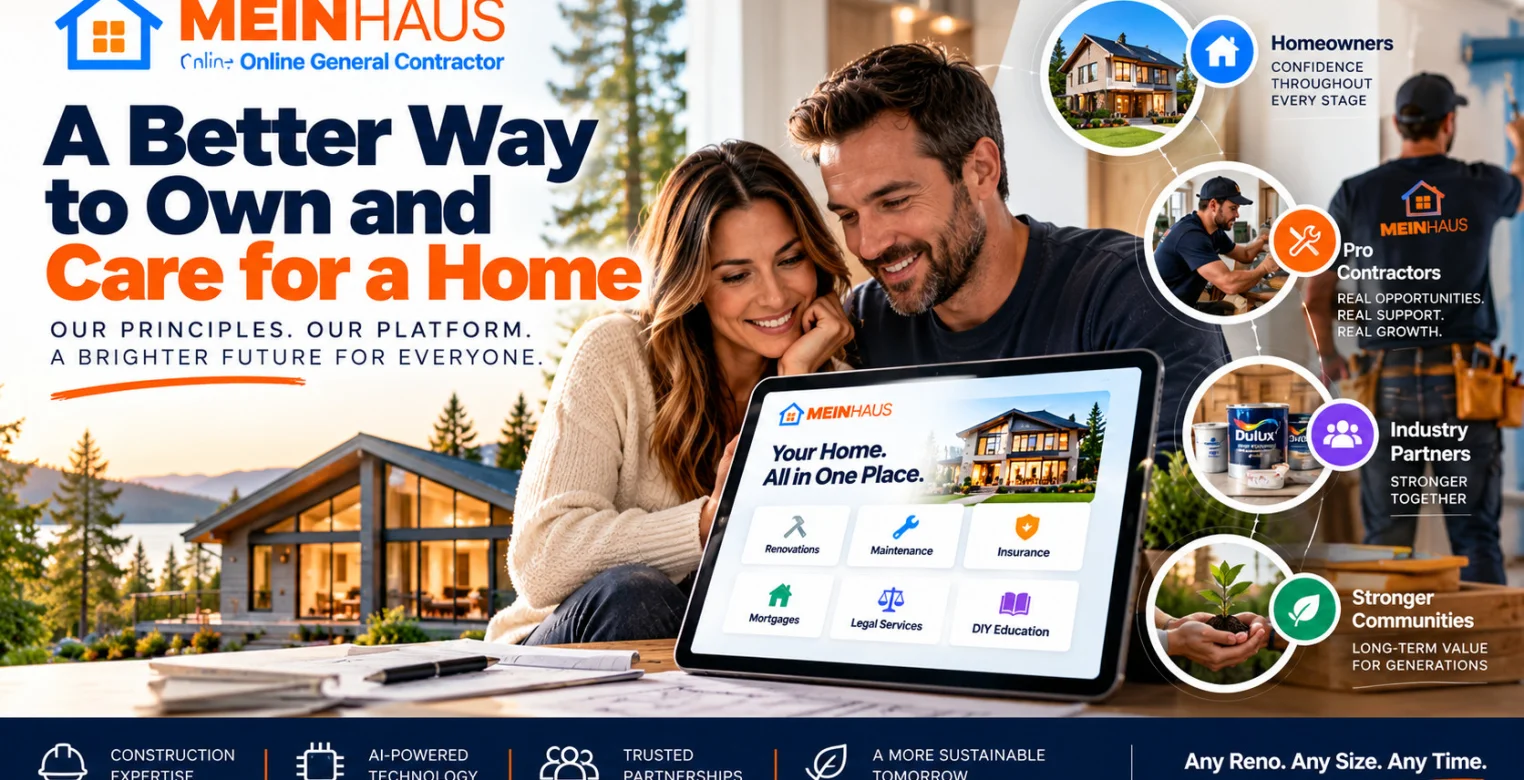
Over time, we want MEINHAUS to help homeowners find and manage more of the services associated with owning property: regular maintenance, home insurance, mortgages and financing, legal services, real estate-related needs and practical DIY education, alongside custom renovations.
These are areas of future platform development, not a claim that MEINHAUS currently provides every service. Where a service requires licensing or specialized advice, we expect to work with qualified professionals and established providers.
We also want education to be part of the experience. Sometimes a homeowner needs a contractor. Sometimes they need to understand how to maintain an appliance, compare materials or recognize when a repair is outside the limits of safe DIY work. Useful guidance should not depend on whether a sale happens that day.
A Home Should Have a Useful Memory
Think about how often homeowners are asked the same questions. How old is the roof? When was the furnace replaced? Was the basement waterproofed? Which paint colour was used? Who installed the windows? Is the electrical panel original? Sometimes the answers are buried in email, paper files or photographs. Sometimes they are simply forgotten.
A useful Home Profile could keep relevant information together with the homeowner's permission. It might include project records, material specifications, maintenance history, warranties, measurements and preferences. The purpose would not be to collect information for its own sake. It would be to make future decisions easier and reduce the need to begin from zero every time the homeowner needs help.
From Purchase to Everyday Ownership
At the time of purchase, a homeowner may be evaluating an inspection report, budgeting for repairs and arranging insurance or financing. During the first year, the priorities may be safety, comfort and necessary maintenance. Later, a growing family may need more space, or an older homeowner may want a more accessible bathroom. The needs change, but the underlying property remains the same.
We see value in a platform that can support those stages without requiring the homeowner to learn a completely new process each time. A renovation estimate could draw on relevant home information. A maintenance reminder could relate to actual equipment or materials. A future real estate transaction could be supported by organized improvement records.
Financial, Legal and Insurance Services Through Qualified Partners
Mortgages, lending, legal services and homeowner insurance require specialized expertise and, in many cases, regulated professionals. Our vision is to make these services easier to understand and access through appropriate partners, not to imply that MEINHAUS is itself a bank, law firm or insurance carrier.
A homeowner planning a substantial renovation may want to explore financing options before deciding on scope. A buyer may need legal assistance with a transaction. A property owner may need help organizing records for an insurer. In each case, the platform could eventually help identify the next appropriate step and make relevant information easier to prepare. The licensed professional would remain responsible for the advice or regulated service.
Maintenance Should Be Planned, Not Only Reacted To
Many homeowners first seek help when something fails. A leak appears, a furnace stops working or an exterior surface deteriorates. Some emergencies cannot be prevented, but routine attention can often help identify problems earlier. A good homeownership platform should make planned care easier to organize.
CMHC's homeowner guidance identifies maintenance and repairs among the ongoing costs of owning a home. We want homeowners to have tools that help them understand those responsibilities and plan for them without turning ordinary upkeep into an unnecessarily complicated process.
Education Is Valuable Even When There Is No Sale
We believe useful education belongs alongside paid services. Homeowners should be able to learn how materials work, how to maintain common systems, what warning signs to watch for and when a job requires professional help. Some tasks are reasonable DIY projects. Others involve electrical hazards, structural work, heights, permits or specialized skills and should be handled by qualified people.
Providing clear guidance may occasionally mean telling a homeowner that a simple maintenance step is enough and a larger renovation is unnecessary. We consider that a good outcome. Trust built through helpful advice is more valuable than a sale that should never have happened.
5. Help Independent Trades Build Better Businesses
Skilled tradespeople are essential to the future we are describing. Their work cannot be replaced by a well-designed website or a convincing AI demonstration.
Yet a small independent contractor often has to do everything: find customers, estimate jobs, manage paperwork, purchase materials, maintain insurance, organize scheduling and perform the work. Much of that effort happens outside billable hours.
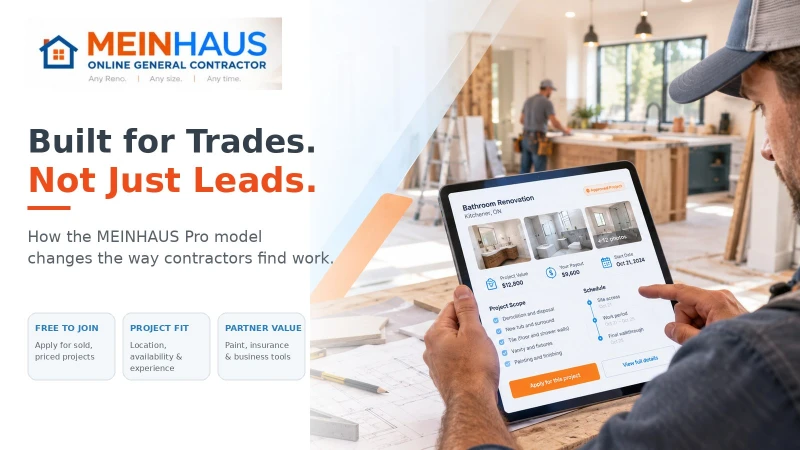
Our Pro model begins by reducing some of the sales burden. Qualified members can review sold, priced projects with defined scopes and payouts. Free members can apply for eligible opportunities without buying homeowner leads. Paid membership can add benefits and improve positioning, but it does not guarantee assignments.
That is only the beginning. We want the MEINHAUS Pro App to become a useful tool for independent business growth, whether or not a project is available in a given week.
Better purchasing access
Supplier relationships and material pricing programs that help eligible Pros reduce operating costs.
Business protection
Access to insurance resources and qualified partners who can help professionals understand coverage options.
Practical technology
Clearer scopes, organized project information, notifications, documentation and tools that reduce administration.
Long-term development
Education, experience, feedback and future partnerships that support stronger independent businesses.
Our existing partner initiatives include paint purchasing benefits and insurance-related resources. Looking ahead, we are interested in appropriate business lending partnerships, improved technical tools and group-rate programs that may make a wider range of personal and business development services more accessible.
Future benefits must be evaluated carefully. A discounted product is only valuable if it is useful, competitively priced and offered on understandable terms. A lending partnership should improve access to suitable options, not encourage unnecessary borrowing. An education program should teach something that helps a professional do better work.
We want Pros to become stronger independent operators through their experience with MEINHAUS—not more dependent on a single source of work. Our Built for Trades, Not Just Leads article explains this commitment in more detail.
A Business Is More than Its Next Project
Many independent tradespeople have built strong reputations through years of difficult physical work. Yet the success of their business also depends on quoting, scheduling, communication, purchasing, insurance, documentation and cash flow. A talented professional may still struggle because those supporting tasks consume time that cannot be billed.
We want MEINHAUS Pro to address more of that burden over time. Project opportunities are one part of the offer, but they should not be the only reason to keep the app. A useful professional platform should help people make better purchasing decisions, understand business requirements, organize work and find resources for professional development.
Purchasing Power Through Supplier Relationships
Independent businesses do not always have the volume needed to negotiate the same material terms as larger organizations. Coordinated supplier programs can help close that gap when the savings are genuine and the products meet the professional's needs.
Our relationship with Dulux is an example of this approach. Eligible free MEINHAUS Pros can access a paint discount, while qualifying subscribed painting Pros can access a higher discount under the program's terms. We want to develop similar practical relationships across additional categories where the benefits make sense.
These arrangements should remain understandable. The goal is not to push a contractor toward a product they would not otherwise use. It is to help a professional access appropriate materials at better terms when possible.
Insurance, Lending and Business Support
Insurance is an essential part of operating responsibly in construction, yet it can be confusing and costly for small businesses. Working with qualified insurance partners can help Pros learn about coverage and obtain appropriate quotes. We also see future potential in partnerships that improve access to business lending and financial education.
Any financing-related offer should be judged by whether it helps a business make an informed decision. Access to borrowing is not automatically a benefit if the terms are unsuitable. Our responsibility is to pursue reputable partners and present options clearly rather than encourage unnecessary debt.
Technology That Respects the Working Day
Contractors often work in environments where attention belongs on the job, not on a complicated app. Tools need to be straightforward, reliable and useful on a phone. Project notifications, clear scopes, documentation, scheduling information and timely communication are valuable precisely because they can reduce uncertainty.
As we develop new features, we want to listen closely to the people using them. A feature that looks impressive in a meeting but is difficult to use on a jobsite is not finished. Practical design should reflect the realities of the work.
Growth Without Dependence
We want Pros to become more capable and successful independent businesses through their experience with MEINHAUS. That may come from better project records, improved estimating knowledge, stronger documentation, useful feedback or relationships with suppliers and service providers.
Over time, we hope to explore group-rate benefits that extend into broader business and personal development: training, software, financial services and other practical resources. These are future possibilities, not a promise that every category is available today. We will judge them by the value they provide, not by the size of a benefits catalogue.
We also recognize that Pros should remain free to build customer relationships and opportunities outside our platform. Our ambition is to be valuable enough that professionals choose to participate, not to make them dependent on us.
6. Work with Established Companies instead of Trying to Replace Them
Many companies already serving the housing industry have spent decades developing products, expertise, distribution systems and professional standards. We respect that work.
We do not need to manufacture paint to help a painter buy better materials. We do not need to become an insurance carrier to help a contractor find an appropriate insurance partner. We do not need to become a bank or law firm to make it easier for a homeowner to reach qualified financial or legal professionals.
Our role is to bring organization, useful information, responsible project management and modern technology to the relationships that already make homeownership possible.
We welcome partnerships with established manufacturers, distributors, insurers, lenders, educators, technology providers and professional service firms. We are especially interested in relationships where the benefit to the end user can be explained clearly.
Partnerships should not be based only on access to an audience. They should help people save time, reduce avoidable cost, improve quality, understand their options or receive more reliable service.
Why Established Expertise Matters
Manufacturers, distributors, insurers, lenders, educators and professional service firms already solve important problems. Many have invested for decades in product quality, logistics, training, compliance and customer support. We believe that experience should be welcomed into a better digital experience, not dismissed as something technology can easily replace.
For a materials partner, a well-organized platform may help products reach the right professional at the right time. For an insurer, better information and education may help a small contractor understand coverage requirements. For an educator, access to working professionals may make practical training easier to distribute. Each relationship should begin with a real user need.
Partnerships Should Work in Both Directions
A good partnership is not simply a discount code or a logo on a page. It has to work for the partner as well. Suppliers need accurate product information and a sustainable commercial arrangement. Insurance partners need responsible processes and appropriate disclosures. Professionals need terms they can understand. Homeowners need confidence that recommendations serve their interests.
We want to be transparent about the role commercial relationships play in our offerings. A partner may benefit from reaching qualified customers, and MEINHAUS may benefit from the relationship, but those interests should not override the needs of the people using the service.
A Collaborative Path to a Broader Platform
We do not believe every home-related service should be built or owned by one company. A better approach is often to coordinate capable specialists while making the experience simpler for the homeowner. The platform can provide continuity and organization, while qualified partners provide the regulated or technical services they know best.
This is also why we welcome legacy companies that are interested in improving established processes. Their knowledge is not an obstacle to progress. It is part of what makes meaningful progress possible.
7. Improve the Company Continuously—and Be Willing to Change
No process we design today should be treated as final. We are still a growing company, and we know that our systems will sometimes fall short of what we intend.
That is why continuous improvement is not a side project. It is a responsibility.
Every estimate can teach us something about pricing and project information. Every completed job can reveal what made delivery easier or harder. Every customer complaint can show us where communication or accountability failed. Every Pro interaction can help us make requirements clearer and tools more useful.
We want those lessons to lead to practical changes: better scopes, clearer terms, improved software, more suitable project assignments and better support when something goes wrong.
We also want to measure outcomes rather than rely on good intentions. A system that saves our office time but creates more work for a contractor is not automatically an improvement. A partnership that earns revenue but offers little customer value does not meet the standard we want to set.
Our commitment is to keep asking a simple question: Did this change make the experience better for the people involved?
Listen, Measure, Improve, Repeat
Continuous improvement is easy to promise and harder to practise. It requires a willingness to examine problems without protecting old assumptions. If customers misunderstand a scope, perhaps the scope needs to be clearer. If a Pro repeatedly struggles with a workflow, perhaps the workflow is poorly designed. If a supplier program receives little use, perhaps it does not offer the value we expected.
We want to turn these observations into changes that can be tested. Better questions during estimating may reduce change orders. Better project descriptions may improve subcontractor fit. Better communication may reduce delays. Better documentation may make warranty and maintenance questions easier to resolve.
Progress Is Not Only About Speed
Technology makes it possible to process information faster, but speed alone is not the goal. A fast estimate that misses important details can be more costly than a slower, careful one. An automated message that confuses a customer is not an improvement. A rapid project assignment that overlooks qualifications is not responsible growth.
We should measure quality alongside efficiency. That includes clarity, customer understanding, Pro experience, safety, project outcomes and the ability to resolve concerns. Growth matters because it allows us to serve more people, but the value of growth depends on what happens to the experience as the company becomes larger.
Be Willing to Correct the Model
We do not assume every decision we make today will still be right in five years. Materials change, regulations evolve, customer expectations shift and new tools become available. We intend to keep the underlying principles steady while remaining willing to improve the methods.
This means treating feedback as useful information rather than an interruption. We will not always get every decision right. The obligation is to be accountable for the result and to learn enough to do better next time.
8. a Long-term Business Should Earn Long-term Trust
We are ambitious about what MEINHAUS could become. We want to build a platform that helps people understand, maintain, improve and manage their homes across many stages of life.
We want independent trades to have access to better tools, opportunities, purchasing programs and professional support. We want established partners to find new ways to serve customers. And we want technology to make these relationships simpler, more transparent and more productive.
But we do not expect anyone to trust that vision simply because we describe it well.
Trust has to be earned through the smaller decisions: an accurate scope, a fair response to a problem, a clearly explained price, a useful partner benefit, a respectful conversation and a project completed properly.
Those everyday decisions are how a company's principles become real.
We want MEINHAUS to grow because it makes homeownership easier and helps the people who serve homeowners succeed—not the other way around.
We believe it is possible to build a commercially successful company while deliberately seeking fair outcomes for customers, independent professionals, employees and partners. That does not mean every decision will be easy. It means the purpose behind those decisions should remain clear.
Our starting point is renovation. Our direction is a more complete homeownership platform. Our responsibility is to make sure the people involved benefit as we build it.
What We Want Homeowners to Gain
We want homeowners to spend less time trying to understand fragmented processes and more time making informed decisions about their homes. That means accessible information, clearer project terms, useful maintenance guidance and, where appropriate, easier access to qualified services.
Over time, we hope that the same relationship can support someone through buying a home, making improvements, maintaining it, adapting it to new needs and eventually selling it. We do not expect all of that to exist at once. We expect to earn the right to expand by doing the current work well.
What We Want Professionals to Gain
We want independent Pros to find real value in the platform even when they are not actively completing a MEINHAUS project. Better access to materials, insurance resources, useful software, education and future business benefits can help create that value. Work opportunities should remain clearly described, fairly managed and based on suitable qualifications and project fit.
Most importantly, we want the experience to support professional confidence and independence. A strong ecosystem should help good businesses become stronger, not make their future entirely dependent on one platform.
What We Want Partners to Gain
We want established companies to see MEINHAUS as a practical collaborator. Better organized demand, clearer information, and thoughtful access to homeowners and professionals can create useful opportunities. We also want to learn from their experience and build services that respect the technical and regulatory responsibilities of each industry.
What We Owe the Future
Our long-term ambition is broad, but our day-to-day obligations remain specific. We owe homeowners clear terms and responsible service. We owe Pros useful information and fair treatment. We owe partners honest representation and dependable processes. We owe our team tools and standards that make good work possible.
We believe a business can pursue ambitious growth while deliberately trying to leave everyone it works with better off. That requires restraint as well as ambition: saying no to partnerships that do not help users, declining shortcuts that compromise quality and admitting when a system needs to change.
MEINHAUS is still being built. Our hope is that, years from now, people will judge it less by the promises we made about technology and more by the practical ways we made homeownership easier and independent businesses stronger.
Build with MEINHAUS
Planning a home improvement project, running an independent trade business, or exploring a partnership? Start with the part of MEINHAUS that fits you.
MEINHAUS is an Online General Contractor. We scope, price, sell and manage renovation projects directly for homeowners, then subcontract the work to qualified independent professionals. We do not operate as a traditional pay-per-lead marketplace.
What Does AI-first Mean at MEINHAUS?
It means using AI and other useful technology as part of the company's operating processes, including project scoping, information management and planning. People remain responsible for professional judgment, safety and service.
Does MEINHAUS Already Provide Mortgages, Legal Services and Homeowner Insurance?
No. Those services are part of our longer-term vision for a coordinated homeownership platform. Where appropriate, they would involve qualified and licensed partners.
Can a Free MEINHAUS Pro Receive Projects?
Yes. Eligible free members can apply for available projects. Assignment depends on project fit and qualifications, and no membership level guarantees work.
What Kinds of Businesses Can Partner with MEINHAUS?
We are interested in useful partnerships with suppliers, manufacturers, insurers, lenders, educators, technology providers and other established companies serving homeowners and trades.
About the author Joshua Noble is Co-Founder of MEINHAUS and works across estimating, project management, operations, product strategy and technology-enabled home services. Connect with Joshua on LinkedIn.
Built for Trades, Not Just Leads: How the MEINHAUS Pro Model Works
Why MEINHAUS gives trades free access to sold and priced project opportunities, how Premium fits into the system, and why we believe contractor platforms should create value even before a Pro wins a job.
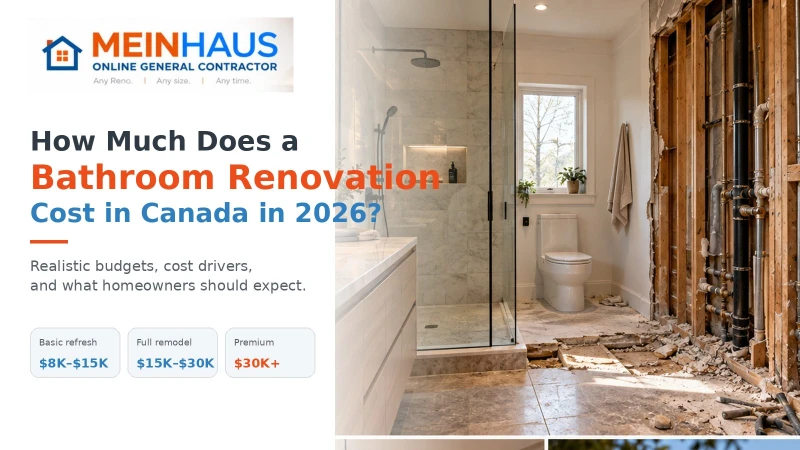
How Much Does a Bathroom Renovation Cost in Canada in 2026?
Realistic budgets, labour and material costs, showers, tile, plumbing, waterproofing and the choices that turn a simple refresh into a premium renovation.
How Much Does It Cost to Finish a Basement in Canada in 2026?
Realistic budgets, price-per-square-foot guidance, bathrooms, legal suites, permits and the details that move a basement from unfinished space to a real part of the home.
MEINHAUS × Dulux: Building Smarter Paint Distribution for Canada’s Trades
How professional pricing, real project demand, local store access and connected trade workflows can make construction-material purchasing faster, more predictable and more intelligent.
How Much Should You Pay a Contractor Up Front in Canada?
A homeowner’s guide to renovation deposits, material payments, credit cards, progress billing, written contracts and safer ways to pay for construction work.