The Cheapest Renovation Quote Is Not Always the Cheapest Renovation
When homeowners receive several contractor estimates, the instinct is often to line up the prices and start comparing from the bottom.
$18,900.
$22,400.
$25,750.
$31,000.
It feels like an easy decision.
Why would somebody voluntarily spend $25,750 if another contractor says they can complete the project for $18,900?
Because a contractor quote is not just a number.
It is a description of what a company has agreed to do, what materials it intends to use, what risks it has accounted for, who will perform the work, when payments are expected, what happens if conditions change and who remains responsible after construction is finished.
Two contractors can look at exactly the same bathroom and give prices that differ by $10,000 while both quotations are technically accurate.
The problem is that they may be pricing two completely different renovations.
One contractor may have included demolition, disposal, waterproofing, plumbing, electrical work, drywall repair, premium setting materials, custom glass, painting and project management.
Another may simply have written:
Bathroom renovation — $15,000.
Until you know what is contained inside that $15,000, you cannot actually compare the two estimates.
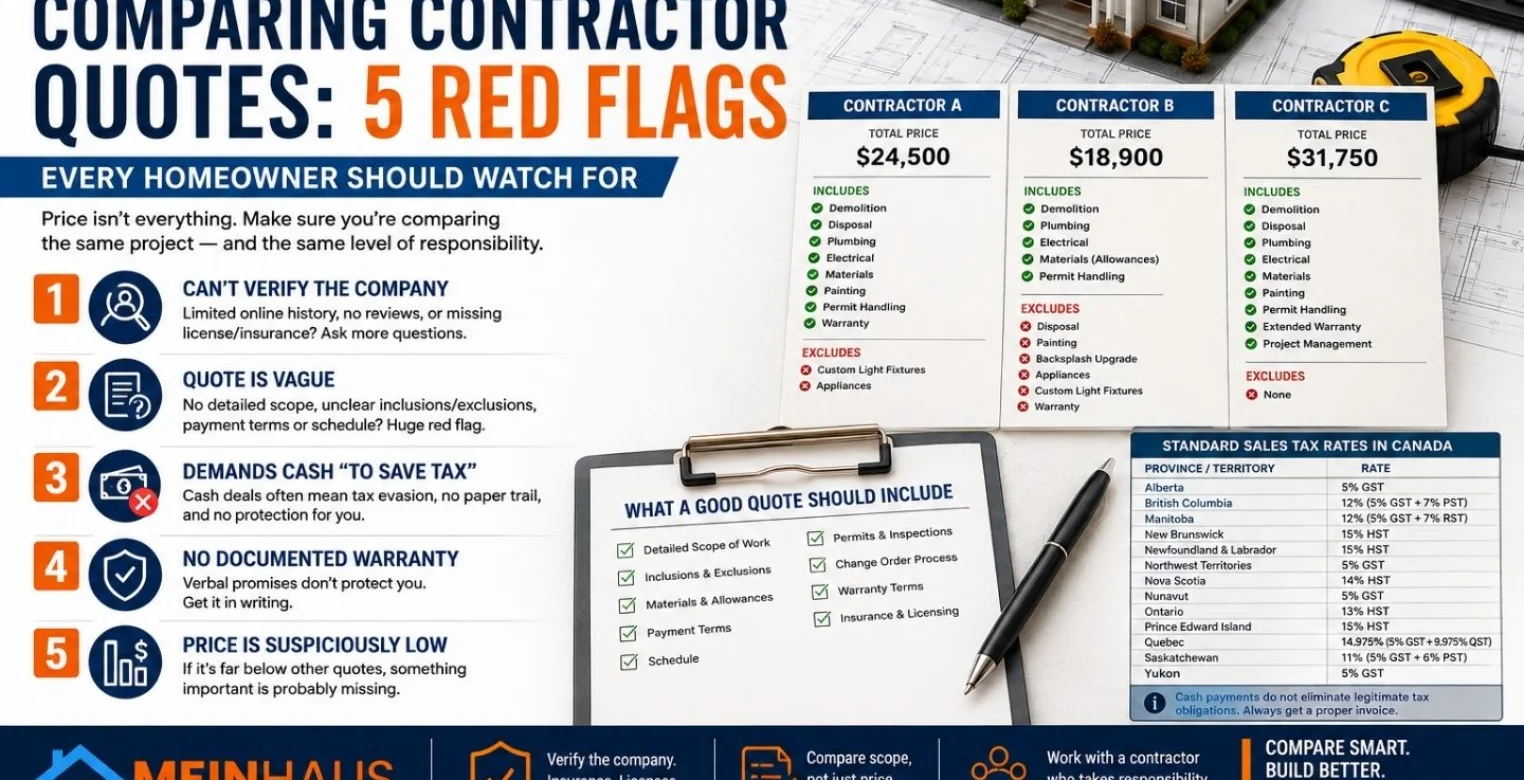
This guide explains five of the biggest red flags Canadian homeowners should watch for when comparing contractor quotes—and how to distinguish a legitimate difference in price from a quote that may create problems later.
Homeowners who are still at the contractor-selection stage should also read the MEINHAUS guide on what to check before hiring a general contractor.
The Five Biggest Contractor Quote Red Flags
The five issues we see most often are:
- The company is difficult to verify.
- The quote is vague or incomplete.
- The contractor pressures you into an undocumented cash transaction.
- There are no clear written warranty terms.
- The price is dramatically lower than every comparable quotation.
None of these automatically proves that a contractor is dishonest.
A newly established company may be excellent.
A contractor may prefer cheque or cash for legitimate reasons.
A small renovation may not require a 20-page contract.
And an efficient contractor can genuinely beat competitors on price.
The issue is what happens when several warning signs begin appearing together.
A homeowner should become much more cautious when a contractor has almost no verifiable business history, provides a one-line quotation, wants a large cash deposit, cannot provide proof of insurance and promises that everything will be “taken care of.”
That is no longer just a low quote.
It is a collection of risks.
Red Flag #1: You Cannot Properly Verify the Company
Before comparing quotations, compare the companies issuing them.
If you are preparing to hand someone $10,000, $30,000 or $100,000 to work inside your home, spending 15 minutes researching their business is reasonable due diligence.
Start with a simple online search.
Look for the contractor on:
- Google
- Google Maps
- HomeStars
- Facebook
- Instagram
- LinkedIn
- Business directories
- Provincial or federal business registries
- Trade-licensing databases where applicable
You are trying to establish whether there is a consistent business identity.
Does the company name on the quotation match the business online?
Does the phone number match?
Does the email domain make sense?
Does the company appear to have existed for more than a few weeks?
Are there photographs of actual completed work?
Are customer reviews spread over a reasonable period?
Does the business have a physical or service location?
Can you determine who owns or operates it?
Canada maintains a searchable network of official corporate registries through Canada's Business Registries, and federally incorporated companies can also be searched through Corporations Canada. These tools can help verify that a business entity actually exists, although not every legitimate contractor will necessarily be federally incorporated.
A Small Online Presence Does Not Automatically Mean a Bad Contractor
This needs to be said clearly.
Some excellent tradespeople are terrible marketers.
A carpenter may have spent 25 years building custom homes and have an Instagram account with six photos.
A new contractor may have recently incorporated after years of working for another company.
A plumbing company may rely almost entirely on referrals.
So the absence of hundreds of Google reviews is not proof of incompetence.
It simply means that you have less independently available information and should compensate by asking more questions.
For example:
- Can I see recent completed projects?
- Can you provide references?
- Can you provide your certificate of insurance?
- What is your legal business name?
- Who will actually be working at my property?
- Are subcontractors being used?
- Which parts of the project require licensed trades?
- Who obtains permits and inspections?
- How long have you personally worked in this trade?
The weaker the public history, the stronger the documentation should be.
Ask for Commercial General Liability Insurance
For most substantial renovation projects, homeowners should ask the contractor for proof of commercial general liability insurance.
Do not rely solely on:
“Yes, we're insured.”
Ask to see documentation.
A certificate of insurance commonly identifies:
- The insured company
- Policy period
- Insurer
- Types of coverage
- Liability limits
For specialized work, there may be additional requirements.
The exact insurance requirements vary depending on the contractor, province and scope, so homeowners should not assume that one insurance standard applies to every trade everywhere in Canada.
But a professional contractor should generally be able to explain what insurance they carry and provide supporting documentation when requested.
MEINHAUS discusses contractor verification in more detail in Why Hiring a Verified Contractor Saves You Time, Money & Stress.
Verify the Trade, Not Just the Company
A general contracting company may coordinate the project without personally performing every regulated trade.
That is normal.
The question is whether the people performing regulated work are properly qualified to do it.
Electrical Work
In Ontario, electrical work performed for hire generally must be completed through a Licensed Electrical Contractor. The Electrical Safety Authority provides a public contractor-verification system and specifically advises homeowners to verify the contractor before hiring.
Homeowners can use the Electrical Safety Authority's Licensed Electrical Contractor resources to verify electrical contractors.
A handyman saying:
“I've done electrical for years.”
is not the same thing as a company being legally authorized to contract electrical work.
Plumbing
Ontario also treats plumber as a compulsory skilled trade. Skilled Trades Ontario states that a person practising the trade must hold the appropriate registered apprenticeship, provisional certificate or Certificate of Qualification and appear in the public register.
Homeowners can check the Skilled Trades Ontario Public Register where applicable.
Rules are different in other provinces, so the correct licensing authority should always be checked for the jurisdiction where the property is located.
Working at Heights and Safety Qualifications
If the project involves roofing, siding, elevated exterior work or other work exposing people to significant fall hazards, safety training becomes particularly important.
In Ontario, Working at Heights training requirements apply to construction workers who may be required to use fall-protection systems. Infrastructure Health & Safety Association guidance explains that Working at Heights training is mandatory in these circumstances.
Homeowners do not need to become workplace-safety experts.
But it is perfectly reasonable to ask:
“What safety training and fall-protection procedures does your crew use for this project?”
A roofing contractor who becomes irritated by that question is providing useful information about how they run their business.
What About WSIB?
Workers' compensation rules are more nuanced than many homeowners realize.
In Ontario, WSIB construction rules contain specific exemptions for certain home-renovation arrangements involving independent operators working directly for homeowners. A homeowner therefore should not assume that the absence of a clearance automatically proves non-compliance. At the same time, businesses with employees can have different coverage obligations.
The best approach is to understand:
- Who is doing the work?
- Are they employees or subcontractors?
- What coverage applies?
- Can the contractor document the answer?
The contractor should understand their obligations better than the homeowner does.
Red Flag #2: The Quote Is Too Vague
A contractor may be excellent at construction and terrible at paperwork.
That does not automatically make them a bad choice.
But a vague estimate creates risk even when the contractor is honest.
Consider this quotation:
Basement renovation: $42,000.
What does that include?
Framing?
Insulation?
Drywall?
Electrical?
Flooring?
Bathroom?
Painting?
Baseboards?
Doors?
Permits?
Bin disposal?
Materials?
Plumbing fixtures?
A ceiling?
Nothing about the number tells you.
Now consider:
Supply labour and materials to frame perimeter walls and interior partitions according to approved layout; provide insulation and vapour barrier where required; complete drywall installation, taping, sanding and paint-ready finishing; supply and install selected flooring within 800 sq. ft.; install approximately 220 linear feet of baseboard; complete electrical rough-in and finish according to listed device schedule; painting and bathroom work excluded.
The second quote can actually be evaluated.
A Summary Quote Is Fine—If a Detailed Scope Exists Behind It
There is nothing wrong with a clean one-page proposal.
Most homeowners do not want to read 14 pages before understanding the price.
A good quote can have:
Project
Primary Bathroom Renovation
Price
$24,750 + applicable tax
Expected Schedule
Approximately 3–4 weeks
Deposit
10%
Then:
See attached detailed scope of work, inclusions, exclusions, payment terms and project conditions.
That is very different from providing only a short description.
The problem is not simplicity.
The problem is ambiguity.
What Should Be Included in a Contractor Quote?
For even a reasonably straightforward project, the homeowner should be able to determine:
Scope of Work
What exactly is the contractor agreeing to build or repair?
Labour
Which labour is included?
Materials
Who supplies materials?
What material level has been allowed?
Are product models specified?
Demolition
Is removal of existing work included?
Disposal
Who removes debris and pays disposal fees?
Preparation
Does painting include patching?
Does flooring include subfloor preparation?
Does tile include waterproofing?
Permits
Who determines whether permits are required?
Who applies?
Who pays?
Inspections
Who coordinates required inspections?
Schedule
When is the expected start?
Approximately how long should the project take?
Payment Terms
How much is due at deposit?
What causes the next payment to become due?
When is final payment due?
Changes
What happens if the customer adds work?
What happens if hidden damage is discovered?
Exclusions
What is explicitly not included?
Completion
What determines that the project is complete?
Warranty
What happens afterward?
Ontario's homeowner-renovation guidance provides a useful example of why written contracts matter. For applicable renovation contracts above $50, the province says the contract should be in writing and should contain important details about the project.
Homeowners outside Ontario should consult their own provincial consumer-protection authority because contract rules differ across Canada.
Inclusions Matter—but Exclusions Are Just as Important
A professional scope should tell the homeowner not only what is included, but also what is not included.
For example:
Painting includes walls, ceilings and baseboards. Interior doors excluded.
That is useful.
So is:
Flooring includes removal of existing laminate. Ceramic tile demolition excluded.
Or:
Plumbing fixture installation included. Fixtures supplied by customer.
These statements prevent misunderstandings.
A contractor saying:
“Well, obviously that wasn't included.”
after the project starts is exactly what written exclusions are designed to prevent.
Watch the Allowances
Allowances can make two quotations look similar when they are not.
Suppose Contractor A includes:
Tile allowance: $3/sq. ft.
Contractor B includes:
Tile allowance: $8/sq. ft.
Contractor C includes:
Customer supplies tile.
Those prices cannot be compared without adjusting for the material allowance.
The same applies to:
- Flooring
- Vanities
- Plumbing fixtures
- Lighting
- Cabinet hardware
- Countertops
- Paint
- Doors
- Trim
- Roofing products
Ask:
“What product quality did you assume when calculating this number?”
A cheap quote with unrealistic allowances often becomes an expensive project after selections begin.
Payment Terms Should Be Connected to Progress
The payment schedule matters almost as much as the total price.
Homeowners should understand:
- Deposit amount
- Material payment
- Mobilization payment
- Progress payments
- Completion payment
- Holdbacks where legally applicable
- How deficiencies affect final payment
A payment schedule should make sense for the actual project.
A custom cabinet company may legitimately require a significant material payment before fabrication.
A contractor asking for 80% upfront to paint an empty bedroom deserves more scrutiny.
The question should always be:
What cost or project milestone does this payment correspond to?
What Is the Cancellation Policy?
This is regularly overlooked.
What happens if:
- The homeowner cancels before work begins?
- Custom materials have already been ordered?
- The contractor reschedules?
- A permit cannot be obtained?
- Financing falls through?
- A condominium refuses approval?
These issues should not first be discussed after somebody wants out of the project.
Consumer cancellation rights can also depend on how and where the contract was entered into, so provincial rules matter. Ontario maintains specific guidance on signing and cancelling consumer contracts.
How Do We Know When the Project Is Complete?
This is one of the most important questions in construction.
Suppose the contractor says:
“We're finished.”
But the homeowner says:
“The bathroom mirror hasn't arrived, the baseboard needs touch-up and the shower door rubs.”
Is the project complete?
The contract should provide a reasonable process for determining completion and correcting deficiencies.
That might include:
- Final walkthrough
- Deficiency list
- Required inspection sign-offs
- Customer acceptance
- Completion photos
- Final documentation
- Final payment
The definition does not need to become excessively legalistic.
It simply needs to exist.
Red Flag #3: “Pay Cash and I'll Save You the Tax”
Cash is legal.
Cash is not the red flag.
A contractor may legitimately accept:
- Cash
- Cheque
- Bank draft
- E-transfer
- Credit card
- Financing
The concern is when cash is being used specifically to avoid documenting the transaction or collecting applicable tax.
For example:
“The price is $20,000 plus tax, but if you pay cash I'll do it for $20,000 all in.”
That should trigger questions.
If the contractor is willing to make the invoice disappear to save tax, what else is being kept off the books?
Will you receive a contract?
Will there be a receipt?
Will the warranty be documented?
Will the contractor still answer if something fails six months later?
Will there be a record of what work was actually performed?
Tax evasion should not be sold as a renovation discount.
What Sales Tax Applies to Renovations in Canada?
A small correction to a common misconception: 14% is not the highest standard HST rate in Canada.
Nova Scotia's HST dropped to 14% on April 1, 2025, while New Brunswick, Newfoundland and Labrador, and Prince Edward Island have standard 15% HST rates. Ontario's HST is 13%. The federal GST rate is 5%.
For provinces with separate sales taxes, ordinary consumer purchases may also attract provincial tax.
Standard Consumer Sales Tax Rates by Province and Territory
| Province / Territory |
Standard rate |
| Alberta |
5% GST |
| British Columbia |
5% GST + 7% PST = 12% |
| Manitoba |
5% GST + 7% RST = 12% |
| New Brunswick |
15% HST |
| Newfoundland and Labrador |
15% HST |
| Northwest Territories |
5% GST |
| Nova Scotia |
14% HST |
| Nunavut |
5% GST |
| Ontario |
13% HST |
| Prince Edward Island |
15% HST |
| Quebec |
5% GST + 9.975% QST = 14.975% |
| Saskatchewan |
5% GST + 6% PST = 11% |
| Yukon |
5% GST |
The CRA confirms the applicable federal/HST rates, while B.C., Manitoba, Saskatchewan and Quebec publish their respective provincial tax rates separately.
Important: the table above shows the standard consumer sales-tax environment. Construction and real-property contracts can have province-specific rules about how provincial sales taxes apply to labour, materials or contractor inputs. Homeowners should rely on a properly issued project invoice rather than applying this table themselves.
A Legitimate Contractor Should Be Able to Invoice You
The Canada Revenue Agency requires businesses collecting GST/HST to identify how the tax is being charged on receipts, invoices, contracts or similar documents, and registrants have record-keeping obligations associated with those transactions.
That means:
“No invoice if you want the cash price.”
should not feel like a benefit.
Documentation protects the homeowner too.
A proper record can establish:
- Contractor identity
- Amount paid
- Tax charged
- Date
- Work performed
- Payment history
That becomes valuable if a dispute, warranty claim, insurance issue or property sale later requires evidence.
Large Cash Deposits Are a Separate Concern
Even when tax is being handled correctly, a large cash deposit can create additional practical risk.
If you hand somebody $15,000 in physical cash, make sure you have:
- A signed contract
- Receipt
- Business name
- Payment amount
- Date
- Purpose of payment
- Remaining balance
Never rely on:
“Don't worry, I know what it's for.”
The contractor should want proper documentation as much as you do.
Red Flag #4: There Is No Documented Warranty
Almost every contractor says some version of:
“We stand behind our work.”
That sounds good.
But what does it mean?
Thirty days?
One year?
Five years?
Only labour?
Labour and materials?
Will they repair the drywall if correcting the plumbing requires opening it?
What if the original installer no longer works for the company?
How do you make a warranty claim?
A verbal promise is difficult to evaluate because nobody knows exactly what was promised.
Ask for the Warranty Before You Hire the Contractor
Do not wait until the project is finished.
Ask during the quotation stage:
- How long is your workmanship warranty?
- When does the warranty start?
- What exactly does it cover?
- What is excluded?
- How do I submit a claim?
- Who comes back to inspect?
- Are labour and materials included?
- Is the warranty transferable?
- Are manufacturer warranties separate?
A contractor who offers a warranty should have no problem explaining it.
Manufacturer Warranty vs Workmanship Warranty
These are not the same thing.
A roofing shingle manufacturer may warranty the product against certain manufacturing defects.
That does not necessarily mean the manufacturer will cover a roof leak caused by incorrectly installed flashing.
A flooring manufacturer may warranty the flooring.
That does not necessarily cover poor subfloor preparation.
A faucet may have a manufacturer warranty.
That does not automatically cover damage from incorrect installation.
The Government of Canada's Office of Consumer Affairs provides general guidance on manufacturer and extended warranties and emphasizes reviewing the actual terms rather than assuming all warranties provide the same protection.
The contractor's workmanship warranty should address the installation work they are responsible for.
What Should a Workmanship Warranty Explain?
At minimum, the homeowner should understand:
Duration
How long does coverage last?
Start Date
Final inspection?
Substantial completion?
Final payment?
Covered Work
Which parts of the project are included?
Exclusions
Normal wear?
Customer damage?
Material defects?
Building movement?
Existing conditions?
Claim Process
Who does the homeowner contact?
Response
What happens after the claim?
Remedy
Inspection?
Repair?
Replacement?
The more expensive the project, the less comfortable a homeowner should be with:
“Just call my cellphone if anything happens.”
Make Sure the Company Providing the Warranty Will Still Exist
This brings us back to Red Flag #1.
A ten-year workmanship warranty from a business that was created three months ago is not automatically more valuable than a shorter warranty from an established company.
The warranty is only as useful as the organization's ability and willingness to honour it.
Look at:
- Business history
- Reviews over time
- Office contact information
- Written process
- Corporate identity
- Project records
MEINHAUS's broader contracting model is explained in MEINHAUS Is Not a Contractor Marketplace, including why the company remains involved in the project rather than simply generating a contractor lead.
Red Flag #5: One Quote Is Dramatically Cheaper Than Everything Else
The cheapest quote is not automatically wrong.
This deserves emphasis.
There are legitimate reasons why one contractor can charge less.
They may:
- Own equipment others rent
- Have better supplier pricing
- Specialize in the work
- Operate with lower overhead
- Be located nearby
- Have an opening in the schedule
- Work more efficiently
- Use a smaller crew
- Be intentionally aggressive on price
Likewise, the most expensive contractor is not automatically the best.
Price alone does not measure quality.
The red flag appears when the price difference is so large that you need to understand what created it.
Example: Three Bathroom Quotes
Imagine receiving:
Contractor A
$22,800
Contractor B
$25,500
Contractor C
$13,900
Contractor C may have found a legitimate way to save you $10,000.
Great.
Now determine how.
Ask all three companies:
- Is demolition included?
- Is disposal included?
- Is waterproofing included?
- What waterproofing system?
- Is plumbing included?
- Is electrical included?
- Is custom glass included?
- Is painting included?
- Who supplies tile?
- What vanity allowance?
- Is trim included?
- Is the fan included?
- Are permits included if required?
- What happens with water damage?
- What warranty is included?
The answer may become obvious.
Low Quotes Are Often Missing Scope Rather Than Offering Savings
Suppose:
Contractor A — $22,800
Includes:
- Demolition
- Disposal
- Plumbing
- Waterproofing
- Tile
- Painting
- Vanity installation
- Custom glass
- Electrical
- Warranty
Contractor C — $13,900
Includes:
- Labour
- Customer supplies materials
- Plumbing extra
- Glass extra
- Disposal extra
- Electrical extra
- Painting extra
- Water damage extra
Contractor C did not beat Contractor A by $8,900.
The homeowner simply compared two different projects.
This is why scope normalization is the most important part of comparing estimates.
Normalize the Quotes Before Comparing the Prices
Create a simple comparison table.
| Item |
Contractor A |
Contractor B |
Contractor C |
| Demolition |
Included |
Included |
Included |
| Disposal |
Included |
Included |
Extra |
| Materials |
Included |
Partial |
Customer supplied |
| Plumbing |
Included |
Included |
Extra |
| Electrical |
Included |
Included |
Extra |
| Waterproofing |
Included |
Included |
Unclear |
| Painting |
Included |
Included |
Extra |
| Glass |
Included |
Allowance |
Extra |
| Permit |
If required |
Extra |
Unclear |
| Warranty |
2 years |
1 year |
Verbal |
| Total |
$22,800 |
$25,500 |
$13,900 |
Now the prices mean something.
Without this process, they do not.
Watch for the Change-Order Business Model
Some contractors unintentionally underquote because they missed details.
Others may intentionally present an attractive starting number knowing the final price will rise later.
That can happen through:
- Unrealistically low allowances
- Missing preparation
- Undefined exclusions
- “Site conditions”
- Material upgrades
- Disposal
- Required trades
- Permit-related items
- Work that should reasonably have been anticipated
Change orders themselves are not suspicious.
Renovations genuinely uncover unexpected conditions.
Homeowners also change their minds.
The issue is whether ordinary predictable components were omitted simply to make the original quote appear cheaper.
Ask the Contractor What Could Make the Price Increase
This is one of the best questions you can ask:
“Assuming I don't change the design, what circumstances could cause this price to increase?”
A good estimator should be able to answer.
For example:
“If we uncover rotten subfloor, we would photograph it and provide a change price before replacing it.”
Good.
Or:
“The quote includes up to five sheets of roof decking. Additional sheets are $110 each if required.”
Good.
Or:
“We don't know. Renovations always cost more.”
Less reassuring.
The Best Contractor Quote Is Usually the One You Understand
The objective is not to find the contractor with the longest contract.
It is not to hire the most expensive company.
It is not to reject small businesses.
And it is not to demand paperwork for the sake of paperwork.
The objective is to reach the point where you can answer:
Who am I hiring?
What are they responsible for?
How much will I pay?
When will I pay it?
What is excluded?
What could change the price?
Who performs regulated work?
What happens if something goes wrong?
If you cannot answer those questions after reading the quotation, the estimate needs more clarification.
Five Quotes Can Be Worse Than Three Good Quotes
Homeowners sometimes assume the safest strategy is obtaining as many quotes as possible.
Ten roof quotes.
Eight kitchen quotes.
Seven bathroom quotations.
This can create more confusion than clarity.
A better approach is often to obtain three well-qualified quotations from companies that appear capable of actually performing the work.
Then normalize those quotes.
If all three come in around:
$23,000
$24,500
$26,000
you have learned something useful about the likely project cost.
If one arrives at $14,000, investigate.
If one arrives at $42,000, investigate that too.
The outlier can be wrong in either direction.
Should You Tell Contractors the Other Prices?
There is no rule against it.
But there is a difference between comparison and auctioning.
Saying:
“Another contractor is $2,000 cheaper. Is there something in your scope that explains the difference?”
is a useful conversation.
Saying:
“Keep cutting your price until you're the cheapest.”
can eventually force contractors to remove scope or walk away.
Good contractors know what it costs them to complete work properly.
You should want that.
Never Compare a Labour-Only Quote to a Labour-and-Material Quote
This sounds obvious.
It happens constantly.
Contractor A:
$7,500 labour only.
Contractor B:
$13,500 labour and materials.
The homeowner says:
“Contractor A is almost half the price.”
No.
Contractor A gave half the project price.
Before comparing, identify whether each quote includes:
- Material
- Delivery
- Disposal
- Consumables
- Fasteners
- Adhesives
- Waterproofing
- Paint
- Trim
- Equipment
- Rental
- Taxes
MEINHAUS's article What Can You Renovate for $25,000 in Canada? uses labour-and-material budgets specifically because material-only pricing can create a misleading impression of total renovation cost.
Deposits: How Much Is Too Much?
There is no single deposit percentage appropriate for every renovation.
Consider two very different projects.
Painting
The contractor may need:
- Paint
- Caulk
- Primer
- Minor supplies
Custom Kitchen
The contractor may need:
- Custom cabinetry
- Stone fabrication
- Hardware
- Appliances
- Specialty materials
The kitchen legitimately requires more money committed before installation begins.
Rather than focusing exclusively on the percentage, ask:
What does this deposit pay for?
If the answer is:
“We need $20,000 so we know you're serious.”
that is different from:
“This payment releases your custom cabinets into fabrication. Here is the cabinet order and payment milestone.”
Never Pay a Contractor You Cannot Identify
Be especially cautious when:
- Quotation is under one name
- E-transfer goes to another
- Invoice uses a third
- Contractor says the corporation is “someone else's”
- Cash receipt has no company name
There can be legitimate explanations.
Ask for them.
The business identity should make sense.
What About Contractor Reviews?
Reviews are useful.
They are not infallible.
Look beyond the star rating.
Read:
- Recent reviews
- Older reviews
- Negative reviews
- Company's responses
- Types of jobs reviewed
- Whether descriptions sound project-specific
- Whether photographs match the services offered
A company with 4.7 stars and hundreds of detailed reviews may tell you more than a business with five perfect reviews posted in the same month.
At the same time, even a strong review history does not replace:
- Insurance
- Licensing
- Scope
- Contract
- Warranty
Reviews are one layer of verification.
Not the entire process.
What If the Contractor Is New?
A new contractor deserves a fair chance.
Every established construction company was new once.
If a newer business gives you the strongest quote, ask for:
- Personal trade history
- Previous employer experience
- Portfolio
- References
- Insurance
- Licences
- Detailed work scope
- Smaller initial deposit where reasonable
- Progress-based payments
You may find an excellent contractor before they become expensive and booked months in advance.
The red flag is not new.
The red flag is unverifiable and unwilling to document anything.
A Contractor Quote Checklist
Before accepting a renovation quote, confirm the following.
Contractor
- Legal or operating business name
- Phone number
- Email
- Online presence
- Business registration where appropriate
- Liability insurance
- Relevant licences
- Trade qualifications
- Safety qualifications
- References or portfolio
Scope
- Work included
- Work excluded
- Demolition
- Disposal
- Preparation
- Materials
- Allowances
- Licensed trades
- Permit responsibility
- Inspection responsibility
- Cleanup
Money
- Base price
- Applicable tax
- Deposit
- Payment milestones
- Final payment
- Allowances
- Unit prices
- Change-order process
Schedule
- Expected start
- Estimated duration
- Material lead times
- Access requirements
- Delay provisions
Completion
- Final walkthrough
- Deficiencies
- Inspections
- Documentation
- Warranty start
Warranty
- Written coverage
- Duration
- Exclusions
- Claim procedure
- Manufacturer warranties
If two contractors answer these questions differently, now you have something useful to compare.
How MEINHAUS Approaches Renovation Quotes
MEINHAUS operates differently from a contractor directory or lead-generation website.
For projects purchased through MEINHAUS, MEINHAUS acts as the general contractor.
The objective is to create a defined scope of work, establish customer-facing project pricing, assign qualified professionals and remain involved in project management rather than simply introducing a homeowner to a contractor and leaving the transaction. The current MEINHAUS project flow includes online project intake and fixed-price positioning for defined projects.
That structure is particularly relevant to quote comparison.
A homeowner should not only ask:
“Who is physically performing the work?”
They should also ask:
“Which company is ultimately responsible for delivering what I purchased?”
Those are not always the same question.
Read more in MEINHAUS Is Not a Contractor Marketplace.
Frequently Asked Questions About Contractor Quotes
How many contractor quotes should I get?
For most renovations, three detailed quotations from qualified companies are usually enough to establish a useful comparison. More may be appropriate for unusually large, complex or specialized projects.
Should I always choose the middle quote?
No. The middle quote has no automatic advantage. Compare scope, qualifications, materials, scheduling, warranty and exclusions before comparing final price.
Is the cheapest contractor usually bad?
No. A lower price can reflect efficiency, lower overhead or better purchasing. A dramatically lower price should simply be investigated.
Is the most expensive contractor usually better?
No. Higher price may reflect stronger scope, premium products, overhead or simply a higher margin. Price alone does not establish quality.
What should be included in a renovation quote?
At minimum, you should understand the work scope, materials, exclusions, price, tax, payment terms, schedule, change-order procedure and warranty.
Should a contractor quote include materials?
It depends on the agreement. Labour-only quotes are perfectly legitimate as long as they are clearly identified as labour only.
What is an allowance?
An allowance is an amount budgeted for an item that has not yet been finally selected, such as tile, flooring, fixtures or cabinetry.
Why are contractor quotes so different?
Differences can result from scope, labour rates, insurance, materials, company overhead, disposal, subcontractors, warranty, project management, access and profit margin.
Should contractors charge tax?
Businesses required to collect applicable GST/HST or provincial sales tax must do so according to the relevant tax rules. A homeowner should receive proper transaction documentation.
Is paying cash to a contractor illegal?
No. Cash itself is a legitimate form of payment. The concern is an undocumented transaction designed to conceal revenue or avoid applicable taxes.
Should I ask for a receipt for cash?
Yes. Any substantial project payment should be documented.
How do I verify an electrical contractor in Ontario?
Use the Electrical Safety Authority's contractor-verification tools and confirm the business is authorized to perform electrical contracting work.
How do I verify an Ontario plumber?
Where compulsory-trade requirements apply, Skilled Trades Ontario maintains a public register that can be used to verify status.
Should a contractor have liability insurance?
For substantial renovation work, requesting proof of commercial general liability insurance is prudent. Exact insurance obligations vary by business, trade and jurisdiction.
Is WSIB always required for an Ontario home-renovation contractor?
Not in every arrangement. Ontario's construction coverage rules contain specific exemptions for certain home-renovation independent operators working directly for homeowners, while businesses with employees can have different obligations.
Should the quote specify a start date?
At minimum, it should provide a reasonable schedule expectation or explain how the project will be scheduled.
What happens if the contractor finds hidden damage?
The contract should explain how concealed conditions are documented, priced and approved before additional work proceeds wherever practical.
Can a contractor increase the price after work starts?
Legitimate changes can occur because of customer additions, material changes or concealed conditions. The change-order process should be documented rather than handled through surprise invoices.
Should warranties be in writing?
Yes. Written terms make the duration, coverage and exclusions much easier for both parties to understand.
What is the difference between manufacturer and workmanship warranty?
Manufacturer warranties generally relate to the product under their terms; workmanship warranties relate to the contractor's installation or construction work.
Should I check Google reviews?
Yes, but reviews should be one part of broader verification that includes insurance, licensing, project history and written scope.
What if a contractor has no Google page?
Ask more questions. It may be a new company or a business that relies on referrals. A limited online footprint is a reason for additional verification, not automatic rejection.
Should I negotiate contractor quotes?
Reasonable negotiation is normal, particularly around scope and material selections. The goal should be to find efficient ways to reduce cost—not force the contractor to remove necessary work without telling you.
What is the best question to ask after receiving a quote?
Ask:
“Assuming I don't change the design, what could cause this price to increase?”
The answer reveals a great deal about how carefully the contractor estimated the job.
Final Takeaway: Compare Responsibility, Not Just Price
When you compare contractor quotes, you are not really choosing between numbers.
You are choosing between different promises.
One company may be promising only labour.
Another may be promising a complete managed renovation.
One contractor may be pricing entry-level materials.
Another may be pricing premium finishes.
One may have included demolition and disposal.
Another may add them later.
One may have a written workmanship warranty.
Another may simply say:
“Call me if anything happens.”
Before choosing a contractor, make the quotations comparable.
Verify the business.
Understand the scope.
Confirm licensed work.
Understand payment terms.
Reject undocumented tax-avoidance deals.
Read the warranty.
And investigate any price that seems dramatically out of line with the rest.
The objective is not to hire the cheapest contractor.
It is not to hire the most expensive contractor.
It is to hire the company offering the best clearly defined value with an acceptable level of accountability and risk.
A $20,000 renovation completed properly is less expensive than a $15,000 renovation that needs $10,000 of corrective work.
And a detailed quotation is often the first indication of whether the company understands that distinction.
If you're comparing renovation estimates and want another perspective on the scope, request a MEINHAUS project quote. MEINHAUS can review the project requirements, develop a detailed scope and establish customer-facing project pricing before work begins.
About the Author
Joshua Noble is a co-founder and senior leader at MEINHAUS, a Canadian Online General Contractor.
His work focuses on renovation estimating, detailed scope development, project planning, contractor coordination, procurement and the use of technology to improve how residential construction projects are priced and managed.
Joshua writes about Canadian renovation costs, contractor selection, construction planning, estimating and the practical issues homeowners should understand before beginning work on their property.
Connect with Joshua Noble on LinkedIn or explore additional MEINHAUS renovation articles.
External Resources