How Much Does a Basement Remodel Cost in Ontario?
A Real-World Cost Guide for Homes Built Since 2000
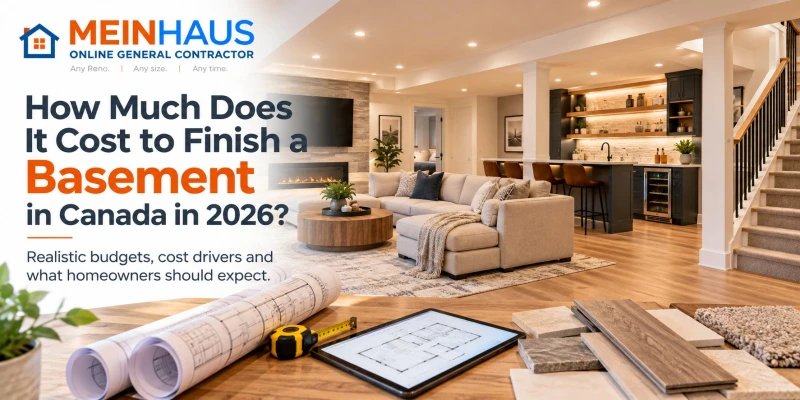
For many Ontario homeowners, the basement is the largest unfinished opportunity in the house. It can become a rec room, home office, gym, guest bedroom, legal basement apartment, kids’ area, theatre room, storage space, or a full second living area.
But the biggest question is usually the same:
How much should a basement renovation cost?
For homes built since the year 2000 in Ontario, MEINHAUS typically sees full basement remodel costs range from approximately $60 to $100 per square foot, depending on the scope, finishes, permit requirements, electrical work, bathroom or kitchen additions, flooring, ceiling work, and whether the project is a standard finished basement or a legal secondary suite.
For a practical middle-class finished basement, homeowners should often plan around $75 per square foot as a realistic working budget.
That means a 600 sq. ft. basement renovation may land around $45,000 for a well-planned finished space, while a larger or more complex basement with bedrooms, a bathroom, kitchen, legal suite requirements, custom millwork, upgraded flooring, or exterior access changes can cost significantly more.
At MEINHAUS, our recent basement renovation experience includes full basement remodels, legal basement suites from permitting to completion, and rec room-style basement renovations. The real-world data has shown one clear pattern: the square footage matters, but the scope matters more.
A simple open rec room is not the same as a legal basement apartment. A finished basement with pot lights and vinyl flooring is not the same as a basement with multiple bedrooms, a bathroom, kitchen, egress work, upgraded electrical, custom closets, epoxy flooring, and permit coordination.
Basement Renovation Cost in Ontario: Quick Answer
For a home built after 2000 in Ontario, a realistic basement renovation budget is:
| Basement Renovation Type |
Typical Cost Range |
| Basic finished basement |
Around $60 per sq. ft. |
| Mid-range finished basement |
Around $75 per sq. ft. |
| Higher-end basement renovation |
Around $100+ per sq. ft. |
| Legal basement suite |
Often higher depending on kitchen, bathroom, egress, permits, fire separation, and access requirements |
These figures are most useful for homes built since 2000 because newer homes often have more predictable construction, more modern foundations, and in many cases, existing plumbing rough-ins. That does not mean the basement will be simple, but it usually reduces some of the unknowns found in older Ontario homes.
Why Homes Built After 2000 Are Different
A basement renovation in a newer Ontario home is usually different from a basement renovation in a 1950s Toronto bungalow, a century home in Hamilton, or an older property in downtown Kitchener, London, or Ottawa.
Homes built since 2000 often have:
- More predictable framing conditions
- More modern concrete foundations
- Better ceiling heights
- Existing plumbing rough-ins
- More accessible mechanical layouts
- Newer electrical panels
- Less likelihood of outdated materials
- Fewer unknowns behind walls and floors
One of the biggest advantages is the plumbing rough-in. Many newer Ontario homes already have a rough-in for a future basement bathroom. When that rough-in is present and properly located, it can save homeowners approximately $5,000 to $10,000 compared to adding new plumbing from scratch.
That said, newer does not always mean easy. Basements built after 2000 can still have inadequate insulation, missing or poorly installed vapour barrier, uneven floors, low bulkheads, limited electrical panel capacity, no proper ventilation for a bathroom, or access issues if the homeowner wants to create a legal basement apartment.
What Does a Standard Basement Remodel Include?
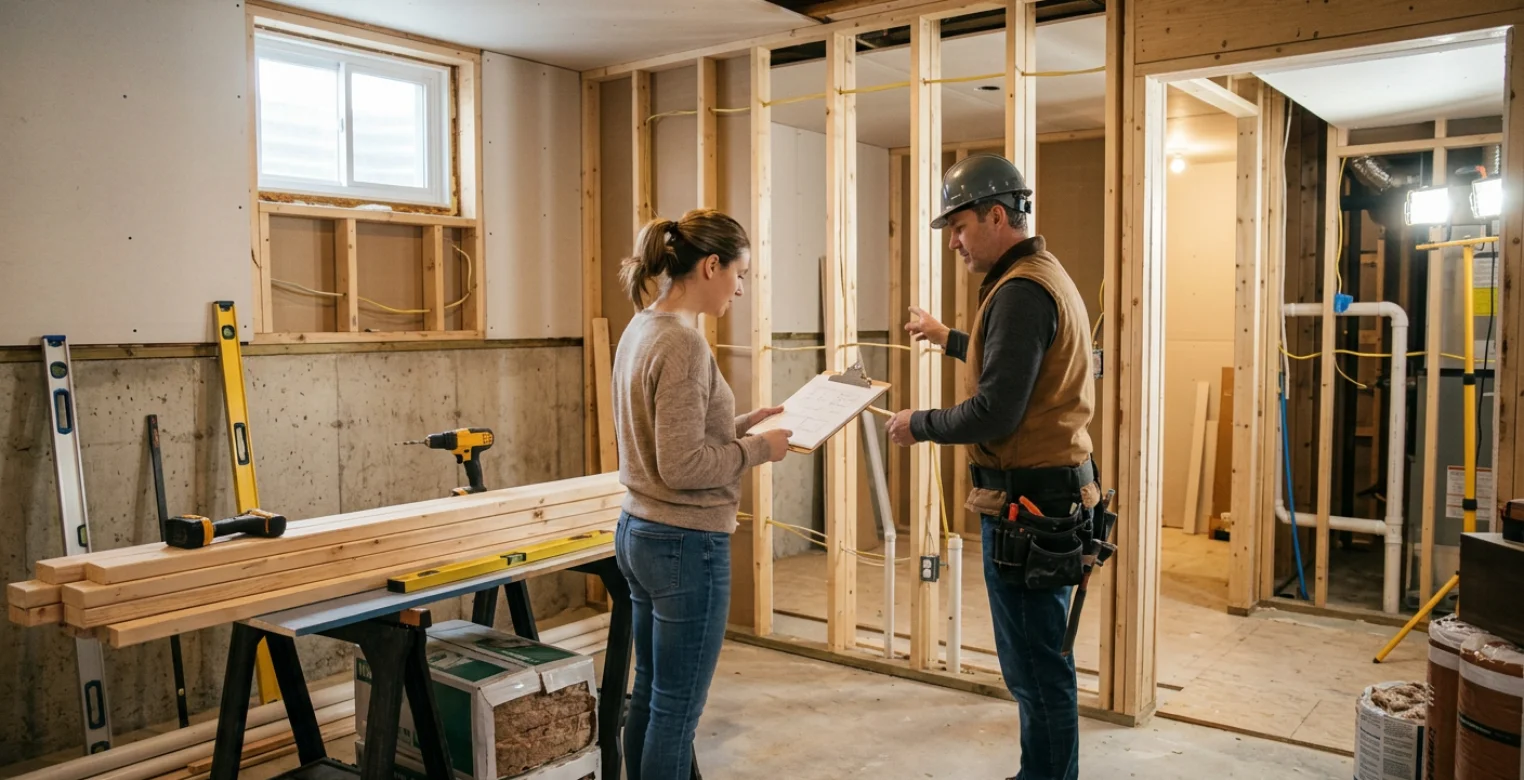
A standard basement renovation in a post-2000 Ontario home usually includes some combination of:
- Permit coordination
- Layout planning
- Framing adjustments
- New interior walls
- Ceiling framing or bulkhead adjustment
- Insulation and vapour barrier review
- Electrical rough-in
- ESA-permitted electrical work
- Pot lights or ceiling lighting
- Drywall hanging
- Taping, mudding, sanding, and paint-ready finishing
- Flooring installation
- Trim and doors
- Painting
- Bathroom finishing, if included
- Storage or closet construction
- Final cleanup
The most common basement requests MEINHAUS sees include rec rooms, bedrooms, basement bathrooms, home offices, entertainment areas, kids’ spaces, gyms, and legal basement suites.
One recent example included a homeowner looking to add two bedrooms, a basement bathroom, custom closet space, pot lights, and epoxy flooring in approximately 600 sq. ft. of basement area. This type of project is a great example of why basement renovation costs cannot be priced by square footage alone. The square footage was manageable, but the bedrooms, bathroom, lighting, closet work, and flooring choices all affected the final cost.
Basement Renovation Cost Per Square Foot
For Ontario homes built since 2000, MEINHAUS generally sees three practical pricing categories.
Basic Finished Basement: Around $60 Per Sq. Ft.
A basic basement finish usually applies to a simpler open-concept space. This may include framing, electrical, drywall, flooring, trim, and paint, but usually avoids major complexity.
This type of basement may be a rec room, kids’ play area, home gym, or simple finished living space.
A basement closer to the $60 per sq. ft. range usually has:
- Simple layout
- Minimal walls
- No kitchen
- No bathroom or existing rough-in used efficiently
- Standard flooring
- Basic lighting
- Limited millwork
- No major access changes
- No major floor leveling
- No legal suite requirements
Mid-Range Finished Basement: Around $75 Per Sq. Ft.
A mid-range basement renovation is the most realistic budget for many Ontario homeowners.
This is the range where the basement starts to feel like a complete living space rather than just a finished lower level. It may include a rec room, bedroom, bathroom, better lighting, upgraded flooring, storage, and a cleaner finish throughout.
A $75 per sq. ft. basement may include:
- Better layout planning
- Pot lights
- Finished drywall ceiling
- New flooring
- Finished bathroom, if rough-in exists
- Trim and doors
- Clean paint finish
- Storage or closet areas
- More careful floor and wall prep
For many middle-class Ontario homes, $75 per sq. ft. is a strong planning number for a finished basement that feels comfortable, durable, and properly completed.
High-End Basement Remodel: $100+ Per Sq. Ft.
A basement renovation can move toward or above $100 per sq. ft. when the project includes premium finishes or major added systems.
Costs increase quickly with:
- High-end flooring
- Custom millwork
- Wet bars
- Full kitchens
- Multiple bedrooms
- Legal basement suite requirements
- Soundproofing
- Heated floors
- Custom entertainment walls
- Built-in storage
- Bathroom additions
- Egress windows
- Exterior entrance work
- Major electrical upgrades
- Floor leveling
- High-end trim and doors
A legal basement suite, in particular, should not be compared to a simple finished basement. Once a basement becomes a separate dwelling unit, the project may involve permits, drawings, fire separation, HVAC considerations, electrical requirements, plumbing, kitchen installation, egress, ceiling height review, smoke and carbon monoxide alarm requirements, and municipal review.
Basement Permit Costs in Ontario
One of the most underestimated basement renovation costs is the permit process.
In MEINHAUS’ experience, homeowners should often budget around $3,500 for the permit-related process on more involved basement renovations. This may include permit coordination, drawings, submission support, design requirements, and municipality-related steps depending on the project.
It is important to separate two things:
The municipal permit fee itself may be only one part of the cost.
The full permit process may also include drawings, design work, revisions, documentation, and coordination.
For a simple rec room, the permit path may be much lighter. For a legal basement suite, the process can become much more involved.
Homeowners often underestimate this because they think of a permit as a small administrative fee. In reality, the cost is often tied to the planning, documentation, design responsibility, and inspection pathway required to complete the project properly.
Framing Costs
For a standard basement renovation in a newer Ontario home, MEINHAUS commonly sees framing adjustments and new wall framing range from approximately $2,500 to $5,000, depending on basement size and complexity.
Framing costs increase when the project includes:
- Multiple rooms
- Bedrooms
- Bathroom walls
- Laundry rooms
- Mechanical room separation
- Bulkhead work
- Ceiling adjustments
- Custom closets
- Storage areas
- Entertainment walls
- Legal suite layouts
Framing is one of the steps that determines how professional the basement will feel when complete. Poor framing creates problems later with drywall, trim, doors, ceilings, bulkheads, and finished lines.
In a basement, framing is also about working around mechanical systems. Ductwork, plumbing lines, beams, teleposts, electrical panels, sump pumps, and furnace rooms all affect layout.
Electrical Costs
Electrical work in a basement can range dramatically.
For a simple rec room with basic wiring and lighting, MEINHAUS has seen electrical costs as low as approximately $1,200.
For more involved basements with kitchens, bathrooms, multiple bedrooms, pot lights, dedicated entertainment circuits, custom media walls, and more complex electrical needs, electrical costs can climb significantly. The highest-end basement electrical scope MEINHAUS has dealt with was around $10,000.
For many standard basement renovations, the average electrical budget is commonly around $2,000 to $3,000.
Electrical costs increase when homeowners request:
- Pot lights throughout
- Multiple new circuits
- Kitchen wiring
- Bathroom wiring
- Dedicated entertainment circuits
- Electric fireplace wiring
- Home theatre wiring
- Office circuits
- Panel upgrades
- Sub-panel installation
- Heated floor electrical
- Exterior entrance lighting
- Legal suite electrical requirements
Basements are often used for entertainment, offices, gyms, or rental spaces, so electrical planning matters. It is much cheaper to plan circuits properly before drywall than to add them later.
Drywall: One of the Largest Labour Costs
Drywall is often one of the largest labour line items in a basement renovation.
In MEINHAUS’ experience, drywall hanging, taping, mudding, sanding, and finishing to a paint-ready standard is commonly around $8 per square foot of floor space for labour only.
This surprises many homeowners because they think of drywall as a simple material. The material itself may not be the most expensive part. The labour is the real cost.
Basement drywall work includes:
- Moving sheets into the basement
- Carrying material through tight stairs
- Hanging ceiling drywall
- Hanging wall drywall
- Boarding bulkheads
- Corner bead
- Taping
- Mudding
- Multiple coats
- Sanding
- Touch-ups
- Getting the surface paint-ready
A good drywall finish can take a week or two on its own, especially when ceilings, bulkheads, multiple rooms, and high-quality finishing are involved.
This is one area where homeowners should not cut too aggressively. A poorly finished basement will show every seam, corner, wave, and sanding mark once the lights are on and the paint is applied.
Good drywall finishing is hard work. It deserves to be priced properly.
Flooring Costs
Basement flooring has a wide price range.
Flooring products can range from approximately $2 per sq. ft. on the very low end to $10 per sq. ft. or more for higher-end products. A realistic current retail average is often around $4 per sq. ft.
MEINHAUS typically has access to strong flooring supplier networks and can often source quality flooring under $3 per sq. ft., depending on availability, product choice, and project timing.
Flooring installation is commonly around $2.50 per sq. ft.
Popular basement flooring options include:
- Luxury vinyl plank
- Vinyl tile
- Carpet
- Laminate
- Engineered flooring
- Epoxy flooring
- Tile
- Heated floor systems
For basements, durability and moisture resistance matter. Many homeowners choose vinyl plank because it is cost-effective, durable, and more moisture-tolerant than many traditional flooring options.
However, the floor preparation underneath is just as important as the finished flooring product.
Painting Costs
For basement renovations, MEINHAUS commonly sees painting at approximately $4 per square foot of floor space, including paint.
Painting costs may include:
- Walls
- Ceilings
- Bulkheads
- Trim
- Doors
- Touch-ups
- Primer
- Finish coats
Basements can be more paint-intensive than homeowners expect because there are often many corners, bulkheads, closets, doors, mechanical room walls, stair areas, and ceiling details.
Lighting also matters. Pot lights and low basement ceilings can reveal imperfections quickly, especially on ceilings and bulkheads. This is another reason proper drywall finishing and paint prep are important.
Bathrooms and Kitchens Add Major Cost
Bathrooms and kitchens are two of the biggest cost drivers in basement renovations.
A basement bathroom may require:
- Plumbing rough-in verification
- Drain and vent work
- Shower or tub installation
- Waterproofing
- Tile
- Vanity
- Toilet
- Exhaust fan
- Lighting
- Electrical
- Drywall and paint
- Flooring
- Inspection coordination
If the basement already has a plumbing rough-in in the right location, the homeowner can save thousands of dollars. If there is no rough-in, or if the bathroom needs to be moved far from the existing plumbing, costs can increase significantly.
A basement kitchen or kitchenette can add even more complexity. It may require plumbing, dedicated electrical circuits, cabinetry, countertop, ventilation, appliances, flooring transitions, lighting, and permit review.
For legal basement suites, kitchens and bathrooms are not just design upgrades. They are part of creating a separate dwelling unit and must be planned accordingly.
Hidden Costs in Basement Renovations
Even in homes built after 2000, basement renovations can reveal hidden costs.
The most common hidden basement renovation costs include:
1. Permitting and Design
Homeowners often underestimate the cost of drawings, submissions, permit coordination, and inspection requirements.
For simple work, this may be manageable. For legal suites, the process is more involved.
2. Inadequate Vapour Barrier or Insulation
Some basements have poor insulation detailing or vapour barrier issues. These should be corrected before framing and drywall.
A finished basement is only as good as the prep behind the walls.
3. No Plumbing Rough-In
A missing rough-in can add thousands of dollars to the cost of a basement bathroom.
For newer homes, a rough-in is common, but it is not guaranteed. Even when it exists, it may not always be located where the homeowner wants the bathroom.
4. Not Enough Electrical Panel Space
Basement renovations often require new circuits. If the electrical panel does not have enough capacity or space, additional electrical work may be needed.
This is especially common when adding kitchens, bathrooms, electric fireplaces, heated floors, entertainment systems, or legal suite features.
5. Exterior Access Problems
Legal basement suites often require serious consideration of access.
If a basement needs a new exterior door, stairs, walkout access, drainage work, grading changes, or exterior concrete work, the cost can increase quickly.
MEINHAUS has seen access-related issues become a $10,000 problem depending on the scope.
6. Egress Windows
If a bedroom or legal suite requires an egress window, homeowners should budget carefully.
MEINHAUS commonly sees egress window work around $5,000, depending on cutting, window size, well requirements, drainage, exterior conditions, and finishing.
This is one of the most common surprises in basement planning.
7. Floor Leveling
Some basements have severe floor slope.
Flooring can only perform as well as the floor underneath it. If the slab is uneven, cracked, or sloped dramatically, the project may require self-leveling concrete, subfloor systems, grinding, patching, or other prep.
This can add meaningful cost but is often worth it.
What Basement Upgrades Are Worth the Money?
Not every basement upgrade is necessary, but some are absolutely worth considering.
Based on MEINHAUS experience, the best basement renovation upgrades are the ones that improve comfort, durability, moisture protection, and long-term use.
Proper Floor Preparation
Good floor prep is one of the smartest basement investments.
This may include a subfloor system, self-leveling concrete, floor patching, or other preparation before finished flooring is installed.
A finished floor over a poorly prepared slab can lead to movement, gaps, uneven finishes, and long-term frustration.
Heated Floors
Heated floors are one of the most appreciated upgrades in basements.
Basements are naturally cooler than upper floors, especially in Ontario winters. Heated flooring can dramatically improve comfort, particularly in bathrooms, bedrooms, rec rooms, and family spaces.
It is not always necessary, but it is one of the upgrades homeowners rarely regret.
High-Quality Insulation and Foundation Prep
Before framing, the basement should be checked for foundation cracks, moisture concerns, insulation gaps, and vapour barrier problems.
Filling foundation cracks, improving insulation, and properly preparing exterior walls can prevent future problems and make the basement more comfortable.
This is the type of work that is not visible when the project is done, but it can be one of the most important parts of the renovation.
Bathroom Ventilation
New ventilation is a small cost compared to the problems it can prevent.
MEINHAUS often sees bathroom ventilation installation in the $500 to $1,000 range, depending on conditions. This is especially important in basement bathrooms where moisture, odours, and poor airflow can become long-term problems.
A basement bathroom without proper ventilation can become musty, uncomfortable, and more prone to moisture issues.
Good Lighting
Basements are naturally darker spaces. Good lighting changes everything.
Pot lights are one of the most worthwhile basement upgrades because they make the space feel larger, brighter, and more finished.
Lighting should be planned around furniture layouts, entertainment areas, offices, bedrooms, bathrooms, stairs, and storage areas.
Quality Drywall Finishing
A basement can have nice flooring and good paint, but if the drywall finish is poor, the whole space feels cheaper.
Paying a skilled drywall finisher properly is worth it. Smooth walls, clean ceilings, straight corners, and proper sanding make a huge difference in the final result.
How Long Does a Basement Renovation Take?
For a standard basement renovation in a post-2000 Ontario home, homeowners should plan for approximately one month of construction time.
This can vary depending on:
- Basement size
- Permit timing
- Inspection scheduling
- Electrical scope
- Plumbing scope
- Bathroom or kitchen additions
- Drywall drying time
- Flooring availability
- Custom millwork
- Legal suite requirements
- Change orders
Drywall alone can take a week or two when hanging, taping, mudding, sanding, and paint-ready finishing are done properly.
Legal basement suites and projects with access changes, egress windows, kitchens, bathrooms, or extensive permit requirements can take longer.
Legal Basement Suites Cost More Than Finished Basements
A legal basement apartment or secondary suite is not just a finished basement with a kitchen.
It may involve:
- Building permit application
- Drawings
- Zoning review
- Fire separation
- Smoke and carbon monoxide alarms
- Electrical requirements
- Plumbing requirements
- HVAC and ventilation review
- Egress requirements
- Ceiling height review
- Separate entrance or access planning
- Inspections
- Final documentation
MEINHAUS has completed legal suite projects from permitting to completion, and the biggest lesson is that homeowners should not compare legal suite pricing to a basic rec room renovation.
The purpose is different. The risk is different. The code pathway is different. The budget should be different.
For homeowners planning to create rental income, the extra investment may be worthwhile, but it must be approached carefully from the beginning.
Example Basement Renovation Scopes
Example 1: Simple Rec Room
A homeowner wants an open basement rec room with pot lights, drywall, flooring, trim, and paint.
This is usually one of the most cost-effective basement renovations because the layout is simple and there are fewer plumbing or kitchen requirements.
Estimated planning range: closer to the lower or mid-range cost per square foot, depending on finishes.
Example 2: Family Basement With Bedrooms and Bathroom
A homeowner wants to add two bedrooms, a bathroom, custom closet space, pot lights, and upgraded flooring in a 600 sq. ft. basement.
This type of project moves into a more complete living-space budget because it includes room divisions, bathroom work, electrical planning, storage, and more detailed finishing.
Estimated planning range: often closer to the mid-range or higher depending on finishes and bathroom conditions.
Example 3: Legal Basement Suite
A homeowner wants to create a legal basement apartment with a kitchen, bathroom, bedroom, living area, electrical work, permit coordination, possible egress work, and separate access considerations.
This is a higher-complexity project and should not be priced like a standard finished basement.
Estimated planning range: often toward the higher end or beyond, depending on municipal requirements, existing rough-ins, access, electrical, fire separation, and layout.
How to Keep Basement Renovation Costs Under Control
The best way to control basement renovation costs is to define the scope early.
Before asking for quotes, homeowners should decide:
- Is this a rec room, living space, bedroom area, or legal suite?
- Will there be a bathroom?
- Is there an existing plumbing rough-in?
- Will there be a kitchen or wet bar?
- Do we need an egress window?
- Are we adding bedrooms?
- Do we need permit drawings?
- Do we need exterior access?
- Is the electrical panel ready for the added load?
- Are we using vinyl plank, carpet, epoxy, tile, or heated floors?
- Are we doing a drywall ceiling or drop ceiling?
- Do we need soundproofing?
- Are we upgrading insulation and vapour barrier?
- Are foundation cracks being repaired before framing?
The most expensive basement renovations are often the ones that start vague and become complicated during construction.
Clear scope creates better estimates, fewer surprises, and a better finished space.
Final Answer: How Much Should a Basement Renovation Cost in Ontario?
For homes built since 2000 in Ontario, homeowners should expect a full basement renovation to typically cost between $60 and $100 per square foot, with $75 per square foot being a realistic planning number for a middle-class finished basement.
Costs increase when the basement includes bathrooms, kitchens, legal suite requirements, egress windows, exterior access changes, upgraded electrical, floor leveling, custom millwork, premium flooring, or high-end finishes.
A newer home may save money if it already has a plumbing rough-in, modern framing conditions, and adequate electrical capacity. But even newer basements can have hidden issues like poor insulation, inadequate vapour barrier, sloped floors, access problems, or ventilation needs.
The best basement renovation budget is not just the lowest number. It is the number that properly accounts for permits, framing, electrical, drywall, flooring, painting, insulation, ventilation, moisture protection, and the way the space will actually be used.
A finished basement should feel like part of the home — not an afterthought underneath it.
FAQ: Basement Renovation Costs in Ontario
How much does it cost to finish a basement in Ontario?
For homes built since 2000, MEINHAUS typically sees basement renovation costs range from approximately $60 to $100 per square foot, depending on layout, finishes, permits, bathrooms, kitchens, electrical work, and whether the basement is being converted into a legal suite.
What is a realistic basement renovation budget?
A realistic middle-class finished basement budget is around $75 per square foot. For a 600 sq. ft. basement, that would suggest a planning budget of about $45,000, depending on the exact scope and finishes.
Why do basement renovation costs vary so much?
Basement costs vary because the square footage is only one part of the project. Bathrooms, kitchens, legal suite requirements, egress windows, electrical upgrades, drywall finishing, flooring, floor leveling, permits, and exterior access can all change the final cost.
How much does basement drywall cost?
MEINHAUS commonly sees basement drywall labour around $8 per square foot of floor space to hang, tape, mud, sand, and finish the drywall to a paint-ready standard. Drywall is often one of the largest labour line items in a basement renovation.
How much does basement flooring cost?
Basement flooring products can range from around $2 to $10 per square foot, with many retail products averaging around $4 per square foot. MEINHAUS can often source quality flooring under $3 per square foot, depending on product availability. Flooring installation is commonly around $2.50 per square foot.
How much does basement electrical work cost?
Simple basement electrical work for a rec room may be around $1,200, while more complex projects with kitchens, bathrooms, pot lights, multiple bedrooms, entertainment systems, and new circuits can reach much higher. MEINHAUS commonly sees average basement electrical scopes around $2,000 to $3,000, with high-end examples reaching around $10,000.
Does a basement bathroom add a lot of cost?
Yes. A basement bathroom can add significant cost, especially if there is no existing plumbing rough-in. In newer Ontario homes, an existing rough-in can save approximately $5,000 to $10,000 compared to adding plumbing from scratch.
How much does an egress window cost?
MEINHAUS commonly sees egress window work around $5,000, depending on the window, cutting, well requirements, drainage, exterior conditions, and finishing.
How long does a basement renovation take?
A standard basement renovation often takes around one month, depending on size, scope, inspections, drywall finishing, electrical work, plumbing, flooring, and material availability. Legal basement suites or complex projects can take longer.
Is a legal basement suite more expensive than a regular finished basement?
Yes. A legal basement suite is more expensive because it may require permits, drawings, fire separation, egress, electrical and plumbing requirements, kitchen installation, ventilation, inspections, and sometimes exterior access changes.
What basement upgrades are worth the money?
The most worthwhile basement upgrades usually include proper floor preparation, high-quality insulation, foundation crack repair before framing, good ventilation, pot lights, heated floors, and skilled drywall finishing. These upgrades improve comfort, durability, and long-term quality. :::
A couple of source-backed notes you may want to keep in your research file: Toronto’s secondary-suite page treats a basement apartment as an added dwelling unit requiring a building permit pathway, and Vaughan specifically says a permit is required for finishing basement areas and for plumbing changes. ESA also says a building permit is not the same as an electrical notification, and homeowners may need both.