Most renovation horror stories start the same way: a homeowner hires someone based on a quick quote and a friendly conversation, without asking the questions that actually matter. By the time a problem shows up; a missed deadline, an uninsured worker, a scope that quietly expanded halfway through; it's a lot harder to fix than it would have been to prevent.
Hiring a general contractor is one of those decisions where doing the homework upfront saves real money and stress later. This guide covers what to actually verify before signing a contract, how the process of hiring a general contractor typically unfolds, and how a newer model; the online general contractor; changes some of the usual guesswork.
If you're planning a renovation in Ontario, it's worth knowing that government and industry organizations consistently emphasize permits, contractor verification, and written contracts as the foundation of a successful project. Resources from the Canada Mortgage and Housing Corporation (CMHC) and the Canadian Home Builders' Association (CHBA) both stress the importance of planning, budgeting, and working with qualified professionals before construction begins.
Ready to get a quote for your renovation? Request a free quote from MeinHaus or call +1 (844) 777-4287.
Why the Hiring Process Matters More Than the Quote
It's tempting to compare contractors purely on price, but the cheapest quote often reflects what's missing rather than what's included. A contractor without proper insurance, for instance, can leave a homeowner personally liable if someone's injured on site. A contractor without the right licensing for a specific type of work risks failed inspections and permit delays that end up costing far more than the initial savings.
This is really the core argument for treating general contractor services as a vetting process, not just a price comparison. The Better Business Bureau specifically recommends verifying licensing, insurance, and complaint history before signing any home improvement contract, and that advice holds regardless of how small or large the project is.
What to Verify Before Hiring Anyone
A few checks are worth doing methodically, not just asking a contractor to confirm verbally:
-
Licensing. Confirm the contractor meets local and provincial licensing requirements for the specific trade involved. Requirements vary by province, so a license valid in one region doesn't automatically apply elsewhere. Homeowners can verify contractor workplace insurance coverage directly through the Workplace Safety and Insurance Board (WSIB) Ontario, which helps confirm that workers on the project are properly covered before construction starts.
-
Insurance. General liability and workers' compensation coverage are essential. In Ontario, this typically means confirming WSIB coverage, since an uninsured worker injured on your property can become your financial responsibility.
-
Certifications. Specialized trades like electrical or plumbing work often require Red Seal certification or equivalent, and this should be something a contractor can produce documentation for, not just claim.
-
Portfolio and references. Past project photos, completed work in your area, and direct references give a clearer picture than online reviews alone.
-
A written scope of work. Verbal agreements leave too much room for disputes later. Everything; materials, timeline, payment schedule; should be documented before work begins.
A contractor who answers these questions openly and provides documentation without hesitation is generally a stronger signal of legitimacy than one who deflects or rushes past them.
Interview Multiple Contractors, Not Just One
Getting a single quote and moving forward with it is one of the more common mistakes homeowners make. Interviewing at least three to five contractors gives a realistic sense of pricing range, communication style, and how each one approaches the same project differently. Referrals from friends or family are a reasonable starting point, but it's worth verifying independently rather than assuming what worked for someone else's project will translate directly to yours.
What "General Contractor Near Me" Searches Often Miss
A search for general contractor near me typically returns a long list of options, but proximity alone doesn't tell you much about reliability. Local presence matters for practical reasons; familiarity with municipal permitting processes, established relationships with local suppliers, and the ability to actually show up for site visits without a long commute. But it shouldn't be the only filter used.
The more useful question isn't just who's nearby, but who's nearby and properly licensed, insured, and experienced with the specific type of project you're planning. A contractor down the street with no relevant portfolio in kitchen renovations isn't necessarily a better fit than one slightly farther away with direct experience in exactly that kind of work.
In Toronto, local experience also matters because structural renovations, additions, basement developments, and many other projects require permits and inspections that follow specific municipal requirements. The City of Toronto's building permit application requirements outline the documentation and approvals often needed before work can begin.
How the Online General Contractor Model Works
A more recent shift in the industry is the rise of the online general contractor model, which changes how homeowners request quotes, vet professionals, and track project progress, without changing the fundamentals of what good contracting work actually requires.
With MeinHaus, the process starts with a quote request, either through the website or the app, including the project address, a description of the work, and ideally photos, measurements, and material preferences. From there, the platform uses proprietary pricing tools and a material supplier network to estimate costs, alongside labour pricing informed by industry data and registered professionals.
The key difference from a typical lead-generation site is that MeinHaus doesn't just pass a homeowner's contact details to multiple contractors and step away. Every project is completed by professionals who've gone through MeinHaus's ProScore vetting system, which reviews identity, credentials, past project outcomes, and approved work categories before a professional is allowed to apply for jobs on the platform. Payments are also tracked through the platform itself, tied to the approved scope of work, rather than handled informally between homeowner and contractor.
Why a Workmanship Guarantee Matters More Than It Sounds
A contract is only as good as what happens when something doesn't go as planned. MeinHaus backs completed projects with what it calls the Done-Right Guarantee; any issue directly tied to workmanship gets reviewed and corrected against the originally approved scope, at no additional cost, with no expiry date attached to that coverage.
This kind of guarantee matters because renovation problems don't always show up immediately. A poorly sealed roof or an improperly installed floor can take months to reveal an issue, and a contractor unwilling to stand behind work after the fact shifts that risk entirely onto the homeowner.
Red Flags Worth Taking Seriously
A few warning signs tend to show up before a renovation goes wrong:
-
Reluctance to provide proof of licensing or insurance
-
Pressure to pay a large deposit before any written scope is agreed upon
-
Vague verbal promises instead of a documented contract
-
No verifiable past project references specific to your type of work
-
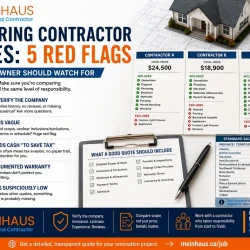
Unusually low quotes with no clear explanation for the gap versus other estimates
Any one of these on its own might be explainable. Multiple appearing together is a reasonable basis to walk away and continue interviewing other contractors.
Frequently Asked Questions
1. How is an online general contractor different from a lead-generation website?
A lead-generation site typically just forwards a homeowner's information to multiple contractors and steps back from the process. An online general contractor like MeinHaus manages the renovation directly, from quoting through project completion, with vetted professionals working under the platform's oversight rather than as independent, unmonitored referrals.
2. What documentation should I ask for before hiring a contractor?
At minimum, proof of licensing for the relevant trade, current insurance coverage including WSIB where applicable, and a written scope of work outlining materials, timeline, and payment schedule. A legitimate contractor should be able to provide all of this without hesitation.
3. How long does it typically take to get a quote for a renovation project?
This depends on project complexity, but including photos, measurements, and material preferences upfront generally speeds up the process, since it gives the estimator a clearer picture without needing a separate in-person visit first for straightforward jobs.
4. What happens if something goes wrong after the project is finished?
With a proper workmanship guarantee in place, issues directly related to the quality of work should be reviewed and corrected against the original approved scope at no additional cost. This is worth confirming explicitly before signing, since not every contractor offers coverage with no expiry date.
5. Is it normal to interview multiple contractors before choosing one?
Yes, interviewing three to five contractors is a reasonable standard for most renovation projects, giving a realistic sense of pricing, communication style, and relevant experience before committing to one.
6. Does hiring locally always mean better service?
Not necessarily. Local proximity helps with things like site visit scheduling and permit familiarity, but licensing, insurance, and relevant project experience matter more for overall project success than distance alone.
Start With a Proper Vetting Process
Hiring a general contractor deserves the same due diligence as any major financial decision, because that's effectively what it is. Checking licensing, insurance, and past project history before signing anything protects both the outcome of the renovation and your financial exposure if something goes wrong. MeinHaus combines that vetting process with an online quoting system and a workmanship guarantee, giving homeowners a single accountable point of contact from quote to completion.
Get in touch:
Mail: info@meinhaus.ca
Call: +1 (844) 777-4287