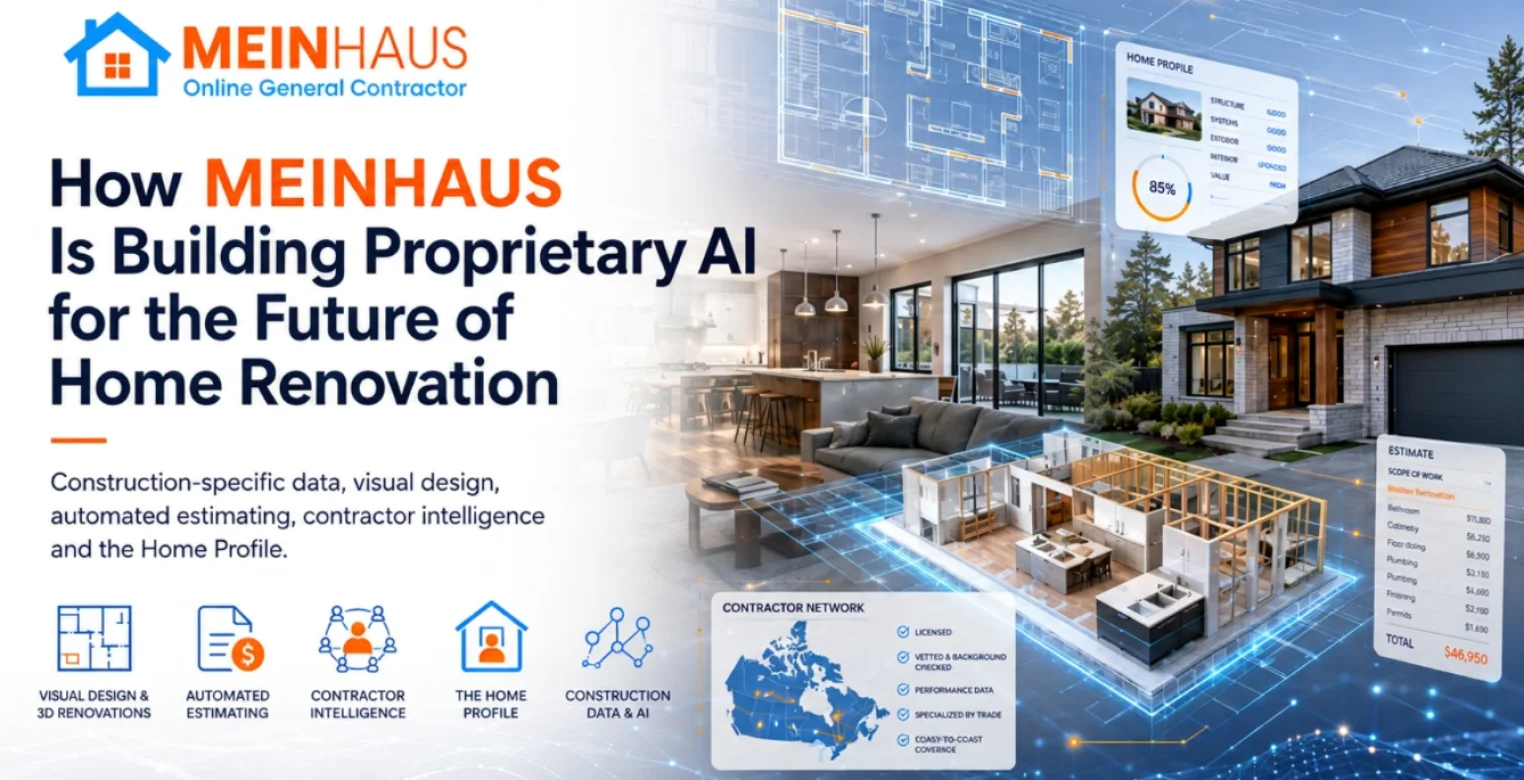
How MEINHAUS Is Building Proprietary AI for the Future of Home Renovation
How construction-specific data, visual design, automated estimating, contractor intelligence and the Home Profile could reshape the way Canadians improve and manage their homes
Artificial intelligence has arrived in construction.
Contractors are using ChatGPT to help prepare estimates and scopes of work. Designers are experimenting with generative rendering. Estimators are using AI to organize information, research products and calculate quantities. Construction software companies are adding automated takeoffs, document analysis and increasingly sophisticated project-management features.
All of this is useful, and almost all of it will eventually become commonplace.
That is precisely why simply using AI is not particularly interesting to us at MEINHAUS.
A contractor who subscribes to ChatGPT, Gemini or Claude can become more productive almost immediately. The technology is remarkable, but the same technology is available to thousands of other contractors. Access to a general-purpose AI model is therefore unlikely to become a lasting competitive advantage.
The much more interesting opportunity is to build intelligence those general-purpose systems do not possess.
MEINHAUS is developing proprietary AI systems and machine-learning processes specifically around residential construction. The objective is not to create another chatbot with our logo attached to it. We are building structured datasets around homes, homeowners, subcontractors, materials, pricing, geography, project duration and actual construction outcomes, then developing systems that can use those datasets to make increasingly informed decisions.
That distinction is central to where we believe home renovation is going.
Public AI models provide extraordinary computing, reasoning and visual capabilities. What they do not inherently possess is MEINHAUS's accumulated understanding of the projects we sell, the homes we work on, the professionals who perform the work, the customers who purchase it and the economics required to make a project worthwhile for everyone involved.
The model is only part of the equation. The information surrounding it may prove to be considerably more valuable.
Construction Has Been Slow to Turn Experience Into Intelligence
The construction industry has an enormous amount of expertise but has historically been poor at capturing it.
A seasoned estimator may have an excellent instinct for what a bathroom should cost. A roofer may recognize a problematic roof configuration immediately. A project manager may know from experience that a certain combination of trades is likely to create scheduling problems.
That knowledge is real. The weakness is that it often belongs to the individual rather than the company.
As construction businesses grow, this becomes increasingly difficult. No estimator can accurately remember every labour price, material selection, project duration, hidden condition, scheduling problem and completed outcome from thousands of projects across different cities and trades.
At a certain point, experience needs to become data.
This is particularly significant in an industry that has struggled to achieve the productivity improvements seen elsewhere in the economy. McKinsey reported in 2026 that global construction output was about $15 trillion in 2025, while construction productivity increased only around 10% between 2000 and 2022. Manufacturing productivity increased approximately 90% over the same period.
McKinsey's argument is not simply that construction companies need better software. Its research increasingly points toward companies redesigning complete workflows around AI and company-owned data.
“Leading companies will use AI to coordinate tasks, institutionalize experience, and convert that experience into pricing power, faster cycle times, and defensible workflow ownership.”
The phrase institutionalize experience is important.
A company should become more knowledgeable because it completed another project. If an estimate was wrong, the company should learn from the difference. If a particular type of scope repeatedly creates change orders, the next scope should change. If certain projects consistently require more labour than anticipated, future labour calculations should reflect what actually happened.
Historically, much of this information ends up scattered throughout invoices, text messages, photographs, spreadsheets and people's memories.
MEINHAUS wants to capture it.
The ultimate objective is not to create an estimator with a slightly better memory. It is to create an organization that remembers.
One of the First Opportunities Was Simply Writing Better Scopes
A surprisingly large part of construction estimating is writing.
A customer may describe a renovation in a few sentences, but the agreement required to actually complete that renovation can involve several pages of information.
The estimator has to translate the customer's idea into construction language. A proper scope may need to establish demolition, preparation, installation procedures, materials, allowances, exclusions, concealed conditions, scheduling expectations, payment terms and warranty requirements.
This administrative process has historically consumed an enormous amount of estimator time.
AI changed that almost immediately for MEINHAUS.
Our estimators can focus on understanding the project and defining the relevant construction details, then use AI systems to transform that information into organized customer-facing and contractor-facing scopes.
In our current workflow, we estimate that this has eliminated approximately 80% of the typing and writing previously required to develop detailed scopes of work.
That is meaningful productivity, but the larger benefit is consistency.
If MEINHAUS determines that certain information should always be addressed when selling a bathroom renovation, the quality of that scope should not depend on whether one particular estimator remembered everything that afternoon.
The company's accumulated knowledge should become part of the process.
Autodesk's 2026 State of Design & Make research shows that this transition is already occurring across architecture, engineering, construction and manufacturing. Among the 2,500 leaders Autodesk surveyed, 98% reported using at least one AI tool, while 84% said AI had increased productivity within their organization.
More interestingly, Autodesk found that the competitive advantage is beginning to move away from simply having access to AI and toward how effectively businesses integrate AI with their data and operating systems.
That second part is where our attention is focused.
Writing an estimate faster is useful. Building a system that becomes better at estimating every time another project passes through it is something different.
Design Is Becoming Part of the Estimate
Another major change is visual.
Home renovation has traditionally required customers to make surprisingly expensive decisions with relatively poor information.
A homeowner may stand inside an existing bathroom while somebody explains that the bathtub will disappear, the shower will move, the vanity will shrink, a partition will be removed and completely different finishes will be installed. Some people can visualize that immediately. Many cannot.
That gap between what the customer sees today and what the contractor intends to build can create indecision, misunderstanding and expensive changes after construction has already begun.
Generative imaging is beginning to close that gap.
MEINHAUS customers already provide photographs and video of existing site conditions. Those files can now be combined with measurements, project descriptions and design direction to create increasingly accurate visual representations of a proposed renovation.
The next stage is considerably more interesting.
We expect this process to develop into a combination of three-dimensional visualization and augmented-reality-style experiences in which homeowners can understand a renovation within the context of their actual property.
Instead of looking at an inspiration photograph of somebody else's bathroom, the customer can see the proposed changes inside their own.
The proportions matter. The position of the window matters. The ceiling height and existing architecture matter. A vanity that looks beautiful in a showroom photograph may be completely wrong for a narrow bathroom.
The visualization therefore becomes useful when it is connected to construction reality.
Our goal is to allow existing-condition data, project scope, material choices and budget to interact. A rendering should not simply produce something beautiful. It should increasingly represent something that can actually be constructed at a realistic price.
This also changes the economics of design iteration.
A customer can experiment with different flooring, tile, cabinetry, paint, siding, landscaping or layouts before physical construction begins. Changing a design while it still exists as pixels is inexpensive. Changing it after demolition is not.
The more precisely we can connect design to scope and scope to price, the more valuable these visual tools become.
Remote Estimating Is About Information Quality, Not Physical Presence
MEINHAUS currently operates remotely.
That surprises some customers, particularly when they receive an estimate that is more detailed than estimates produced after conventional contractor site visits.
There is a tendency to assume that physically attending a property automatically makes an estimate more accurate. Sometimes it does. But not always.
A contractor standing inside a finished room still cannot see through drywall. They cannot automatically know what is below a finished floor or behind a waterproofed shower wall. They are still collecting information, taking superficial measurements and making assumptions about concealed conditions.
The real question is therefore not simply whether an estimator visited the house. It is whether the correct information was collected.
This is where we have invested considerable attention.
A homeowner with a modern smartphone can provide a remarkable amount of useful information when guided properly. Additional photographs, video walkthroughs, measurements and close-ups can frequently answer the questions required to create an accurate preliminary scope.
The conversation with the customer matters just as much.
Two homeowners asking for a “bathroom renovation” may be describing completely different projects. Understanding their expectations, the existing conditions, intended layout and desired level of finish is what allows the project to be properly defined.
Today, human construction expertise remains important in knowing which information needs to be requested.
We do not, however, view every one of those decisions as something that must permanently remain inside a person's head.
Each time an estimator identifies a missing photograph, measurement or condition that materially affects an estimate, another useful variable has been identified.
Over time, the intake itself becomes more intelligent.
A roofing project should require different information from a bathroom renovation. A basement in a 1950s bungalow should trigger different considerations from a basement in a recently built townhouse. Moving a potentially load-bearing wall belongs on an entirely different information path from repainting a bedroom.
The result is not merely remote estimating. It is a structured method of collecting the information necessary to make a construction decision.
When that method is designed properly, we believe it can frequently be more precise than a conventional site visit that depends almost entirely on one person's memory and judgement.
The MEINHAUS Customer App on Google Play already reflects an early version of this model. Customers can digitally provide project information and photographs for our team to develop into estimates and projects.
What happens behind that relatively simple interaction will become considerably more sophisticated.
Pricing Should Be Based on the Market That Actually Exists
One of the more difficult aspects of residential estimating is labour.
Material prices are often relatively visible. Labour is not.
A contractor may know approximately what painters, roofers or flooring installers charge in a particular market, but those numbers can change considerably according to geography, season, project complexity and current availability.
MEINHAUS has a different opportunity because of the professional network we have accumulated.
Our network now includes approximately 10,000 registered subcontractors and trade professionals, concentrated primarily in Canadian metropolitan areas. The useful part of that network is not simply the number of people registered. It is the data that can eventually surround them.
Service categories, operating areas, previous work, availability, project activity, skill sets, pricing behaviour and completed-project performance can all influence how suitable a professional is for a particular project.
Our current pricing systems are already moving in this direction.
When estimating labour, we can increasingly consider the professionals capable of performing the required services within the relevant region, their geographic proximity and ongoing availability rather than relying exclusively on a generalized labour rate.
As this dataset grows, pricing should become increasingly responsive to the market that actually exists.
A flooring project in Edmonton does not necessarily have the same labour economics as an identical project in Toronto. Even different parts of the same metropolitan area can have different contractor supply, travel requirements and scheduling constraints.
The objective is not to identify the lowest price a subcontractor can possibly be persuaded to accept. That would be a poor long-term system.
A project only works when the customer considers the price compelling and the professional considers the compensation worthwhile.
MEINHAUS's opportunity is to identify that economic overlap with increasing precision.
This Is Where Generic AI Ends
It is important to be very specific about this point.
MEINHAUS uses publicly available artificial intelligence systems. We expect to continue using them.
But they are not the product we are attempting to build.
A generic AI model can know a tremendous amount about roofing. It can explain waterproofing systems, describe a bathroom renovation or compare flooring products.
It cannot inherently know which MEINHAUS subcontractors within thirty kilometres of a project have availability next week, which regularly perform that exact service, what similar projects have historically cost through our platform, what products our suppliers make available to us, what was previously installed in that particular home or what design direction the customer consistently prefers.
That intelligence has to be constructed.
MEINHAUS is therefore conducting research and development around purpose-built AI systems, machine-learning processes and construction-specific datasets rather than defining our technology strategy around any one publicly available model.
There is a useful parallel in residential real estate.
Zillow's 2026 AI strategy emphasizes that its advantage comes from combining powerful AI models with Zillow's proprietary knowledge of homes, neighbourhoods, users, markets and transactions.
Its engineers describe the architecture plainly:
“The technology is not defined by any single model.”
Zillow CEO Jeremy Wacksman has described another part of the company's approach just as succinctly:
“We don't just answer questions; we personalize the transaction.”
That is a useful analogy for what we are trying to accomplish in renovation.
Zillow's intelligence comes partly from operating within the real-estate transaction and understanding the information surrounding it.
MEINHAUS intends to build comparable intelligence around the physical improvement and ongoing operation of the home.
That requires a very different dataset.
The Home Profile
A house should not be treated as though MEINHAUS has never encountered it before every time its owner requests a service.
That is the reasoning behind our Home Profile.
The Home Profile is intended to become a structured representation of the physical property and everything MEINHAUS learns about it over time.
The age and type of the house are obvious starting points, but useful property data extends much further. Construction materials, layout, roof system, windows, mechanical components, previous renovations, completed repairs, photographs, warranties and historical scopes can all affect future decisions.
The neighbourhood itself can also be informative.
A neighbourhood filled with similar 1950s bungalows often shares construction characteristics. A townhouse development completed in 2024 belongs to an entirely different property category.
The recommendations made to those homes should reflect that reality.
It would make very little sense for a two-year-old townhouse with its original roof to be repeatedly presented with roof-replacement advertising. An older bungalow with a 25-year-old roofing system belongs in a completely different category.
The same principle extends to renovation design.
Certain wall configurations are common to particular housing types. Some kitchens are more practical to modify than others. Basement conditions, electrical systems, plumbing arrangements and flooring assemblies vary according to building age and construction practice.
As the Home Profile becomes more complete, the system should become better at understanding what is likely to make sense for that property before the owner has to explain everything again.
There are parallels here with the concept of a digital twin, which has become increasingly important in industrial and commercial asset management.
IBM describes a digital twin as a digital representation of a physical object or system that can continue to reflect its real-world counterpart throughout its lifecycle.
A residential Home Profile does not necessarily require a perfect engineering simulation of the house.
Much of the most useful information is considerably simpler.
Knowing that a roof was replaced on a particular date, which shingles were installed, whether decking was replaced, who completed the work and where the completion photographs and warranty documents are stored may become enormously valuable years later.
Today, that information is very easy to lose.
We think it should remain with the home.
The Customer Profile
The physical property represents only half of a renovation decision.
The person living inside it is the other half.
Two homeowners can live in identical houses and make completely different design decisions.
One may value durability above everything else. Another may care deeply about design. One customer may gravitate toward traditional millwork and warm materials while another consistently chooses minimalist finishes and neutral colours.
Budget, family requirements and long-term plans matter as well.
A renovation for somebody intending to sell a house next year should not necessarily be approached in the same way as a renovation for somebody expecting to remain there for thirty years.
The Customer Profile is intended to help MEINHAUS understand those differences.
With appropriate permission, this can eventually extend beyond selections made directly inside our platform. A customer may choose to connect Pinterest boards, social content or other sources of design inspiration.
Even photographs of the customer's existing home contain useful signals about colours, furniture, materials and styles that person has already selected.
The objective is not to produce an enormous gallery and ask the customer to choose from hundreds of designs.
Ideally, the opposite happens.
If the system understands the Home Profile and has also learned something meaningful about the Customer Profile, it should be capable of producing one or two design directions that are unusually appropriate from the beginning.
They should suit the home, suit the customer and, critically, exist within a realistic economic range.
There is, of course, an important privacy responsibility attached to this.
The Office of the Privacy Commissioner of Canada states that organizations using artificial intelligence need an appropriate legal basis for collecting and using personal information, and that inferences made about identifiable people can themselves constitute personal information.
Meaningful consent and transparency therefore need to be part of the Customer Profile from the beginning.
Our view is that personalization should be something a customer deliberately chooses because it makes the experience better.
The customer should understand what the system knows and why that information is useful.
The Professional Profile Is Equally Important
There is another person in almost every renovation transaction: the person who physically has to build it.
Construction technology is often discussed almost entirely from the homeowner's perspective. We think that overlooks a tremendous amount of potential value.
A skilled subcontractor currently spends a significant amount of time doing things that are not the trade they trained to perform.
They answer inquiries, drive to estimates, study photographs, develop prices, prepare proposals, follow up with potential customers and repeatedly explain similar information. Much of this work is never compensated because a professional may quote several projects for every job they eventually receive.
MEINHAUS has an opportunity to remove a large portion of that friction.
A project offered to a professional should increasingly arrive already organized. The location, defined scope, existing-condition photographs, expected duration, material responsibilities, scheduling requirements and compensation should be understandable before the professional decides whether the project makes sense for them.
As our systems improve, the professional should have to perform progressively less unpaid sales and administrative work. They should be able to spend more time performing their trade.
This matters for more than convenience.
Canada needs skilled construction labour.
BuildForce Canada's 2026–2035 national construction outlook estimates that the industry will require approximately 306,200 hires by 2034 when expansion and retirements are considered. Even after expected new entrants, BuildForce projects that construction could still face a shortage of as many as 34,300 workers.
In that environment, wasting skilled tradespeople's time becomes particularly expensive.
Artificial intelligence is not useful simply because it may reduce administrative labour. It can also make the existing skilled workforce substantially more productive by removing work that never required those skills in the first place.
For more about the operating distinction between MEINHAUS and a conventional contractor lead platform, see MEINHAUS Is Not a Contractor Marketplace.
We Do Not Believe Human Intuition Should Automatically Win
There is a familiar way companies talk about artificial intelligence. The technology assists. The human decides.
It is reassuring, and in many circumstances it remains legally and practically necessary.
We do not think it should be treated as an absolute principle.
Human intuition is not inherently more accurate simply because it is human.
An experienced estimator may have personally seen several hundred bathrooms. A mature MEINHAUS system may eventually be able to analyze the structured results of tens of thousands of projects, including the original scope, expected cost, actual labour, material selection, duration, contractor performance, change orders and final outcome.
At that point, the question should not be whether the person or computer deserves authority by default. The question should be which process produces the more reliable decision.
McKinsey's construction research reaches considerably further than the familiar “AI assistant” narrative. Its analysis estimates that AI could potentially automate approximately 39% of nonphysical work in construction and argues that companies can increasingly turn project data into reusable institutional assets.
The feedback loop is what makes this especially valuable.
A price should improve because the system knows whether previous prices were accurate. A project-duration estimate should become more precise because the system knows how long comparable work actually took. Contractor assignment should improve because the system understands which professionals successfully completed similar projects. Scope generation should improve because the system knows where previous scopes created ambiguity.
This does not eliminate engineers, licensed trades, inspectors or experienced construction professionals. There will always be situations involving structural safety, regulation, concealed conditions and unusual circumstances where qualified professional judgement is required.
But there are also enormous numbers of ordinary business decisions that should ultimately be driven by the best information available.
That is what we intend to build.
MEINHAUS Does Not Need One Person Who Knows Everything About Construction
Operating across Canada makes this philosophy particularly important.
MEINHAUS has sold and managed interior and exterior work across an unusually broad range of residential services. Our projects have included bathrooms, painting, flooring, landscaping, roofing, siding, carpentry, windows and doors, concrete, demolition and many other types of residential work.
The geography is equally diverse.
Construction conditions and labour economics in the Greater Toronto Area differ from Calgary, Edmonton or Vancouver. A century home presents completely different questions from a newly constructed subdivision property.
No single person knows every nuance of every one of these environments.
We do not think that person exists.
Our objective is therefore not to hire a mythical estimator who perfectly understands every trade, product, building type and regional price throughout Canada.
The objective is to build a system that accumulates that knowledge.
During 2025, a very small MEINHAUS core team sold and managed approximately 115 projects. During 2026, we have already moved through roughly another 100 projects.
Those numbers matter to us primarily because of the operating leverage behind them.
Technology has allowed a small team to work across services and geography that would traditionally require considerably more administrative infrastructure.
That does not mean technology has removed the complexity of construction. It means we are becoming better at organizing it.
Every completed project can then contribute something to the next one.
Customer Success Is Still the Test
There is an obvious danger for any technology company operating in construction.
It is possible to become so interested in the technology that the actual renovation becomes secondary.
That cannot happen.
The customer ultimately cares about what happened to the house.
MEINHAUS's public customer feedback is therefore a more meaningful test of the model than whether we can produce an impressive AI demonstration.
Independent review aggregation last verified in June 2026 reported MEINHAUS at 4.9 stars across 98 Google reviews. View the independently indexed review summary.
Customers can also learn more through the MEINHAUS website, explore current work through MEINHAUS on Instagram, or find the company through MEINHAUS on Google.
The technology creates value only when it ultimately produces a better experience for the people using it.
AI Could Expand the Renovation Market Rather Than Shrink It
Much of the public discussion about artificial intelligence centres on displacement.
We believe residential renovation may move in a different direction.
There are millions of homeowners living with things they would like to improve. Their bathroom may be outdated. Their basement may never have been properly finished. The backyard may be underused. Storage may be poor. Flooring may be damaged. A kitchen may have an awkward layout that the family has simply learned to tolerate.
Many of those homeowners never become renovation customers.
Cost is obviously one reason. But information is another.
Home renovation remains difficult to understand. A homeowner may know they dislike their bathroom without knowing whether improving it should cost $5,000, $15,000 or $40,000. They may have no idea whether the wall they want to remove can actually move, whether permits are required or which improvement makes the most economic sense to complete first.
The traditional way to obtain that information is often to begin contacting contractors.
That process itself creates friction. Homeowners research companies, arrange appointments, accommodate site visits and then attempt to compare estimates that may describe different versions of the project.
Some potential customers simply never begin.
We see artificial intelligence as a democratization of renovation information.
If a homeowner can easily understand what is possible, see what it could look like, receive a credible preliminary price and understand what is involved, an enormous amount of latent demand can potentially become real construction work.
A family may discover that an improvement they assumed would cost $30,000 can actually be completed for $8,000. Another homeowner may discover that the $10,000 project they imagined requires structural changes and is more realistically a $40,000 undertaking.
Both outcomes are useful. The information allows a decision.
This is one reason we believe the discussion about AI replacing skilled trades misses an important economic possibility.
AI can make renovation easier to discover, design, scope, price and organize. But once the homeowner decides to proceed, somebody still has to build it.
The more people who become confident enough to renovate, the more valuable capable tradespeople become.
Our guide What Can You Renovate for $25,000 in Canada? is an example of the type of information we believe should become substantially easier for homeowners to access and eventually personalize to their own property.
The Home Profile Should Eventually Recommend What Makes Sense
The Home Profile becomes particularly powerful when it stops simply storing information and begins interpreting it.
Today, homeowners generally decide they want something and then begin searching for a provider.
We believe that relationship can eventually work in both directions.
If the system understands the age and characteristics of the property, its previous renovations, the age of major components and the current economics of local construction, it should increasingly be able to identify what deserves attention.
That does not mean constantly trying to sell the homeowner something.
Trust requires the opposite.
Sometimes the correct recommendation should be that nothing needs to be done.
A two-year-old roof should probably be ignored. An aging roof approaching its expected replacement window may deserve periodic assessment. A bathroom renovated recently should not receive the same recommendation as an original bathroom in a forty-year-old home.
The system could eventually identify reasonable improvement windows, expected costs and available options, while the Customer Profile helps determine whether the improvement is actually relevant to the owner.
The relationship with the home then becomes less reactive.
Instead of waiting for something to fail, the homeowner can understand what is likely to require attention and what the economics may look like before an emergency occurs.
Eventually, the Home Profile Becomes a Living Record
Every project produces information.
Photographs are taken. Materials are purchased. Work is completed. Warranties begin. Contractors document conditions that may never be visible again once the walls close.
Most of this information currently has a remarkably short useful life.
The customer loses the invoice. Photographs stay on somebody's phone. A warranty disappears into an email account. The contractor changes businesses. Eventually the property is sold and the next owner begins again.
We believe that information should return to the Home Profile.
A completed project could eventually leave behind a permanent digital record containing its scope, completion date, material information, warranties, photographs and professional documentation.
The next renovation would therefore begin with more knowledge than the last one.
Over time, the Home Profile becomes a living dataset attached to the property.
This concept becomes more valuable as the property ages.
A twenty-year documented renovation and maintenance history can tell a homeowner considerably more than a folder of disconnected receipts.
If the property changes ownership, much of that information remains relevant.
Renovation Is Only the Beginning of the Home's Economic Life
This leads to a broader vision for MEINHAUS.
Renovation and home services are our starting point because that is where we currently operate and where much of our data is being created.
But a home participates in many other transactions.
It is insured. It is financed. It is bought and sold. It may be refinanced. Legal work accompanies transactions. Inspections and appraisals occur. Major improvements affect both value and risk.
These services currently exist in relatively separate environments even though they all revolve around the same physical asset.
We envision a future MEINHAUS application where much more of the economic life of the property can eventually be managed from one place.
The Home Profile provides a logical foundation.
A mortgage provider may care about property value and improvement history. An insurer may care about roofing, electrical, plumbing and previous losses. A future purchaser may care about documented renovations. A real-estate professional may care about improvements completed before a property is listed.
The homeowner should not have to recreate the identity of the property every time they interact with another service.
This does not mean MEINHAUS needs to become an insurance company, mortgage lender, law firm and real-estate brokerage simultaneously.
The larger opportunity is for the platform to become the environment where those services can interact with a much deeper understanding of the property.
A Verified Property History Could Become Valuable in Its Own Right
Our longer-term thinking includes blockchain or another tamper-resistant method of maintaining important portions of the property record.
Blockchain is often discussed in ways that are unnecessarily complicated.
Our interest is relatively straightforward: provenance.
If a roof replacement is added to a Home Profile, it matters who added the information, whether that person was the verified property owner or the verified roofing professional who performed the work, when the record was created and whether photographs or product documentation were attached at completion.
A verified professional completing work through MEINHAUS could eventually append documentation directly to the property record. The homeowner could verify or approve the information.
That record would then remain associated with the home.
Over many years, this could produce a much more trustworthy history than the mixture of paper receipts, old emails and verbal representations that often accompanies a property today.
The underlying technology used to secure that history is secondary to the principle.
The home should be able to accumulate verified knowledge about itself.
Material Intelligence Is Another Part of the System
Residential renovation also involves an enormous product ecosystem.
Paint, shingles, membranes, siding, tile, flooring, cabinetry, insulation, windows, fixtures and thousands of other products all carry their own prices, availability, installation requirements and performance characteristics.
MEINHAUS already works with suppliers and manufacturers across multiple construction categories.
Over time, product and supplier information can become another structured layer of our AI.
A design should eventually understand whether a proposed material is available. An estimate should understand what it costs. A scope should understand the appropriate installation requirements. The system should be capable of identifying when another product provides a better economic or technical alternative.
This creates another connection between the customer's design and the actual execution of the project.
The more those layers are connected, the less frequently a renovation has to be reconstructed manually from disconnected information.
The Professional Should Receive a Project That Is Ready to Build
The ideal end state for contractor procurement is not simply better matching.
It is better preparation.
When a professional receives a MEINHAUS project, we want as much uncertainty as practical to have already been removed.
The professional should understand what they are being asked to accomplish, what the existing conditions look like, where the project is located, when it needs to occur, what materials are involved and what compensation is attached to the work.
As the system matures, historical project information should also improve expected duration and labour requirements.
That creates a different relationship between the general contractor and subcontractor.
MEINHAUS handles more of the sales process, information gathering, project definition and customer communication. The professional spends more time executing the work.
That division of labour creates economic value.
The homeowner does not need to individually locate and negotiate with every trade. The tradesperson does not need to build a complete marketing and sales infrastructure simply to remain busy.
MEINHAUS's role becomes organizing the transaction well enough that both parties encounter less friction.
The Real Intellectual Property Is the Learning Loop
There will eventually be hundreds of excellent AI models.
Some will be open source. Some will come from enormous technology companies. Many will outperform today's systems by orders of magnitude.
We do not believe MEINHAUS needs to create a general-purpose language model that competes with those companies.
That would miss the point.
The intellectual property we care about is the system connecting construction information to actual outcomes.
McKinsey's construction research makes a similar argument: one of the strongest competitive advantages may come from capturing information while work is actually happening, structuring it so it can be reused and retaining the ability to learn from it over time.
A project begins as customer information and gradually becomes a scope, estimate, sale, contractor assignment and physical construction project. Once construction begins, the assumptions made during estimating encounter reality.
Actual labour can be compared with expected labour. Actual duration can be compared with the schedule. Material use can be compared with allowances. Changes can be documented. Customer feedback and professional performance become additional pieces of information.
The completed project therefore contains information that can improve the next one.
That learning cycle is considerably more important to us than which publicly available AI model happened to assist with one stage of the process.
A Small Team Can Operate Across an Extremely Large Problem
This is also why we believe a relatively small organization can eventually operate at a scale that would have been extraordinarily difficult under the traditional general-contractor model.
MEINHAUS does not need hundreds of estimators independently rebuilding the same knowledge.
The system should allow a smaller number of experienced people to supervise an increasingly capable operating environment.
The size of Canada makes this particularly valuable.
Building a conventional construction company capable of estimating multiple trades across Toronto, Cambridge, Ottawa, Calgary, Edmonton and Vancouver becomes administratively intensive very quickly.
Data changes the economics.
A system can understand regional prices independently. It can understand local professional availability. It can recognize different housing types and eventually incorporate local construction practices, supplier information and historical outcomes.
As project volume increases, those datasets become more useful rather than simply creating more paperwork.
That is the kind of operating leverage that allowed a very small MEINHAUS core team to sell and manage approximately 115 projects in 2025 and roughly another 100 projects during 2026 so far.
Our goal is not simply to do more work with fewer people.
It is to make the quality of the organization less dependent on how many people happen to be sitting in the office.
What We Think Happens Next
Artificial intelligence in construction is still early.
Autodesk's 2026 research found that 59% of organizations surveyed either already use or plan to use agentic AI within a year. These systems move beyond simply generating an answer and begin coordinating tasks and participating more actively in workflows.
McKinsey goes further, describing a longer-term construction environment in which AI increasingly connects design, planning, logistics, procurement and site execution into a more automated operating system.
For MEINHAUS, that future begins with something very practical.
The homeowner opens the application and the system already understands the property. The homeowner describes the improvement being considered, while the Customer Profile provides relevant context about preferences and priorities.
The system can begin developing an appropriate visual concept, identifying the likely construction scope, estimating the expected cost and evaluating the supply of qualified professionals capable of completing the work.
If the homeowner proceeds, more of the organization around that project can occur automatically.
The professional receives a project that has been prepared for execution.
After completion, useful information returns to the Home Profile.
The system knows more than it did before. The next interaction begins from a better starting point.
Over time, renovation becomes only one component of a much larger relationship between the homeowner, the property and the services surrounding it.
The Opportunity Is Larger Than Making Construction Faster
Construction will always remain physical.
Homes will continue to contain surprises. Weather will interfere with schedules. Old buildings will reveal strange things when walls are opened. Craftsmanship will remain important. Licensed professionals, engineers and inspectors will continue to play essential roles.
None of this undermines the opportunity for artificial intelligence.
The inefficient part of residential construction is not only what happens on the job site.
A considerable amount of the difficulty exists before work even begins.
Homeowners struggle to understand what is possible, what a project should cost, how it should be executed, who is capable of doing it and whether the idea makes economic sense for their property.
These are fundamentally information problems.
And information problems are exactly where modern computing is becoming extraordinarily capable.
Our belief at MEINHAUS is that solving those problems will not simply make existing renovations more efficient.
It can allow far more homeowners to renovate in the first place.
People who have lived with the same frustrating space for ten years may discover that changing it is more attainable than they assumed. Others may receive enough information to realize that a project is not financially sensible before wasting time and money pursuing it.
Professionals can spend less time trying to sell themselves and more time performing valuable skilled work. Suppliers can become involved in projects where product requirements are understood earlier. Every completed renovation can contribute knowledge that makes the next project easier to understand.
That is considerably larger than using ChatGPT to write an estimate.
It is why MEINHAUS is investing in proprietary artificial intelligence rather than simply consuming the AI tools already available.
The underlying models will change. The technology will become dramatically more powerful.
What we intend to keep building is the intelligence surrounding the home.
If we do that properly, the finished product may not feel like an AI product at all.
It may simply feel like renovating a home has finally become easier to understand.
About MEINHAUS
MEINHAUS is a Canadian Online General Contractor developing technology intended to make residential renovation easier to design, price, organize and execute.
MEINHAUS manages the customer relationship and project scope, establishes project pricing and assigns qualified professionals from its subcontractor network to complete the work.
Homeowners can request a renovation estimate from MEINHAUS, follow current projects and company updates through MEINHAUS on Instagram, view MEINHAUS on Google, or download the MEINHAUS Customer App.
Professionals interested in working on MEINHAUS-managed projects can learn more through the MEINHAUS Professional App.
About the Author
Joshua Noble is a co-founder and senior leader at MEINHAUS working across construction estimating, project planning, contractor procurement, operations and the development of technology used to manage residential renovation projects across Canada.
Connect with Joshua Noble on LinkedIn.
Research and Further Reading
McKinsey — How AI Is Reshaping the Future of the AEC Industry
Autodesk — 2026 State of Design & Make: AI Pulse
Zillow — Building an AI-Native Housing Platform
Zillow — How Zillow's New AI Mode Works Throughout the Real Estate Journey
BuildForce Canada — Construction and Maintenance Looking Forward 2026–2035