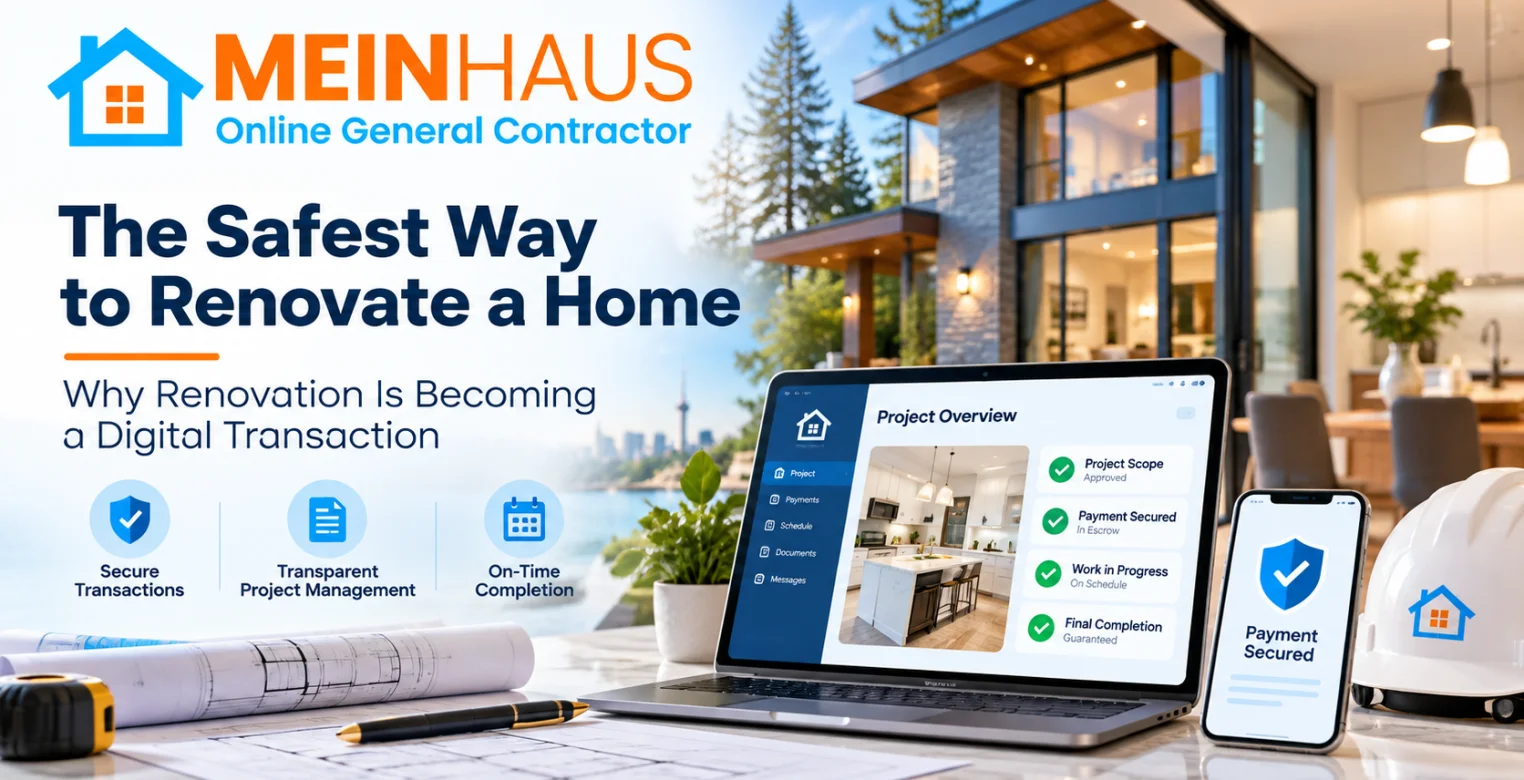
The Safest Way to Renovate a Home? Why Renovation Is Becoming a Digital Transaction
How MEINHAUS is using structured scopes, fixed pricing, online scheduling, documented payments, contractor verification and persistent project records to make home renovation more predictable, accountable and efficient.
Home renovation is one of the largest purchases many people will make after buying the home itself. Yet the transaction is often handled with surprisingly little structure.
A homeowner may receive a quotation by text message. A deposit may be transferred directly to an individual contractor. Important inclusions and exclusions may be discussed verbally. Scheduling can depend on phone calls and personal calendars. Changes can happen on site without being formally documented. Photos may live on several different phones. Receipts, warranties and product information can disappear into email threads. Years later, the homeowner may have little permanent record of what was actually done to the property.
That is an unusual way to manage a transaction worth $20,000, $50,000, $100,000 or more.
It is also one of the fundamental problems MEINHAUS is trying to solve.
MEINHAUS is an online general contractor. The company uses technology to structure the planning, pricing, purchasing, scheduling and management of residential renovation and home-service projects while maintaining the accountability of a general contractor.
The objective is not simply to move contractor discovery onto the internet. Search engines and directories already do that. The more important opportunity is to make the renovation transaction itself more structured.
That means answering some very basic questions before work begins: What exactly is being purchased? How much will it cost? Who is responsible for delivering it? Who will perform the work? How will changes be approved? How will payment be recorded? What happens if a problem occurs? Where will the project record exist afterward?
Government guidance already points homeowners in this direction. Ontario advises homeowners to define exactly what they want done, use written contracts, verify appropriate insurance and trade credentials, and avoid informal arrangements that leave important details undocumented. Read Ontario’s homeowner renovation guidance.
The federal Office of Consumer Affairs similarly recommends renovation contracts that identify the work, project cost, payment schedule, subcontractor responsibilities, materials, permits, warranties, cleanup requirements and other important details before work proceeds. Read the federal home renovation guidance.
That is fundamentally a call for better transaction structure. MEINHAUS is building technology around that same principle.
Renovation Has Historically Been an Informal Transaction
Residential construction is highly skilled work. The way it is purchased, however, has often remained remarkably informal.
A typical homeowner may ask neighbours for recommendations, search Google, contact several contractors, wait for site visits, explain the same project multiple times, receive quotations using completely different formats, try to determine whether they are actually comparing the same scope, independently verify insurance, negotiate scheduling, send a deposit, coordinate materials, manage trades, approve unforeseen work, document completion and pursue warranty concerns later.
The homeowner is effectively being asked to become a temporary project manager.
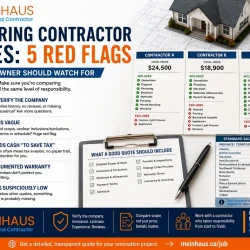
That creates friction before construction even begins. It also creates risk because the customer may be comparing prices without understanding whether the quotations include the same work. A $22,000 bathroom quote and a $31,000 bathroom quote may appear dramatically different until someone discovers that one includes waterproofing, electrical changes, disposal, painting and shower glass while the other does not.
The problem is not merely price. It is a lack of standardized information.
A Better Renovation Transaction Starts With a Defined Scope
The scope of work is one of the most important documents in a renovation. It tells the homeowner what is being purchased and tells the contractor what is expected.
A useful scope should define not only what is included, but also what is not included. Consider something as straightforward as replacing flooring. A weak scope might say:
Supply and install new flooring throughout main floor.
That leaves enormous unanswered questions. Who removes the existing flooring? Who disposes of it? Are baseboards being removed and reinstalled? Is subfloor levelling included? What flooring allowance is included? Are stairs included? What happens if water damage is discovered? Who moves appliances? Are transitions included? Is painting required afterward?
A more structured scope addresses those questions before construction begins. That matters because disputes often emerge in the space between what one person assumed and what another person intended.
MEINHAUS applies the same philosophy digitally. Customers provide information about the project through photographs, video, measurements, conversations and structured project inputs. That information is used to create a more detailed scope before pricing and execution.
For many projects, homeowners can begin entirely online through the MEINHAUS project request system.
The technology does not eliminate construction judgment. It gives that judgment a consistent place to live.
Fixed Pricing Changes the Conversation
One of the greatest sources of renovation anxiety is uncertainty around the final cost. The homeowner is not simply asking, “How much does this renovation cost today?” They are also wondering, “How much will it cost by the time it is finished?”
There will always be legitimate situations where unforeseen conditions require additional work. A wall can conceal water damage. A bathroom floor can reveal deteriorated subflooring. Electrical systems can contain conditions that were not visible before demolition.
The existence of unforeseen work does not mean the original transaction should be vague. The initial project should still have a defined scope, a defined price, documented assumptions, stated exclusions and a process for additional work.
MEINHAUS prices eligible projects around an agreed scope rather than treating the customer transaction as an open-ended labour tab.
Transaction Security Is Bigger Than Cybersecurity
When people hear the phrase secure transaction, they often think only about passwords, encryption or credit-card processing. Those things matter. But in home renovation, transaction security is much broader.
A secure renovation transaction should provide certainty around identity, responsibility, scope, price, payment, scheduling, professional assignment, change authorization, documentation, completion and warranty.
In other words, the customer should be able to understand the chain of accountability.
Why Credit Card and Recorded Electronic Payments Matter
Many homeowners have encountered contractors who prefer cash or direct e-transfer. Neither payment method is inherently improper. The problem arises when payment becomes disconnected from the formal project record.
Ontario specifically advises homeowners to avoid undocumented cash arrangements and to obtain detailed receipts if cash is used. The federal Office of Consumer Affairs similarly emphasizes written documentation and payment records.
MEINHAUS allows customers to purchase eligible projects electronically, including by credit card where available. That creates a recorded transaction connected to the project rather than an isolated payment floating outside the project-management system.
Payment-card security itself is governed by a mature international framework. The PCI Security Standards Council maintains the Payment Card Industry Data Security Standard, or PCI DSS, which establishes technical and operational requirements intended to protect payment-account data across merchants, processors and service providers.
MEINHAUS does not suggest that a credit card alone makes a renovation safe. The point is that formal digital payments create a better transaction record than undocumented informal payments.
Online Scheduling Removes Another Source of Friction
Scheduling is one of the least glamorous parts of construction, but it causes a disproportionate amount of frustration. Traditional scheduling can involve missed calls, several people checking calendars, contractors arriving unexpectedly, trades waiting for previous trades, homeowners repeatedly asking when someone is coming, and material delivery dates that do not align with labour.
A digital project-management model can simplify this considerably. MEINHAUS is building scheduling into the project experience so that customer availability, professional availability and project requirements can be coordinated through one system.
MEINHAUS Is Not a Lead Marketplace
This distinction is central to understanding the security of the model.
MEINHAUS is not designed to collect a homeowner's information, distribute it to several contractors and then disappear from the transaction.
The homeowner purchases the project through MEINHAUS. MEINHAUS develops the scope. MEINHAUS establishes the customer price. MEINHAUS assigns professional execution. MEINHAUS manages the project relationship. MEINHAUS administers the customer transaction. MEINHAUS remains involved in project support.
We explain this distinction in detail in MEINHAUS Is Not a Contractor Marketplace: Why the Online General Contractor Model Changes Your Renovation.
That structure provides something a simple referral platform cannot: institutional continuity.
Contractor Verification Should Be Part of the Infrastructure
A homeowner should not need to become an expert in contractor due diligence every time something in the house needs repair. Yet Canadian consumer guidance repeatedly tells homeowners to investigate insurance, trade certification, worker coverage, references, business identity, contracts and permits.
MEINHAUS is building that diligence into professional onboarding and project assignment. Depending on the work, MEINHAUS may review information such as identity, business information, trade experience, liability insurance, applicable trade licences, applicable worker-coverage documentation, project photographs, geography, service categories, availability, previous MEINHAUS performance, customer feedback, project-management feedback and platform standing.
Not every trade is regulated in the same way. A painter, electrician and roofer do not have identical licensing or regulatory requirements. That is why a responsible verification process should evaluate credentials according to the work being performed, rather than simply displaying a generic “licensed contractor” badge.
Insurance Is Not Administrative Clutter
Insurance is more accurately understood as part of risk management. A contractor working in somebody else's home can accidentally damage property, cause water damage, injure a third party or become involved in a dispute that generates significant legal expense.
Commercial general liability insurance can provide important protection against certain third-party bodily-injury and property-damage claims, depending on the terms of the policy.
MEINHAUS has made insurance status part of its broader professional-evaluation system and has partnered with Zensurance to help Pros review contractor-insurance options.
Read more in Every MEINHAUS Pro Should Carry Commercial Liability Insurance.
Safety and Regulation Still Apply When the Transaction Moves Online
Digitizing construction does not mean bypassing construction regulation. If anything, a well-designed digital system should make compliance easier to organize and document.
Electrical work still needs to follow applicable electrical rules. Building permits still apply when required. Regulated trades still require applicable licences or certification. Worker-safety obligations still exist. Municipal requirements still exist. Manufacturer installation specifications still exist.
Ontario provides detailed guidance for renovation businesses around contracts, certifications, licences, permits, insurance and workplace safety. Read Ontario’s guide for renovation and roofing businesses.
Ontario also publishes homeowner guidance for roofing safety and contractor due diligence. Read Ontario’s roofing guidance.
Technology does not replace those obligations. It gives the general contractor a better way to track them.
National Partnerships Strengthen the Transaction
A general contractor does not operate in isolation. Renovations depend on an ecosystem of product manufacturers, building-material suppliers, insurers, distributors, specialty trades, inspectors, engineers and logistics providers.
MEINHAUS has intentionally developed national and regional industry relationships as part of that system.
Dulux is MEINHAUS’s exclusive paint partner, supporting product selection and procurement across interior and exterior painting projects.
MEINHAUS also works with Zensurance around contractor-insurance access and professional verification within the Pro ecosystem.
Within roofing and exterior construction, MEINHAUS regularly works with established manufacturers and suppliers including IKO, Roofmart and James Hardie as part of its broader material-selection and procurement ecosystem.
The strategic reason for developing these relationships is straightforward. A more organized supply chain creates better information. Better information produces better estimates. Better estimates produce clearer scopes. Clearer scopes reduce disputes.
Reputation Still Matters in a Digital Model
Technology does not remove the need for trust. It makes trust easier to measure.
MEINHAUS maintains a strong public Google profile with a 4.9-star rating across 100+ reviews. Those reviews represent a public record of customer experience across real projects.
They matter because the model can be evaluated through actual outcomes rather than marketing language alone. Customers discuss responsiveness, project coordination, pricing, workmanship, scheduling, communication and post-project follow-up.
A safe system should not only promise accountability. It should accumulate evidence of how that accountability performs over time.
Documentation Should Continue During Construction
The scope and contract should not be the end of the project record. They should be the beginning.
Construction produces valuable information while the project is happening: existing-condition photographs, demolition photographs, exposed framing, plumbing rough-ins, electrical rough-ins, waterproofing, insulation, material labels, installation details, concealed work before drywall, finished surfaces and final completion.
Historically, many of those photographs remain on an individual contractor's phone. That is wasted information.
MEINHAUS increasingly uses milestone documentation as part of project management so that work can be reviewed, progress can be documented and information can become part of the project record.
Change Orders Should Be Data, Not Conversations That Disappear
Some of the most expensive renovation disputes begin with an innocent sentence:
“While you're here, can you just do this too?”
There is nothing wrong with adding work. The problem is failing to document it.
If the scope changes, the transaction should change with it. A proper change-order process should identify what changed, why it changed, the additional work and material required, the price adjustment, the schedule impact and customer approval.
That record protects both sides.
Customer Support Is Part of Transaction Security
One of the biggest weaknesses of informal contracting is that the entire transaction can depend on one person's phone. If that contractor becomes busy, sick, unavailable or simply stops responding, the customer may have no escalation path.
MEINHAUS is intentionally building centralized customer support around the project. Customers can communicate digitally and can also reach real people when they need assistance.
The House Should Remember What Happened to It
This is where the technology becomes much more interesting.
Imagine buying a 25-year-old house. You want to know when the roof was replaced, what shingles were used, who installed them, whether the attic insulation was upgraded, how old the windows are, whether the basement was waterproofed, what electrical work was completed, which bathroom was renovated, what waterproofing system was used, what flooring product is installed, whether the furnace was replaced and whether warranties are still active.
Today, those answers often disappear with the previous homeowner.
The house should remember what happened to it.
MEINHAUS is developing the concept of a Home Profile: a persistent digital record associated with the property.
Each completed project can add information back to that profile. A roof replacement might eventually record completion date, scope, product, colour, manufacturer, warranty, installation photographs, final photographs, contractor information, project price and expected service interval.
A bathroom renovation could record plumbing modifications, waterproofing system, fixture specifications, tile product, electrical additions, photographs before walls were closed, warranties and completion date.
The project is no longer a transaction that disappears when the contractor leaves. It becomes part of the property record.
From Renovation Company to Home Intelligence Platform
This is also where MEINHAUS's work in artificial intelligence becomes relevant.
Read more in MEINHAUS: Proprietary AI for the Future of the Home.
The long-term opportunity is not simply to ask an AI model how much a bathroom should cost. It is to develop intelligence around the actual home.
That can include information about location, age, construction type, roof, windows, mechanical systems, renovations, materials, layouts, previous service history, homeowner preferences, available professionals, labour pricing, material pricing and previous project outcomes.
Once those datasets become connected, the system can begin answering much more useful questions: What is this particular home likely to need over the next five years? Which improvements are urgent? Which are primarily cosmetic? What should those projects reasonably cost? Which projects should be combined? Which material systems make sense for this property? Which qualified professionals are available nearby? What renovation styles does this homeowner prefer?
That moves the technology from a contractor-search tool toward a property intelligence system.
Better Technology Can Make Skilled Trades More Productive
The objective is not to eliminate skilled professionals. It is to reduce the administrative waste surrounding their work.
A highly competent tile installer should not necessarily spend three evenings per week driving to unpaid estimates, writing contracts, responding to marketing leads, chasing deposits, coordinating unrelated trades, explaining payment terms and managing customer acquisition.
A stronger general-contracting system can absorb more of that administrative burden. MEINHAUS can acquire the customer, understand the project, define the scope, price the transaction, coordinate materials, manage scheduling, document requirements, assign the work, support the customer and administer payment.
The skilled professional can spend more time performing skilled work.
That is efficiency.
The Transaction Layer for the Home
Renovation is only the beginning.
A home generates transactions throughout its entire life: roofing, painting, landscaping, snow removal, insurance, mortgage refinancing, maintenance, real-estate transactions, legal services, windows, HVAC, appliances, electrical upgrades, plumbing, energy retrofits and property inspections.
Every one of these currently lives in a different system. The homeowner repeatedly enters the same address, explains the same house, uploads the same photographs, searches for another provider, creates another account and starts another relationship.
That is inefficient.
MEINHAUS is being built toward a different model.
The Home Profile becomes the information layer.
The transaction platform becomes the purchasing layer.
The professional network becomes the fulfillment layer.
Artificial intelligence becomes the interpretation layer.
Together, those components can eventually create something much larger than a renovation marketplace: a transaction layer for the home.
What MEINHAUS Does Today and What Comes Next
What MEINHAUS Does Today
MEINHAUS currently operates as an online general contractor. Customers can use the platform to begin projects remotely, provide photographs and project details, receive detailed scopes and pricing, communicate with the company, purchase eligible work electronically and coordinate project execution.
MEINHAUS manages residential work across many categories, including painting, roofing, flooring, bathrooms, kitchens, basements, windows and doors, concrete, landscaping and other interior and exterior services.
Projects are executed through qualified professionals from the MEINHAUS network under MEINHAUS project management.
What MEINHAUS Is Building Toward
The longer-term system is intended to make the property itself increasingly intelligent through persistent Home Profiles, deeper project records, better property data, automated renovation planning, customer preference profiles, contractor-performance intelligence, material intelligence, predictive maintenance, AI-assisted design, increasingly automated estimating, integrated purchasing and additional home-related financial and professional services.
The destination is not simply a faster way to hire a contractor.
It is a better way to operate a home.
Why We Believe This Model Can Be Safer
There is no renovation system that can eliminate all construction risk. Homes contain hidden conditions. People make mistakes. Materials fail. Weather changes. Projects evolve.
The more credible goal is to systematically reduce avoidable risk.
| Traditional Renovation |
Managed Digital Renovation |
| Verbal scope |
Written structured scope |
| Handwritten quote |
Defined digital estimate |
| Informal payment |
Recorded electronic transaction |
| Customer coordinates trades |
General contractor manages execution |
| Verbal extras |
Documented change orders |
| Photos scattered across phones |
Milestone project documentation |
| Little persistent property history |
Home Profile vision |
| Single contractor relationship |
Central company accountability |
A managed digital renovation model can reduce uncertainty by replacing ambiguity with records.
Instead of “Who said what?” there is a scope. Instead of “What did I pay for?” there is a transaction record. Instead of “Was this extra included?” there is a documented change. Instead of “Which contractor did the work?” there is an assignment record. Instead of “What was behind this wall?” there can be photographs. Instead of “When was this roof installed?” there can eventually be a Home Profile. Instead of “Who do I call now?” there is an accountable general contractor.
That is what we mean when we talk about making renovation safer: not the absence of risk, but the reduction of unnecessary uncertainty.
Frequently Asked Questions
Is MEINHAUS a contractor marketplace?
No. MEINHAUS operates as an online general contractor. Customers purchase MEINHAUS-managed renovation projects rather than simply receiving introductions to contractors. Read MEINHAUS Is Not a Contractor Marketplace.
How can MEINHAUS price a renovation remotely?
Customers can provide photographs, videos, measurements and structured project information. MEINHAUS combines that information with estimating expertise, project data, material information and pricing systems to develop scopes and estimates.
Does MEINHAUS use insured professionals?
Insurance status is part of MEINHAUS's professional verification and assignment process where applicable. MEINHAUS also works with Zensurance to help professionals understand and obtain appropriate contractor coverage.
Can I pay by credit card?
Eligible MEINHAUS projects can be purchased electronically, including by credit card where available. This provides customers with a documented transaction connected to the project.
What is the MEINHAUS Home Profile?
The Home Profile is part of MEINHAUS's longer-term technology strategy. The concept is to create a living digital record of the property containing relevant renovation, maintenance, material and project history.
Does MEINHAUS use artificial intelligence?
Yes. MEINHAUS uses AI and is developing construction-specific data systems around project scoping, estimating, design visualization, property intelligence and professional procurement.
A Renovation Should Be a Transaction You Can Understand
Home renovation will always involve physical work. Someone still has to install the roof. Someone still has to frame the wall. Someone still has to tile the shower.
Technology does not change that.
What technology can change is everything surrounding the work. It can make the project easier to understand before construction begins. It can make the price clearer. It can improve contractor procurement. It can simplify scheduling. It can formalize payments. It can preserve documentation. It can make project history searchable. It can give the homeowner a central point of accountability. And eventually, it can allow the home itself to accumulate intelligence over time.
That is the future MEINHAUS is building toward.
The objective is straightforward: make improving and managing a home safer, easier to understand and dramatically more efficient.
Ready to start a project? Request a MEINHAUS Project.
Learn more at https://www.meinhaus.ca/.
About the Author
Joshua Noble is a Co-Founder and senior leader at MEINHAUS, working across residential estimating, project management, contractor procurement, operations and technology-enabled home services.
His work focuses on using structured construction data, digital project management and artificial intelligence to improve how homeowners plan, purchase and manage residential renovation.
Connect with Joshua Noble on LinkedIn.