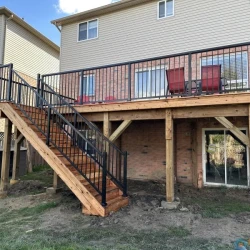
What Can You Actually Renovate for $25,000?
A $25,000 renovation budget in Canada is enough to make one substantial improvement to a typical home. In 2026, realistic possibilities include a premium three-piece bathroom renovation, a whole-home painting and trim transformation, a carefully planned kitchen cabinetry and countertop replacement, approximately 1,600 square feet of new flooring with trim, or a significant deck and landscaping package.
One of the biggest renovation-budget mistakes homeowners make is spreading a good budget across too many unrelated projects.
Twenty-five thousand dollars sounds like a lot of money—and it is—but construction costs can disappear quickly once demolition, labour, materials, disposal, licensed trades, finishing, taxes and unexpected conditions are included.
A homeowner trying to renovate a kitchen, bathroom, flooring, stairs and exterior simultaneously for $25,000 is likely to make a mess everywhere.
A homeowner who directs that same $25,000 toward one clearly defined objective can accomplish something very different.
You can build a genuinely beautiful bathroom.
You can transform the appearance of most of a 1,500- to 2,200-square-foot home.
You can replace a substantial amount of flooring.
You can build an excellent deck and improve the surrounding exterior.
And, with careful product selection, you can make significant improvements to a standard kitchen.
This article breaks down what MEINHAUS considers the most realistic uses of a $25,000 Canadian renovation budget in 2026, based on the types of projects we regularly scope and estimate.
For a broader look at Canadian construction pricing, homeowners can also explore the MEINHAUS renovation article library.
The Five Best Ways to Spend $25,000 on a Renovation
Based on MEINHAUS estimating experience, these are five of the strongest renovation paths at this budget.
| $25,000 renovation option |
What the budget can realistically accomplish |
| Premium bathroom |
Complete three-piece bathroom renovation with premium shower and finishes |
| Whole-home cosmetic transformation |
Extensive painting, wall preparation, baseboards and door casings |
| Kitchen cabinetry and countertops |
Significant 10 × 10 L-shaped kitchen upgrade with careful selections |
| Whole-home flooring |
Approximately 1,600 sq. ft. of quality flooring plus selected trim |
| Deck + exterior improvements |
Deck construction combined with interlock, landscaping or other upgrades |
There are many other ways to spend $25,000.
These five stand out because each can create a noticeable and useful transformation without requiring the homeowner to spread the budget too thinly.
Option 1: A Premium Three-Piece Bathroom Renovation
Is $25,000 Enough for a Really Nice Bathroom Renovation?
Yes. In MEINHAUS's experience, $25,000 is a healthy budget for a high-quality standard three-piece bathroom renovation when there are no extraordinary structural complications. It can allow the bathroom to be demolished to the studs, rebuilt properly and finished with considerably better-than-basic design choices.
At this budget, we are not talking about putting new faucets on an old vanity and painting the walls.
We are talking about a meaningful renovation.
A standard project could include:
- Complete demolition
- Removal of the existing tub, vanity and toilet
- Tile removal
- Drywall removal where necessary
- Disposal of demolition material
- Inspection of wall and floor conditions
- Insulation repairs
- Vapour-barrier repairs
- Minor framing work
- Water-damage remediation allowance
- Plumbing modifications
- New waterproofing
- Tub-to-shower conversion
- Curbless shower design where technically appropriate
- Linear drain
- Premium shower tile
- Built-in shower niche
- LED niche lighting
- Custom glass
- New vanity
- Stone countertop
- Sink and faucet
- New toilet
- Lighting modifications
- New bathroom fan
- Drywall finishing
- Painting
- Trim
- Final plumbing and electrical finishes
That is enough scope to create a bathroom that looks and functions substantially differently from where it started.
For homeowners comparing bathroom options, the existing MEINHAUS bathroom renovation service provides additional information about the types of bathroom work MEINHAUS manages.
Where Does the $25,000 Bathroom Budget Go?
One useful way to understand bathroom pricing is to stop thinking about the room only in terms of tile and fixtures.
A bathroom contains a surprising number of construction systems in a very small area.
Typical MEINHAUS Planning Breakdown
| Bathroom component |
Approximate planning range |
| Demolition and disposal |
$2,000–$2,500 |
| Framing, insulation, preparation and minor rough plumbing |
$3,500–$6,500 |
| Drywall, tile installation and painting |
Approximately $3,500–$6,500 depending on scope |
| Premium vanity package with top, sink, faucet and installation |
$1,500–$2,000 |
| Shower system, glass, electrical, fixtures, waterproofing and contingency |
Balance of budget |
| Target total |
Up to approximately $25,000 |
These are MEINHAUS planning figures, not fixed national rates. Every home is different.
The important lesson is where the money actually goes.
A bathroom renovation is not expensive simply because somebody chose nice tile.
Much of the cost occurs before the finished tile ever goes on the wall.
Demolishing the Bathroom Properly
For a typical three-piece bathroom, MEINHAUS often expects demolition and disposal to fall around $2,000 to $2,500.
That can include removing:
- Tub
- Toilet
- Vanity
- Tile walls
- Tile flooring
- Drywall or backing
- Old trim
- Shower doors
- Accessories
- Construction debris
Older bathrooms can cost more.
There may be:
- Multiple layers of flooring
- Cement or mortar beds
- Steel mesh
- Plaster
- Heavy tile backing
- Unexpected bulkheads
- Water-damaged material
- Older plumbing
- Difficult access
This is one reason a homeowner should not spend the entire $25,000 on visible fixtures before demolition begins.
The Contingency Is Part of the Renovation
For a bathroom at this budget, MEINHAUS would normally recommend keeping a few thousand dollars of breathing room for conditions that may become visible once the room is opened.
That can include:
- Damaged insulation
- Missing vapour barrier
- Rotten framing
- Damaged subfloor
- Minor joist reinforcement
- Water staining
- Mould remediation
- Plumbing corrections
- Inadequate ventilation
- Framing correction
A contingency should not be treated as wasted money.
If none of these problems appear, that portion of the budget can potentially be redirected toward better finishes.
If they do appear, the project does not immediately fall apart financially.
What Does a Premium $25,000 Shower Look Like?
This is where the bathroom can become substantially better than an entry-level renovation.
A homeowner may be able to move from a standard builder-grade tub-and-shower combination to something such as:
Curbless Shower
A properly planned curbless shower creates a much cleaner transition between the bathroom floor and shower.
On a second floor, however, this needs to be approached carefully because floor structure, drain position, joist direction and required slope can affect whether the design is practical.
The right solution should be determined before demolition proceeds too far.
Linear Drain
A linear drain can help create a more contemporary shower floor and may simplify certain tile layouts.
It also needs to be integrated properly with the shower's waterproofing and slope.
Built-In Niche
Rather than adding shelves afterward, the shower wall can incorporate a properly waterproofed built-in niche.
Adding low-voltage LED lighting can make it an architectural feature rather than simply storage.
Premium Glass
Frameless or minimally framed glass can have a major impact on the final appearance of a relatively small bathroom.
Better Tile
A $25,000 budget allows the homeowner to think beyond the absolute lowest-cost tile selection.
That does not mean buying the most expensive stone in the showroom.
It means having enough room to choose a tile that suits the design without destroying the rest of the construction budget.
A Better Vanity Makes a Difference
MEINHAUS currently sees good-quality vanity packages for a standard bathroom around $1,500 to $2,000 when combining the vanity, stone countertop, sink, faucet and installation.
The range can include products with features such as:
- Stone countertops
- Soft-close drawers
- Dovetail drawer construction
- Better hardware
- Integrated sink
- Quality faucet
- Improved storage
At this project level, we generally believe homeowners should spend enough to get a vanity they actually like.
Bathrooms are used every day.
Saving $400 on the vanity while spending thousands on tile may not be the best allocation of the budget.
What $25,000 Usually Does Not Mean in a Bathroom
Even at $25,000, there are limits.
A budget can become strained when the project adds:
- Major plumbing relocation
- Moving the toilet substantially
- Extensive structural modifications
- Large-format specialty stone
- Steam shower systems
- Multiple shower valves and body sprays
- Fully custom cabinetry
- Heated floors throughout
- Major window changes
- Significant electrical service upgrades
- High-end smart toilets
- Extensive millwork
This is why the phrase “$25,000 bathroom” still requires a scope.
A well-designed $25,000 bathroom can feel premium.
An uncontrolled $25,000 bathroom can run out of money very quickly.
Option 2: Transform the Interior With Painting and New Trim
If the bathroom is the strongest single-room option, painting and finish carpentry may be the strongest whole-home visual transformation.
Assume a typical Canadian home contains approximately 1,500 to 2,200 square feet of interior living space.
A $25,000 budget can make that entire property feel substantially newer without removing a kitchen or bathroom.
The transformation could include:
- New baseboards
- New door casings
- Selected new trim
- Caulking
- Filling
- Pole sanding
- Wall preparation
- Skim coating where necessary
- Stain blocking
- Ceiling preparation
- Wall painting
- Ceiling painting
- Trim painting
- Door and casing finishing
- Surface corrections
MEINHAUS painting services include wall and ceiling painting, trim and door finishing, drywall repair, preparation, caulking, priming and stain blocking—exactly the type of work that becomes important when the goal is a whole-home reset rather than merely changing wall colour.
How Much Does Whole-Home Trim Replacement Cost?
For a typical 1,500- to 2,200-square-foot home, MEINHAUS would often plan approximately:
$5,000–$10,000 labour and materials
for substantial baseboard and door-casing work.
The range changes depending on:
- Number of doors
- Existing trim removal
- Baseboard profile
- Casing profile
- MDF versus wood
- Wall condition
- Number of corners
- Height of baseboard
- Caulking requirements
- Filling requirements
- Painting
- Damaged jambs
- Flooring transitions
A simple three-inch baseboard is very different from a larger contemporary trim package with upgraded door casings.
Painting Is One of the Most Underrated Renovations
Homeowners frequently spend heavily on kitchens, bathrooms and flooring while treating painting as something that can always be done later.
That underestimates how much of the home is actually made up of painted surfaces.
Every room has walls.
Most rooms have ceilings.
Every doorway creates casing.
Most floors create baseboard.
Hallways, stairwells, closets and open-concept areas connect all of them.
When walls are dirty, patched poorly, heavily textured or painted in dated colours, the entire home feels older.
When the surfaces are repaired properly and painted consistently, almost everything else in the home looks better.
For substantial whole-home preparation and painting, MEINHAUS would commonly consider a budget around $10,000 labour and materials, depending on the exact amount of preparation and surfaces being painted.
Surface Preparation Is Where the Quality Comes From
A professional repaint is not:
Open paint can. Roll wall. Leave.
The preparation can include:
Pole Sanding
Light sanding helps remove imperfections and improves the consistency of the finished surface.
Skim Coating
Walls with extensive damage, poor previous repairs or uneven texture may require skim coating.
Stain Blocking
Water marks, smoke, tannins and other stains sometimes require specialized primers so they do not bleed through the new finish.
Drywall Repairs
Old television mounts, shelving, artwork, settlement cracks and previous electrical work can leave holes and patches throughout a home.
Caulking
Small gaps where trim meets walls can make new finish carpentry look unfinished.
Ceiling Corrections
Ceilings often show defects more readily because natural and artificial light travels across them.
Preparation is therefore not an optional extra if the homeowner expects a genuinely premium result.
A $25,000 Whole-Home Cosmetic Budget Might Look Like This
| Interior improvement |
Approximate budget |
| Baseboards and door casings |
$5,000–$10,000 |
| Wall and ceiling preparation + painting |
Around $10,000 |
| Additional door/trim corrections, hardware or contingency |
Remaining budget |
| Target project budget |
Up to $25,000 |
The result is not a new floor plan.
But visually, the difference can be enormous.
For homeowners who just bought a property with dated colours, worn walls and old trim, this can be one of the most efficient uses of $25,000.
Option 3: Can You Renovate a Kitchen for $25,000?
Yes—but This Is the Option Where Expectations Matter Most
A $25,000 kitchen renovation is possible.
It is also the renovation category where we would tell homeowners to proceed with the most caution.
For a standard approximately 10 × 10 L-shaped kitchen, $25,000 can potentially provide a meaningful replacement of:
- Cabinetry
- Countertops
- Hardware
- Sink
- Faucet
- Selected backsplash
- Minor finishing
- Selected lighting or electrical changes
But kitchens are highly customizable.
The same number of cabinet boxes can vary enormously in price.
Cabinet Construction Matters
When homeowners say they want “new cabinets,” that can describe many completely different products.
Cabinet components can use materials such as:
- Particleboard or pressboard
- MDF
- Plywood
- Solid wood
- Veneered materials
- Thermofoil
- Painted MDF
- Stained wood
And the cabinet box is only part of the price.
Hardware and internal mechanisms can include:
- Standard hinges
- Soft-close hinges
- Standard drawers
- Soft-close drawers
- Dovetail drawers
- Pull-out garbage systems
- Pantry mechanisms
- Corner systems
- Lazy Susans
- Drawer organizers
- Spice racks
- Appliance panels
- Integrated lighting
Two kitchens that look similar in a photograph can have very different construction costs.
$25,000 Should Not Start With Luxury-Kitchen Expectations
We would be cautious about telling a homeowner:
“You have $25,000, so let's build your dream kitchen.”
For many homeowners, a $50,000 budget is a more realistic starting point for a substantial full kitchen renovation, particularly when appliances, plumbing, electrical, flooring, wall changes and premium cabinetry enter the discussion.
That does not mean $25,000 is useless.
Quite the opposite.
A prudent homeowner who keeps the layout relatively stable and focuses the budget on the most important components can make an impressive improvement.
The critical requirement is setting expectations before demolition.
Where a $25,000 Kitchen Works Best
The budget is strongest when:
- The existing layout remains
- Plumbing stays reasonably close to its current location
- Major structural walls remain untouched
- Appliances are retained or budgeted separately
- Cabinet dimensions remain relatively standard
- Countertop area is moderate
- The homeowner chooses materials strategically
- Electrical changes are limited
- Flooring does not require major replacement
- The project does not become a complete main-floor renovation
For a project like this, the focus should be:
Make the existing kitchen dramatically better—not dramatically larger.
Homeowners considering a kitchen in this budget range should have MEINHAUS scope the actual space before assuming an online cabinet price represents the complete renovation.
Option 4: Replace the Flooring Throughout Most of a Home
Flooring is another very strong use of a $25,000 budget because the improvement is visible across a large portion of the property.
Consider a 1,600-square-foot home or unit where most of the flooring needs replacement.
Based on MEINHAUS planning experience, a useful working figure for:
- Existing flooring demolition
- Disposal
- New flooring material
- Delivery
- Basic preparation
- Installation
is approximately:
$10 per square foot
depending on the flooring selected and existing conditions.
That means:
1,600 sq. ft. × $10 = approximately $16,000
before applicable tax.
A prudent homeowner might therefore reserve slightly under $20,000 for the flooring portion.
That leaves some room inside a $25,000 overall budget for new baseboards or related finishing.
MEINHAUS has a separate flooring and tile guide for homeowners who want to understand preparation and flooring choices in more detail.
What Types of Flooring Could Fit?
Around this overall project level, options may include:
Premium Luxury Vinyl
Quality luxury vinyl can provide durability, water resistance and a consistent appearance across large areas.
Engineered Hardwood
Engineered hardwood provides a genuine wood wear layer while offering dimensional stability suitable for many Canadian homes.
Entry-Level Genuine Hardwood
Depending on species, grade and installation requirements, genuine hardwood may remain feasible at this budget.
The right choice depends on:
- Existing subfloor
- Moisture
- Basement versus above-grade location
- Pets
- Children
- Existing stairs
- Desired appearance
- Maintenance expectations
- Installation method
Flooring Is About More Than the Floor
One reason flooring renovations expand is that new flooring affects everything touching it.
Homeowners may discover that they now want:
- New baseboards
- New shoe moulding
- Door casing repairs
- Transition strips
- Stair nosing
- Stair caps
- Railings
- Newel posts
- Floor vents
- Closet flooring
- Door adjustments
The floor itself can remain within budget while the surrounding finish carpentry expands the project.
Stairs Can Push the $25,000 Flooring Budget to the Limit
This deserves specific attention.
When homeowners replace flooring throughout a two-storey home, they frequently look at the staircase and realize the old finish no longer matches.
Then the conversation changes from:
“Replace our floors.”
to:
“Replace our floors, cap the stairs and replace the railing.”
Stair work can be labour-intensive.
Capping treads and risers, modifying nosings, staining or painting components, replacing railings and updating newel posts can consume several thousand dollars surprisingly quickly.
So a practical $25,000 flooring plan may look like:
| Flooring component |
Planning amount |
| 1,600 sq. ft. demolition + material + installation |
~$16,000 |
| Tax / project contingency |
Brings flooring allowance toward ~$20,000 |
| Baseboard improvements |
Remaining budget |
| Full stair/railing package |
May push project to or beyond $25,000 |
If stairs are important, they should be priced before the flooring is purchased.
Option 5: Build a Deck and Transform the Exterior
The exterior is where $25,000 can create a completely different type of improvement.
Rather than renovating an interior room, homeowners can use the budget to create usable outdoor space and improve curb appeal.
One of the strongest candidates is:
A permitted deck combined with selected hardscaping and landscaping.
How Much Does a Deck Cost in 2026?
Based on MEINHAUS project planning, standard elevated pressure-treated deck construction with stairs often falls around:
$40–$60 per square foot
depending on:
- Height
- Foundation
- Footings
- Framing
- Stairs
- Railings
- Access
- Deck shape
- Site conditions
- Material
- Permit requirements
MEINHAUS deck work is structured around proper footings, framing, weather-resistant materials and railing requirements.
What Would a 400-Square-Foot Deck Cost?
At the lower end:
400 sq. ft. × $40 = $16,000
At the upper end:
400 sq. ft. × $60 = $24,000
That means a 400-square-foot elevated deck can consume nearly the entire $25,000 budget before significant premium upgrades are introduced.
And 400 square feet is a large residential deck.
That is why the budget can change quickly once the homeowner adds:
- Composite boards
- Aluminum railings
- Glass railings
- Privacy walls
- Lighting
- Built-in seating
- Multiple staircases
- Skirting
- Pergola components
Composite Decking Changes the Equation
Composite decking can increase the material budget substantially compared with basic pressure-treated lumber.
On a smaller deck, it can be an excellent upgrade.
On a large 400-square-foot deck, premium boards and railing systems can push the project above $25,000 fairly easily.
The homeowner therefore needs to decide:
Do I want more deck?
or:
Do I want a smaller deck with more premium finishes?
Both can be good decisions.
They are different budgets.
Most Decks Don't Need to Be 400 Square Feet
In MEINHAUS experience, many newly constructed decks are closer to 150 square feet or less.
Another common project is extending the small builder-grade deck included with a newer home.
These more moderate deck projects can often land around:
$10,000 or slightly less before tax
with the completed cost sometimes approaching roughly $12,000 after applicable taxes and project specifics.
That leaves a substantial portion of the $25,000 budget available for the rest of the property.
This is where the exterior option becomes particularly interesting.
Combine the Deck With an Interlock Entrance
For newer suburban properties, we often see a house with:
- Small rear builder deck
- Basic front concrete step
- Asphalt driveway
- Minimal landscaping
- Narrow side yards
A relatively modest amount of construction can make these properties feel much more established.
For example:
Rear Yard
Expand or rebuild the deck.
Front Yard
Install an interlocking-stone walkway from the front porch alongside the driveway and toward the front steps.
MEINHAUS commonly sees these front-entry hardscape projects fall in approximately the:
$6,000–$9,000 range
depending on:
- Square footage
- Excavation
- Base preparation
- Stone choice
- Pattern
- Borders
- Steps
- Drainage
- Access
A $25,000 Exterior Package Could Look Like This
| Exterior improvement |
Approximate planning range |
| Moderate deck / builder-deck expansion |
~$10,000 |
| Allowance after tax / project specifics |
~$12,000 |
| Front interlock walkway / entrance |
$6,000–$9,000 |
| Remaining budget |
Landscaping, lighting, fencing, driveway or lawn improvements |
This gives the homeowner a project total in the general neighbourhood of $18,000–$25,000, depending on selections and taxes.
The remaining amount could potentially go toward:
- Exterior lighting
- Small fence section
- Gate
- Garden bed
- New sod
- Tree or shrub planting
- Driveway sealing
- Premium deck finishes
- Privacy screen
- Seasonal lawn-care program
For a newer property, that can be a very sharp transformation.
Do I Need a Building Permit for a Deck?
Depending on the municipality, deck height, size, attachment to the building and local requirements, a permit may be required.
Homeowners should confirm requirements before construction begins.
For example, Ontario directs homeowners to their local municipality for permit and inspection requirements, and provincial guidance notes that permits are used to ensure construction and renovations comply with applicable building requirements.
Canada's provinces and territories adopt or adapt national model building codes into their own regulatory systems, so requirements should always be checked where the property is located rather than assuming one national rule applies everywhere.
MEINHAUS also maintains a separate guide on when a building permit may be required.
Permit costs and drawings need to be included when they apply.
Which $25,000 Renovation Has the Biggest Impact?
There is no universal answer.
The best project depends on what is currently wrong with the house.
If Your Bathroom Is Dated
Choose the bathroom.
A premium three-piece bathroom provides a concentrated transformation and solves functional as well as aesthetic issues.
If the Whole House Looks Tired
Choose trim and painting.
Fresh walls, ceilings and finish carpentry can affect almost every room.
If Your Kitchen Is Functional but Ugly
Consider cabinetry and countertops—but manage expectations carefully.
Keeping the layout can make $25,000 considerably more effective.
If the Floors Are Worn Throughout
Choose flooring.
A continuous floor can unify the entire house.
If You Bought a Newer Home With a Bare Yard
Consider the deck and hardscape package.
It adds living space outdoors while also improving the entrance and overall curb appeal.
What Should I Renovate First After Buying a House?
This is one of the questions first-time and recent homeowners should ask before deciding where to spend $25,000.
A beautiful bathroom is not the priority if the roof is actively leaking.
New hardwood is not the priority if there is ongoing basement water intrusion.
Kitchen cabinets should not take precedence over unsafe electrical conditions.
A reasonable order is:
First: Protect the House
Address active:
- Water intrusion
- Roofing problems
- Foundation problems
- Structural concerns
- Electrical hazards
- Plumbing leaks
- Safety issues
Second: Correct Functional Deficiencies
Examples:
- Poor ventilation
- Broken fixtures
- Failed flooring
- Insufficient storage
- Unsafe stairs
- Damaged bathrooms
Third: Make the House Yours
Then consider:
- Bathroom renovation
- New floors
- Painting
- Trim
- Kitchen improvements
- Exterior living space
The purpose of a renovation budget is not just to spend it.
It is to improve the property intelligently.
Should I Spend $25,000 on One Renovation or Several Smaller Projects?
For most homeowners, we favour one clearly defined objective.
There are exceptions.
The deck-and-interlock combination works because the two improvements naturally complement one another.
Painting and trim work together for the same reason.
But combining unrelated work can dilute the result.
For example:
- $5,000 bathroom
- $5,000 kitchen
- $5,000 flooring
- $5,000 deck
- $5,000 painting
sounds diversified.
In practice, it can create five unfinished or compromised projects.
Construction usually rewards concentration.
What $25,000 Probably Won't Do
Setting honest expectations is as important as showing what's possible.
In 2026, we would generally not recommend assuming $25,000 will comfortably provide:
A Luxury Full Kitchen
Cabinets, stone, appliances, electrical, plumbing, flooring, backsplash and structural changes can easily move beyond this budget.
Multiple Full Bathrooms
One excellent bathroom is generally preferable to trying to fully gut and rebuild several.
Complete Main-Floor Renovation
Removing walls, changing kitchens, replacing floors, painting, electrical and structural work can quickly reach $50,000–$100,000+.
Premium Flooring Plus Full Staircase and Railing Renovation
It may be possible in certain homes, but the budget becomes tight.
Large Premium Composite Deck With Glass Railings
A substantial elevated deck can use the full budget on its own.
Being realistic at the start is how a homeowner avoids disappointing compromises halfway through construction.
Keep a Renovation Contingency
A $25,000 budget should not automatically mean:
“Design exactly $25,000 worth of visible finishes.”
Especially in older homes.
The more demolition involved, the more useful contingency becomes.
A homeowner might consider holding approximately:
10%–15%
of a renovation budget for:
- Hidden water damage
- Subfloor repairs
- Framing
- Electrical corrections
- Plumbing repairs
- Material changes
- Delivery problems
- Small scope changes
More complicated or older properties may justify more.
The important point is that contingency is not permission to spend more money automatically.
It is a reserve.
If it is not needed, it remains available.
Labour and Materials Need to Be Considered Together
All of the examples in this article are intended as labour-and-material planning budgets.
That distinction matters.
A homeowner might see:
Vanity: $1,200
online and conclude the bathroom is inexpensive.
But the finished renovation may also require:
- Delivery
- Removal of the old vanity
- Plumbing disconnect
- Wall repair
- Flooring repair
- Assembly
- Vanity installation
- Sink
- Faucet
- Drain
- Supply connections
- Mirror
- Caulking
- Painting
The same principle applies to flooring, kitchens and decks.
A renovation budget must account for the finished installed project, not only the materials visible in a shopping cart.
Does $25,000 Include Tax?
The numbers in this guide are planning figures.
Applicable GST, HST, provincial taxes, permit fees and other project-specific charges need to be confirmed in the actual quotation.
Homeowners should always ask whether a price is:
- Before tax
- After tax
- Labour only
- Material only
- Labour and material
- Disposal included
- Permit included
- Engineering included
- Delivery included
Never compare two renovation prices until you know they describe the same thing.
The Written Scope Matters More Than the Headline Price
Ontario's consumer guidance provides a useful example of why detailed renovation contracts matter: for covered home-renovation arrangements, written contracts should clearly describe the work, pricing and other important terms.
Regardless of province, homeowners should insist that a renovation quotation clearly state:
- Areas included
- Areas excluded
- Labour
- Materials
- Product allowances
- Demolition
- Disposal
- Preparation
- Licensed trades
- Permits
- Warranty
- Payment schedule
- Change-order process
- Hidden-condition treatment
- Cleanup
A $25,000 fixed scope is far more useful than a $20,000 vague promise.
MEINHAUS currently positions itself as an Online General Contractor, combining project planning, clear pricing, professional management and qualified professionals rather than simply leaving homeowners to manage the renovation themselves.
Four Common $25,000 Renovation Mistakes
1. Trying to Renovate Too Much
This is the biggest one.
A focused $25,000 renovation can look expensive.
A scattered $25,000 renovation can look cheap.
2. Spending Everything on Finishes
The beautiful tile cannot compensate for improper waterproofing.
Premium flooring cannot compensate for a failed subfloor.
A composite deck board cannot compensate for poor framing.
Construction underneath matters.
3. Forgetting the Final 10%
Projects frequently reach the visual “almost finished” stage and still need:
- Trim
- Paint touchups
- Glass
- Hardware
- Caulking
- Electrical finishing
- Plumbing finishing
- Cleanup
Budget for completion—not simply construction.
4. Making Selections After Construction Begins
Late selections create:
- Delays
- Rush shipping
- Substitutions
- Change orders
- Labour inefficiency
Choose major finishes before demolition whenever reasonably possible.
So, What Is the Best $25,000 Renovation?
If we had to summarize the strongest choices:
Best Single-Room Transformation
Premium three-piece bathroom
Best Whole-Home Visual Transformation
Painting + baseboards + door casings
Best High-Risk / High-Reward Option
Kitchen cabinetry + countertops
Best Whole-Home Functional Upgrade
New flooring + selected trim
Best Exterior Lifestyle Upgrade
Deck + interlock + selected landscaping
The “best” option depends on the house.
But each is large enough to create a meaningful before-and-after result.
$25,000 Renovation Comparison
| Renovation |
Impact |
Budget predictability |
Risk of exceeding $25K |
| Premium bathroom |
Very high |
Good |
Moderate |
| Painting + trim |
Very high throughout home |
Very good |
Low–moderate |
| Kitchen |
Very high |
Moderate |
High |
| Flooring + trim |
High throughout home |
Good |
Moderate if stairs included |
| Deck + landscaping |
High |
Good |
Moderate with premium options |
Frequently Asked Questions
Is $25,000 a good renovation budget?
Yes. $25,000 is enough for one substantial professional renovation in many Canadian homes. The key is selecting a defined project rather than spreading the budget across too many unrelated improvements.
Can I renovate a bathroom for $25,000?
Yes. MEINHAUS considers $25,000 a healthy budget for a premium standard three-piece bathroom renovation when major structural complications are not present.
Can $25,000 include a curbless shower?
Potentially. A curbless shower can be incorporated when the existing floor structure, drainage and waterproofing requirements allow it. Second-floor conditions need to be assessed carefully.
Can I get a linear drain at this budget?
Yes. A linear drain can fit within a premium $25,000 bathroom budget when the overall project is designed around it.
Can I get custom shower glass?
Yes. Custom glass is a reasonable premium bathroom inclusion, assuming other finish selections remain within budget.
How much does bathroom demolition cost?
MEINHAUS often plans approximately $2,000–$2,500 for demolition and disposal of a standard three-piece bathroom, although construction type and access can change the price.
Should I keep money for hidden bathroom damage?
Yes. We recommend contingency for possible water damage, framing, insulation, vapour barrier, subfloor or plumbing conditions discovered during demolition.
Can $25,000 paint my whole house?
For many 1,500- to 2,200-square-foot properties, $25,000 can allow extensive interior preparation and painting together with substantial trim replacement.
How much should whole-home painting cost?
For a substantial 1,500- to 2,200-square-foot interior requiring professional preparation, MEINHAUS often uses approximately $10,000 as a broad labour-and-material planning figure.
How much does replacing baseboard and door casing cost?
MEINHAUS commonly considers approximately $5,000–$10,000 for substantial baseboard and casing replacement in a typical home, depending heavily on profiles and quantities.
Can I renovate my kitchen for $25,000?
Yes, but cautiously. A standard roughly 10 × 10 L-shaped kitchen can potentially receive new cabinetry and countertops within this budget when the layout remains stable and selections are controlled.
Is $50,000 more realistic for a kitchen?
For a complete kitchen renovation involving broader mechanical, appliance and finish changes, MEINHAUS generally considers $50,000 a more comfortable planning level.
How much does 1,600 square feet of flooring cost?
Using a MEINHAUS planning figure of approximately $10 per square foot for demolition, material and installation, 1,600 square feet would be approximately $16,000 before tax and project-specific extras.
Can I include baseboards with the flooring?
Potentially. Reserving slightly under $20,000 for the main flooring work can leave part of a $25,000 budget available for baseboards.
Can I replace my stairs too?
Possibly, but stair capping and new railings can push a whole-home flooring project close to or beyond the $25,000 limit.
How much does a deck cost?
MEINHAUS frequently plans approximately $40–$60 per square foot for standard elevated pressure-treated deck construction with stairs, depending on design and site conditions.
How much would a 400-square-foot deck cost?
At $40–$60 per square foot, approximately $16,000–$24,000 before substantial premium features.
Is 400 square feet a large deck?
Yes. In MEINHAUS experience, many residential deck projects and builder-deck expansions are closer to 150 square feet or less.
Can I build a deck and do landscaping for $25,000?
Yes. A moderate deck or builder-deck expansion combined with interlock, landscaping or exterior upgrades can be an excellent use of a $25,000 budget.
Should I renovate one thing or several things?
Usually one primary objective. Projects such as painting + trim or deck + hardscape work well together because the scopes complement each other.
What should I renovate first after buying a house?
Address water intrusion, structural problems, electrical hazards, plumbing problems and other important building defects first. Cosmetic improvements should generally come afterward.
How much contingency should I keep?
Around 10%–15% is a useful starting point for many renovation projects, with more potentially appropriate for older or higher-risk properties.
Does $25,000 include permits?
Not necessarily. Permit, drawing, engineering and municipal costs should be identified in the project-specific quotation.
Is labour included in these examples?
Yes. This article is intentionally discussing approximate labour-and-material renovation budgets, not material-only pricing.
How do I know which $25,000 project is right for my home?
Start with the current condition of the property, your length of ownership, the problems you need to solve and which improvement would affect your daily use of the home most. A detailed project scope is much more useful than choosing a renovation solely from an online price.
Final Answer: What Can $25,000 Renovate in Canada?
Twenty-five thousand dollars is enough to make a meaningful change to a Canadian home.
It is not an unlimited renovation budget.
And that is exactly why prioritization matters.
At MEINHAUS, we would generally look toward five strong options:
1. Build one genuinely premium three-piece bathroom.
2. Transform the interior of a typical home with new trim, proper wall preparation and professional painting.
3. Carefully replace cabinetry and countertops in a modest kitchen while keeping expectations and layout under control.
4. Replace approximately 1,600 square feet of flooring and improve surrounding trim.
5. Build or expand a deck and combine it with interlock, landscaping and selected exterior improvements.
There are countless variations inside each category.
The most important principle is not trying to squeeze the greatest possible number of renovation items into $25,000.
It is deciding what improvement will create the greatest value for your particular home and then giving that project enough budget to be completed properly.
A beautiful bathroom completed properly is better than three half-finished rooms.
A professionally prepared and repainted home is better than expensive new flooring surrounded by damaged trim and old walls.
A modest kitchen designed intelligently is better than beginning a luxury kitchen you cannot afford to finish.
And a well-built smaller deck with thoughtful landscaping can be better than spending the entire budget simply trying to maximize square footage.
Good renovation budgeting is not about doing the most work. It is about getting the most value from the work you choose to do.
If you're working with approximately $25,000 and want to understand what the budget could accomplish in your specific home, contact MEINHAUS for a project quote. MEINHAUS can develop the scope, establish realistic pricing and manage the renovation as your Online General Contractor.
About the Author
Joshua Noble is a senior leader at MEINHAUS, a Canadian Online General Contractor focused on renovation estimating, project planning, contractor coordination and the use of technology to make residential construction easier to understand and manage.
His renovation-cost articles draw on real MEINHAUS scoping and estimating experience rather than relying solely on generic online cost averages.
Connect with Joshua Noble on LinkedIn or explore more MEINHAUS renovation articles.
Internal Links
External Resources