
Every MEINHAUS Pro Should Carry Commercial Liability Insurance
Why Every MEINHAUS Pro Should Carry Commercial Liability Insurance
Read Article

What to repair immediately, which improvements offer the greatest everyday value, what renovations cost in Canada in 2026, and how to organize your new home without wasting money.
Buying a house is one of the largest financial decisions most Canadians will make. It also marks the beginning of an entirely new relationship with a property they may know surprisingly little about. The home inspection has identified a few concerns, the previous owners' decorating choices aren't quite yours, and the list of things you would like to change is already longer than the amount of money left after closing.
Perhaps the roof is approaching the end of its expected life, the living room is covered in dated paint, the floors have seen better days and the kitchen would benefit from a complete redesign. Meanwhile, the driveway needs attention, the backyard is bare and winter will bring an entirely different set of maintenance responsibilities. It can be difficult to decide whether to spend your first $5,000 on painting, drainage, a bathroom, new windows or simply getting the property ready for the next season.
At MEINHAUS, our work as an online general contractor spans interior renovations, painting, flooring, roofing, windows and doors, concrete, landscaping and other residential services across Canadian markets. That range gives us a useful perspective on what happens when a homeowner tackles projects in the wrong order. A beautifully refinished basement offers little comfort if a drainage problem is still sending water toward the foundation. New flooring becomes considerably less attractive if an upcoming kitchen renovation will require it to be cut apart.
The aim of this guide is to help you think about the entire property, rather than treating every room or repair as a separate transaction. We'll examine what should happen immediately, the improvements worth completing before you move in, realistic Canadian renovation budgets, the importance of painting and proper surface preparation, and how to establish a seasonal maintenance routine that doesn't take over your weekends.
For most new homeowners, the right first renovation is the one that addresses the greatest combination of safety, active damage, property protection and everyday use. Cosmetic improvements are important, but they should not consume the budget required to correct active water infiltration, dangerous electrical conditions, defective stairs or a failing essential system.
Once the house is safe and protected, we usually look at the projects that are easiest to complete while it is empty. Painting, major ceiling preparation and flooring replacement are obvious examples. They affect a remarkable amount of the home's appearance, and completing them before furniture arrives often makes both the work and the move considerably easier.
| Priority | Typical work | When to act |
|---|---|---|
| Safety and active damage | Serious electrical concerns, leaking plumbing, active water entry, unsafe stairs, confirmed structural defects | Immediately; arrange qualified assessment where required |
| Protect the building | Roof and flashing, eavestroughs, grading, drainage, failed exterior seals, essential mechanical repairs | Before damage spreads or the next severe season arrives |
| Disruptive interior improvements | Whole-home painting, ceiling flattening, extensive flooring, major kitchen or bathroom demolition | Ideally before moving in if already planned and funded |
| Function and comfort | Storage, lighting, ventilation, selective window replacement, kitchen and bathroom upgrades | According to actual needs and budget |
| Outdoor and recurring care | Lawn care, seasonal landscaping, paving, concrete, decks, gutter cleaning and snow removal | Plan during the first season; arrange recurring service as appropriate |
This order is a decision-making framework, not a rule that every house needs the same work. A nearly new townhouse with sound exterior systems may be ready for a cosmetic transformation. A 1970s bungalow with a wet basement needs a very different plan.
The home inspection is an excellent starting document, but it is not a complete construction specification. A general inspection is usually visual and non-invasive. It can identify visible defects and areas requiring specialist attention, but it generally cannot confirm the condition of concealed plumbing, roofing components under intact shingles, structural members behind drywall or waterproofing beneath finished tile.
Read the report with three questions in mind: What has actually failed? What may fail within the next few years? What is simply older or cosmetically dated? These are different problems and they belong in different budgets.
Imagine buying a thirty-year-old detached house. The inspection identifies a small active plumbing leak, loose stair railing, an aging but presently functional roof, several drafty windows and original oak kitchen cabinets. The leak and railing are immediate jobs. The roof deserves a proper condition assessment and a realistic replacement allowance. The windows should be evaluated for failed seals, air leakage and general performance before assuming they all require replacement. The cabinetry may be a renovation preference rather than a building defect.
Be particularly careful when an inspection report recommends further evaluation. An observation about possible movement is not a structural engineering conclusion. A question about electrical safety requires a qualified electrical contractor, and the applicable provincial or local approval process still matters. In Ontario, for example, use the Electrical Safety Authority's guidance on hiring licensed electrical contractors when electrical work is needed.
If several findings point toward one underlying issue, investigate the cause before pricing only the visible repairs. Repeated basement dampness, deteriorating lower drywall and exterior grading that slopes toward the foundation may all relate to the same water-management problem. Repainting the drywall three times will not solve it.
Through the MEINHAUS project request system, a homeowner can describe the property, supply photographs and relevant inspection findings, and ask our team to develop a defined repair or renovation scope. Our remote estimating process is based on gathering the information that actually affects the job. Where photographs and customer-guided measurements cannot resolve a critical condition, the scope should identify the need for further investigation or a specialist visit.
The amount a buyer thinks is available for renovations is often quite different from the amount remaining after land transfer tax, legal fees, moving costs, property-tax adjustments, furnishings and the first unexpected repair. Decide what you can actually commit to construction without exhausting the cash you may need for a future emergency.
The following figures are illustrative MEINHAUS planning allowances in Canadian dollars for 2026, not national statistical averages or fixed quotations. Local labour, property age, access, specifications, taxes, permits and concealed conditions can materially change the result.
| Available project budget | What it may realistically accomplish |
|---|---|
| $5,000 | Targeted painting, drywall repairs, hardware and lighting improvements, a small landscaping project or urgent localized repairs |
| $10,000 | A sizeable interior repaint, selected flooring, basic exterior improvements or a controlled repair package |
| $25,000 | One substantial project: a quality three-piece bathroom, whole-home painting and trim, extensive flooring, or a deck and hardscape combination |
| $50,000 | A controlled kitchen renovation, a combination of important interior improvements, or essential exterior work plus a concentrated cosmetic renovation |
| $100,000 | Multiple major projects, potentially including kitchen, bathroom, flooring and painting, or a substantial basement renovation |
| $200,000+ | Larger whole-home modernization, significant structural alterations, premium finishing or an addition, depending on the property |
For a detailed breakdown of what one substantial budget can achieve, read What Can You Renovate for $25,000 in Canada in 2026?. Our complete Canadian home renovation cost guide explores larger projects, regional differences and the effect of scope on price.
An important practical distinction is whether a quote includes labour, materials, disposal, delivery, permits, drawings, applicable taxes and allowances for unknown conditions. Two proposals that display the same number may represent quite different financial commitments. If you're comparing estimates, our guide to five red flags in Canadian contractor quotes explains how to compare the underlying work rather than just the headline price.
For a relatively straightforward cosmetic project, consider retaining around 10% of the planned spend as a contingency. Older buildings or renovations involving demolition and concealed plumbing, framing or electrical work may justify 15–20% or more. This money remains the homeowner's reserve; it is not an automatic fee that a contractor gets to spend.
Consider a hypothetical family buying a detached Canadian home built in the mid-1990s. The roof is aging but dry, the walls are marked and painted in several incompatible colours, the main-floor flooring is scratched, the bathroom is functional but dated, and the backyard has only basic grass and an aging patio. The family has $50,000 available after closing.
There is no sensible way to complete a new roof, full kitchen, bathroom, all flooring, whole-home painting and a large composite deck for that figure without eliminating important parts of several scopes. A coordinated plan might look different:
| Planned work | Illustrative allocation |
|---|---|
| Roof inspection, necessary localized repairs and future replacement planning | $2,000 |
| Substantial painting, preparation and selected trim replacement | $11,000 |
| Main-floor flooring, removal and essential subfloor preparation | $13,000 |
| Focused bathroom renovation or upgrade | $16,000 |
| Seasonal landscape cleanup and simple exterior improvements | $2,000 |
| Reserved contingency | $6,000 |
| Total available budget | $50,000 |
These numbers describe a planning exercise, not a promise that the listed work will fit every house. The roof's assessed condition could change everything: a replacement that cannot wait may take priority over the bathroom. If the bathroom is sound, its allocation might instead fund roofing, drainage or windows. The lesson is to decide at the property level and sequence the work accordingly.

If the building is sound, professional interior painting is one of the first improvements we recommend considering. Few services affect as much of a home's appearance for a comparable investment, and painting is substantially easier when the property is empty.
Walls and ceilings establish the background for every other decision. A home with heavy colours, stained ceilings, badly patched drywall and worn trim can look tired even when the flooring and cabinetry are relatively good. Repairing those surfaces and establishing a coherent colour scheme can transform the appearance of the entire property without changing the floor plan.
Moving in first creates avoidable obstacles. Furniture must be moved and protected, closets become filled, rooms cannot be taken out of service as easily, and painters may need to work around family routines. When you already know the house needs a substantial repaint, scheduling it between possession and moving day can be one of the more sensible decisions in the whole renovation plan.
MEINHAUS is working with Dulux as our exclusive paint partner. This relationship supports our approach to material selection and procurement for projects ranging from individual rooms to extensive interior and exterior refinishing.
We regularly consider the intended use of the space before specifying a coating. An empty guest bedroom, a busy family hallway, kitchen walls and a laundry room do not necessarily require identical products or finishes. Dulux's interior and exterior product catalogue includes Dulux Lifemaster and Dulux Diamond, among other specialized options. Lifemaster is a practical consideration for many interior applications; Diamond offers enhanced stain resistance for more demanding areas. The right product also depends on the substrate, required sheen, primer and application conditions.
Choosing a quality paint is useful, but surface preparation remains decisive. An expensive finish will not conceal a poorly repaired drywall seam or stop an untreated water stain from bleeding through. In older homes, the preparation allowance can make the difference between a fresh colour and a genuinely refurbished interior.
Our MEINHAUS painting service covers interior walls and ceilings, trim and doors, surface preparation, drywall repair, cabinet finishing and exterior coatings. If you're considering a full-home reset after taking possession, request one coordinated quote that clearly distinguishes wall painting from ceiling work, door and trim refinishing, major patching and any plaster or popcorn-ceiling repairs.
A house advertised as 1,800 square feet does not have 1,800 square feet of paintable surface. Walls have height, ceilings add area, and stairwells, doors, baseboards and closets introduce extra preparation and labour. Occupied versus empty conditions matter too.
| Painting scope | Illustrative 2026 budget |
|---|---|
| Small bedroom, walls only | $400–$800 |
| Standard bedroom with walls, ceiling and basic trim | $700–$1,500 |
| Living room and connecting hallway | $1,200–$3,500 |
| Small apartment or condominium repaint | $2,000–$4,500 |
| Typical 1,500–2,000 sq. ft. home, walls with modest preparation | $3,000–$6,000 |
| Extensive walls, ceilings, doors and trim | $7,000–$12,000+ |
| Significant drywall restoration and comprehensive interior refinishing | $10,000–$20,000+ |
These are budget examples from the types of projects we estimate, not guaranteed prices or published national averages. A vacant house with sound walls and a light colour transition is very different from an occupied older home requiring skim coating, stain blocking, high-ceiling access and extensive finish carpentry.
A proper repaint starts with identifying the surfaces that need attention. Old television mounts, shelving, settlement cracks, nail pops, uneven previous patches and gaps at the baseboards are common in recently purchased properties. Ceilings may reveal old water staining, visible repairs or dated texture once new lighting is installed.
There is a substantial difference between a standard repaint and a restoration of the painted surfaces. If you want an exceptionally smooth contemporary finish, that expectation belongs in the scope from the beginning. Professional sanding, selective skim coating and appropriate primers take labour. So does replacing old baseboards and door casings rather than simply coating them again.
For a homeowner who has just bought a 1,500–2,200-square-foot house, an integrated painting and trim project may create a stronger whole-home transformation than spending the same money on decorative work in only one room. The exact result depends on the existing finishes, but it is worth evaluating before committing to a kitchen demolition.
If you intend to replace both flooring and baseboards, avoid arranging separate contractors who never discuss the order of their work. Demolition, substantial drywall repairs and ceiling sanding should ordinarily be completed before the new floor is exposed to construction dust and damage. Flooring and new baseboards can follow, with final caulking, trim finishing and touch-ups sequenced to protect the finished result.
This coordination is one reason to consider a general contractor for several related improvements rather than pricing each one independently. MEINHAUS scopes, prices and manages renovations directly, then assigns qualified subcontractors to execute the required work under one defined customer project.
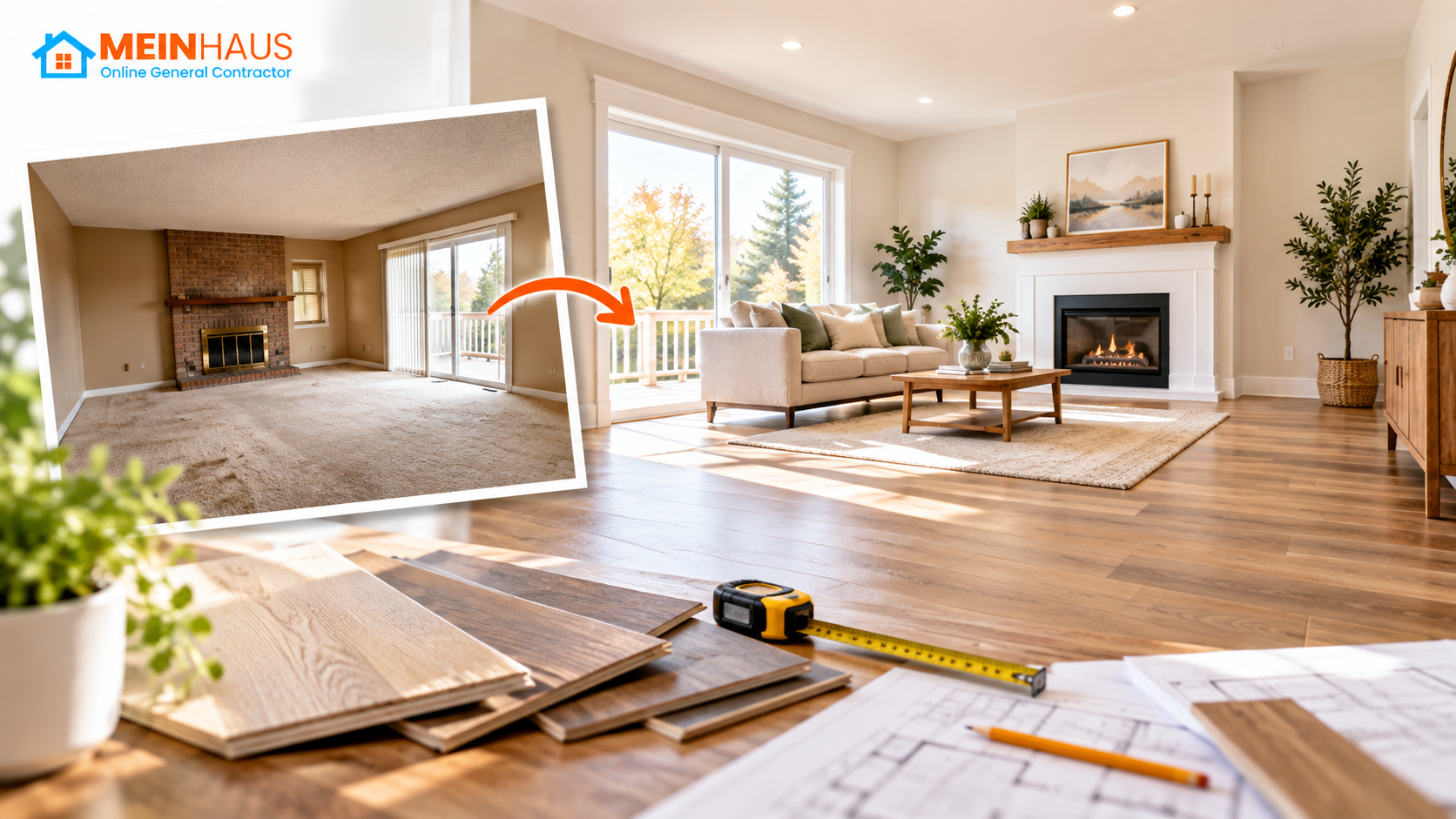
Replacing worn carpet, heavily scratched laminate or mismatched flooring across several rooms can change the feel of a property as dramatically as repainting it. The advantages are especially noticeable when a continuous floor can replace several incompatible materials throughout an open-concept main level.
Flooring is easier to replace before furniture, appliances and personal belongings create access problems. It is also worth planning the project at the level of the whole floor rather than considering every room in isolation. A product selected for the living room may become discontinued before the dining room is addressed the following year, and a patchwork of unnecessary transitions can weaken the finished appearance.
For a typical Canadian home, the main options include luxury vinyl plank, laminate, engineered hardwood, solid hardwood and ceramic or porcelain tile. The right choice depends on the room, moisture conditions, subfloor, budget, expected wear and the family's preference for natural or manufactured finishes.
| Flooring type | Illustrative supply-and-install budget per sq. ft. |
|---|---|
| Entry-level laminate | $5–$9 |
| Mid-range laminate | $7–$11 |
| Luxury vinyl plank | $6–$12 |
| Engineered hardwood | $10–$18 |
| Solid hardwood | $12–$22+ |
| Standard ceramic or porcelain tile | $12–$25+ |
| Premium large-format tile | $20–$35+ |
Subfloor levelling, demolition, disposal, stair work, unusual layouts and trim may be additional. An attractive floor installed over a defective substrate is an expensive mistake; old plywood, uneven concrete and previous moisture damage should be assessed before new material is ordered.
Don't forget the staircase. Homeowners often decide to replace the main-floor flooring and only later realize the old stairs and railing no longer match. Stair capping, nosings, refinishing and railing modifications can consume a meaningful portion of the renovation budget. Include them in the initial design if they matter to you.
MEINHAUS provides flooring and tile services ranging from vinyl and engineered hardwood to subfloor repairs, shower tile and large-format porcelain installation.
Kitchens are emotionally compelling projects. They're also one of the easiest ways to spend considerably more than intended. A kitchen that looks old is not necessarily a kitchen that requires complete demolition. Structurally sound cabinets, a usable layout and serviceable appliances create a different economic starting point from failing cabinetry or a layout that genuinely prevents the room from functioning.
Before approving a complete renovation, decide whether the problem is mainly appearance, storage, circulation or the location of the plumbing and appliances. If the existing layout works, painted or refaced cabinetry, new hardware, better lighting, an updated backsplash and selected countertop replacement may make sense. If you want to remove walls, relocate the sink, increase electrical capacity and commission custom cabinetry, you're describing a very different project.
For initial planning, $15,000–$30,000 may support a carefully limited cabinet-and-countertop replacement, while a standard complete kitchen can move into approximately $30,000–$55,000 and more substantial custom work can cost considerably more. These are not universal rates; appliance selection, cabinet construction, layout changes and finish specifications can make two superficially similar kitchens cost very different amounts.
If you have just moved into the property and the kitchen is functional, it may be worth living with the layout for several months before making a large commitment. You may discover that the pantry location matters more than the cabinet colour, or that the room needs better lighting rather than a wall removed. If you already know the kitchen needs full reconstruction and have the budget, doing it before moving in can avoid weeks of living without an operating kitchen.
Explore the options through MEINHAUS kitchen, bath and renovation services, or submit your kitchen project and photographs for a scope built around your actual space.
Bathrooms deserve particular attention in recently purchased houses because waterproofing, plumbing and ventilation are concealed behind finishes. A dated vanity or unattractive tile is not the same problem as a shower that has been leaking into the framing for years.
A cosmetic bathroom update may involve paint, a new vanity, lighting, hardware and selected fixture replacements. A complete renovation can require demolition to the framing, plumbing alterations, new substrates, a properly designed waterproofing system, tile, ventilation, glass, painting and finish plumbing. Projects with structural changes, custom glass or extensive concealed damage require additional planning.
For many standard Canadian three-piece bathrooms, a broad complete-renovation planning range of $15,000–$35,000 is useful, with premium selections and complicated site conditions moving above that level. MEINHAUS has also discussed how a carefully organized $25,000 bathroom project can provide a substantial transformation, including higher-end finishes, without distributing the budget across several unrelated rooms. Read our detailed $25,000 renovation pathways for an example.
If the inspection identified soft flooring near the toilet, unexplained staining or persistent moisture, investigate before treating the bathroom as merely a design project. A fresh coat of paint is not a substitute for repairing the source of water damage.
A roof does not need replacing merely because a home inspector described it as old. Equally, a roof should not be ignored because the attic happens to be dry on inspection day. Its remaining life depends on the actual shingle or membrane condition, flashing, ventilation, installation quality, storm exposure and local climate.
For recently purchased houses, a professional roofing assessment can help distinguish between a localized repair and a replacement project. Missing shingles, damaged flashing, poorly detailed penetrations or a localized roof-edge problem may sometimes be repairable. Widespread deterioration, multiple recurring leaks and extensive underlying decking problems may justify a different approach.
MEINHAUS provides roof replacement, roof repair, siding, eavestrough, soffit and fascia services. A proper replacement scope should address more than the visible shingles: it should identify tear-off, damaged decking assumptions, ice-and-water protection, underlayment, flashing, ventilation, disposal and applicable warranties.
Drainage is just as important. Blocked eavestroughs, disconnected downspouts, negative grading and water discharged immediately beside the foundation can undermine other renovation spending. Before finishing a basement, verify that the exterior water-management issues identified in the inspection have been addressed. If the house has mature trees, plan appropriate gutter cleaning and maintenance rather than waiting for a heavy rainfall to expose a blockage.
New windows can improve comfort, operation, appearance and energy performance, but replacing every window in a house simply because it is older may not be the most sensible immediate use of your budget. Distinguish failed insulated-glass seals, rotting frames, major air leakage and chronic condensation from issues that could be corrected through adjustment, sealing or maintenance.
In its Canadian ENERGY STAR guidance for windows and doors, Natural Resources Canada notes that windows, doors and skylights can account for substantial energy loss and explains the performance advantages of certified products. When shopping, compare complete unit specifications, installation details, warranties and the products' suitability for your climate—not just a salesperson's promise of energy savings.
As a broad initial allowance, straightforward window replacement may be approximately $900–$2,000 per opening, with large, custom, difficult-access or premium units costing more. Entry doors and patio doors vary even more widely by construction, size, hardware and installation conditions. A useful quote should specify the unit and the work around it, including trim, flashing, exterior sealing and disposal.
You can request a coordinated supply-and-install quotation through MEINHAUS Windows & Doors.
New homeowners often concentrate on the interior and discover the following spring that the yard has its own renovation budget. Drainage, settlement, weed growth, damaged hardscaping and neglected garden beds can require attention before the property becomes enjoyable to use.
Start with grading and water movement. Decorative landscaping is less valuable if the patio drains toward the house or the garden beds trap moisture against the foundation. If the driveway has settled, identify whether the problem is a worn surface, failed base material or a larger drainage issue before choosing asphalt or interlock purely by appearance.
MEINHAUS can scope landscaping and garden improvements, concrete patios and walkways, and paving, interlock or driveway projects through our general project request system. For homeowners interested in a new deck, we can also organize the framing, stair and railing requirements associated with exterior living spaces.
Many new properties benefit from a coordinated but modest package: lawn rehabilitation, topdressing and overseeding, a defined planting plan, corrected garden-bed edges, selective tree or shrub work and cleaning or repairing the entrance walkway. A complete driveway replacement or large raised deck should be treated as its own substantial construction project with appropriately detailed scope and pricing.
An existing deck deserves an assessment of its structure before cosmetic refinishing. Poor footings, decayed posts, defective ledger connections and inadequate guards are not corrected by painting the deck boards. A sound deck may be suitable for repairs, new decking or refinishing; one with substantial structural defects may be better replaced.
Budget carefully for height, stairs, railing type, footings, access and the difference between pressure-treated wood and composite products. A smaller, properly designed deck can be more useful than spending the entire exterior budget on the greatest possible surface area. Permit and guard requirements vary by municipality and by the deck's configuration, so verify the local rules before construction begins.
There is a difference between buying a house and establishing a manageable way to own one. The first year often includes unfamiliar tasks that the previous owner handled without mentioning them: spring cleanup, lawn feeding, pruning, gutter cleaning, leaf removal, winter preparation and snow clearing.
If you're moving from a condominium or rental apartment to a detached home, recurring exterior work can be a larger lifestyle change than the original renovations. It makes sense to organize services at the beginning of each season rather than searching for help when the lawn is already overgrown or a major snowfall has arrived.
MEINHAUS customers can use the customer platform and app to begin their relationship with the property through photographs and descriptions of the work required. Depending on service availability in your area, homeowners can request recurring or seasonal landscaping packages, lawn care and snow removal alongside one-time renovation work. You can also explore our dedicated landscaping and seasonal snow-clearing pages.
For a first-year maintenance plan, think of the calendar as four connected phases rather than four unrelated emergencies. Spring is a useful time for drainage checks, lawn rehabilitation, garden cleanup and evaluating winter damage. Summer suits exterior painting, paving, concrete and deck work when weather conditions are appropriate. Autumn is a natural time for gutter cleaning, roof checks, garden preparation and confirming winter access. Winter requires a realistic snow-removal plan and attention to ice accumulation, heating and indoor moisture.
The specific work depends on your climate. Vancouver's rainfall, Calgary's freeze-thaw cycles, a Toronto winter and a property in Atlantic Canada do not create identical maintenance schedules. The best service arrangement is one built around the property you actually own, not a generic national package.

Most homeowners have historically approached each improvement as a fresh search. They find a painter for one project, a roofer for another, a landscaping company in the spring and a snow-removal provider when winter arrives. Important photographs, contracts and warranty information end up spread across different email threads and invoices.
MEINHAUS is developing a different relationship with the home. Our current digital intake lets customers submit photographs and descriptions for renovation estimates, and our team develops customized scopes and pricing rather than simply selling the homeowner's contact information to unrelated contractors. We remain the general contractor responsible for the MEINHAUS project sold to the customer, with qualified professionals completing the appropriate trade work through our network.
For a new owner, the simplest way to begin is to register and submit your first project through MEINHAUS or explore the MEINHAUS customer app on Google Play. You might begin with full-home painting, then request a flooring project, add a seasonal lawn-care package and later obtain pricing for concrete, paving, windows or roofing. Specific service and package availability depends on your address and the nature of the project.
Our longer-term vision is a Home Profile that retains useful property information over time. The goal is for renovations, repairs, product selections, photos, service dates and warranty records to contribute to a living history of the property, so future decisions can be made with better information. That future capability is a development vision, not a claim that every element is already available inside today's app.
Renovation trades affect one another. A new kitchen may require flooring changes. New windows can disturb interior trim and painted surfaces. Electrical upgrades may require drywall openings. A bathroom renovation may expose subfloor damage. A new driveway should be coordinated with any planned underground service work or drainage changes.
When scheduling several projects, start with investigations, permits and work that opens or alters the building. Follow with plumbing, electrical, framing, roofing or moisture-related work where required, then progress through drywall, preparation, flooring, millwork and final painting as the actual project demands. Protect completed finishes, and do not order materials before dimensions and installation requirements are confirmed.
The exact sequence differs from house to house. The important thing is having one written renovation roadmap and clear scopes for each stage. Ontario's official guidance on home renovations and repairs emphasizes written estimates, detailed contracts, materials, schedules and documented changes. Requirements elsewhere in Canada differ, so homeowners should verify local consumer-protection and permit rules.
This is also where a fixed-price project can be useful. MEINHAUS prices the defined work and identifies exclusions, rather than leaving the homeowner to discover after the fact that demolition, disposal, preparation or finishing were never included. Concealed conditions and customer-requested changes can still require separately approved work. Read our explanation of how MEINHAUS differs from a contractor marketplace for more about that responsibility.
A first year of homeownership can create competing cash demands. Before financing an improvement, distinguish between work that prevents further damage and work that is primarily a preference. An active plumbing leak may be expensive to ignore; a kitchen that is merely unfashionable can often wait while you establish a financial reserve.
Some purchasers investigate purchase-plus-improvements mortgage arrangements before closing. Others consider home-equity borrowing after establishing ownership, subject to lender requirements and available equity. These products have different costs, qualification rules and risks. Compare the total borrowing cost, payment flexibility and what happens if the project exceeds its original budget rather than focusing only on the advertised interest rate.
Energy-efficiency programs are also worth checking, but do not base the renovation budget on a grant or rebate until you have verified that the program is open, your home and planned work are eligible, and any required pre-retrofit steps have been completed. Federal and provincial programs change. Natural Resources Canada maintains updates on Canada's Greener Homes initiatives and other efficiency resources.
A renovation should improve the home without leaving the homeowner unable to manage the expenses of owning it.
Before possession or during the first two weeks, gather the inspection report, warranties, available drawings and information about past repairs. Confirm home insurance, locate the main water shutoff and electrical panel, test smoke and carbon monoxide alarms, and address obvious safety issues or active leaks.
During the first month, create a single list of essential repairs and preferred improvements. Obtain specialist assessments where the inspection calls for them, establish a realistic budget, and decide whether whole-home painting and flooring should happen before furniture arrives. Document existing conditions with photographs before any demolition.
During the first season, evaluate the roof and drainage, establish lawn and garden maintenance, and inspect exterior surfaces for failures that could worsen through another winter. If a deck, concrete walkway, interlock or driveway project is planned, establish the scope early enough to coordinate material availability and appropriate weather.
By the end of the first year, review the work completed, keep the invoices and warranty documentation together, and revisit the longer-term projects that did not make the original budget. A property that is safe, dry and comfortable is a much better starting point for a future luxury kitchen or basement than a property with unfinished essential repairs.
Correct immediate safety hazards and active damage first. Depending on the inspection, that may mean electrical assessment, plumbing-leak repair, roof work, water-management corrections or stabilizing unsafe stairs and railings. Do not assume that the least attractive room is automatically the highest priority.
If the house needs a substantial repaint, yes, it is worth considering. Empty rooms are easier to prepare, protect and paint, and you avoid moving furniture twice. Schedule major ceiling and wall repairs before new flooring, then coordinate final painting and trim work around the remaining renovation sequence.
A relatively straightforward walls-only project may fall in an illustrative $3,000–$6,000 range, while comprehensive walls, ceilings, doors and trim can reach $7,000–$12,000 or more, particularly when significant preparation is needed. The correct price depends on paintable surface area and scope, not floor area alone. Request a MEINHAUS painting estimate for your property.
MEINHAUS works with Dulux as its exclusive paint partner. Product selection is based on the intended surface, preparation requirements and desired finish. Dulux's Canadian product catalogue provides information on Lifemaster, Diamond and other interior and exterior coatings.
If you already intend to replace extensive flooring, completing the work while the home is vacant can reduce disruption. Account for demolition, subfloor preparation, stair finishing, thresholds and baseboards before selecting the flooring product. MEINHAUS flooring and tile services can be scoped separately or as part of a coordinated renovation.
If the kitchen is unsafe, failing or scheduled for complete reconstruction, renovating before moving in may make sense. If it is functional but dated, living with the layout can reveal which changes are genuinely valuable before you commit to new cabinetry, plumbing and electrical work.
A carefully defined standard three-piece bathroom can fit within that budget in many circumstances, potentially including an upgraded shower and quality finishes. Significant structural changes, concealed damage, unusual access and premium material choices may increase the cost. See our $25,000 renovation guide.
Age is only one factor. A roofing assessment should consider the visible condition of the roof covering, flashing, ventilation, previous repairs, recurring leaks and the condition of accessible decking. MEINHAUS roofing services include localized repair as well as full replacement.
Not automatically. Begin with windows showing material deterioration, failed seals, substantial air leakage or operational problems. Compare the installed cost and energy performance of proposed units and prioritize the openings that present the strongest combination of condition and comfort concerns.
Do not assume every crack is a structural emergency, but do not cover up unexplained movement or active water entry. Follow the inspector's recommendation for appropriate investigation, which may involve drainage evaluation, foundation repair expertise or a structural engineer depending on the evidence.
A reserve of approximately 10% is a useful starting point for simple cosmetic work. More invasive or older-home renovations may justify 15–20% or more, depending on the uncertainty. The amount should reflect the real risk rather than being an automatic charge on every project.
It depends on the work and municipality. Structural changes, certain plumbing and electrical projects, additions and many decks commonly require permits or specialized approvals. Painting and straightforward cosmetic updates generally do not. Ask the local building department and confirm the permit responsibility in your contract.
Homeowners can request landscaping and seasonal lawn services and explore seasonal snow clearing. Recurring package availability and terms vary by location and season. You can also submit requests through the MEINHAUS customer platform.
Yes, homeowners can request concrete patio and walkway work, as well as paving, driveway and interlock projects through the MEINHAUS project intake. A detailed scope should address the existing base, drainage, removal, thickness or material specification, access and disposal as applicable.
Yes. MEINHAUS operates as the general contractor, organizing the defined scope, customer price and professional execution. Coordinating related painting, flooring, carpentry, plumbing or exterior projects can reduce duplicated preparation and help keep the work in the right sequence.
No. MEINHAUS sells and manages renovation projects directly, then subcontracts execution to qualified professionals. For an eligible project, the customer purchases the defined work from MEINHAUS rather than purchasing a lead or separately negotiating the project with an introduced contractor. Read how the MEINHAUS model works.
Many MEINHAUS projects can begin remotely using customer-supplied photographs, videos, measurements and guided questions. Some conditions still require field verification, investigation, licensed-trade assessment or engineering before a final scope can responsibly be confirmed. Start your project here.
MEINHAUS offers fixed pricing for the defined scope and stated assumptions of eligible projects. The contract should clearly identify inclusions, exclusions, allowances, taxes, permit responsibility and how customer-requested changes or unexpected concealed conditions are handled. A fixed price does not mean every possible unknown condition is automatically included.
Finance urgent work only after comparing the borrowing cost and your ability to absorb future homeownership expenses. For optional cosmetic work, waiting until the budget is comfortable may be a sensible alternative. Verify the eligibility of any financing or efficiency program before relying on it.
After essential repairs, concentrate the money on one achievable improvement. A focused paint and drywall project, targeted flooring repair, selected fixtures or modest landscaping can make a visible difference. Avoid beginning several demolition projects with no realistic completion budget.
The most expensive renovation mistake a new homeowner can make is treating every visible problem as a separate emergency. Buying a house gives you a long list of possibilities, but it also gives you the opportunity to organize them sensibly. Protect the building first, use the vacant period for disruptive work where practical, choose projects that improve the way you live, and establish recurring maintenance before the next season forces your hand.
Painting is often the first improvement that makes a house feel like home, especially when it is accompanied by the right preparation, fresh trim and a coherent colour scheme. Flooring, kitchens and bathrooms can follow according to condition and budget. Roofing, windows, drainage, concrete, paving and landscaping deserve their own place in the same plan rather than being treated as unrelated purchases.
MEINHAUS is built around that broader relationship with the property. Whether you need a complete repaint with products selected through our exclusive Dulux partnership, a roof assessment, a new bathroom, seasonal landscaping, snow removal or several coordinated renovations, you can begin with the same digital project-intake process.
Start your first MEINHAUS project, browse our Canadian renovation articles, or download the MEINHAUS customer app and begin organizing the improvements that will make your new house work for you.
About the author. Joshua Noble is a co-founder and senior leader at MEINHAUS, working across residential estimating, renovation planning, contractor procurement and technology-enabled project management across Canada.
Free quote in under 24 hours. MEINHAUS-vetted crews. Payment held until the work is done right.
Why Every MEINHAUS Pro Should Carry Commercial Liability Insurance
Read Article
A Practical Guide for MEINHAUS Pros
Read Article
A general overview for meinhaus pros to understand the business cycle.
Read Article
How construction-specific data, visual design, automated estimating, contractor intelligence and the Home Profile could reshape the way Canadians improve and manage their homes
Read Article
Comparing renovation quotes? Learn five contractor red flags Canadian homeowners should watch for, including vague scopes, cash deals, missing insurance, unclear warranties and suspiciously low prices.
Read Article
Most renovation horror stories start the same way: a homeowner hires someone based on a quick quote and a friendly conversation, without asking the questions that actually matter. By the time a problem shows up; a missed deadline, an uninsured worker, a scope that quietly expanded halfway through; it's a lot harder to fix than it would have been to prevent. Hiring a general contractor is one of those decisions where doing the homework upfront saves real money and stress later. This guide covers what to actually verify before signing a contract, how the process of hiring a general contractor typically unfolds, and how a newer model; the online general contractor; changes some of the usual guesswork.
Read Article
What does a $25,000 renovation budget actually buy in Canada in 2026? See realistic options for bathrooms, kitchens, flooring, painting, trim, decks and landscaping based on MEINHAUS project-estimating experience.
Read Article